KP solitons, higher Bruhat and Tamari orders
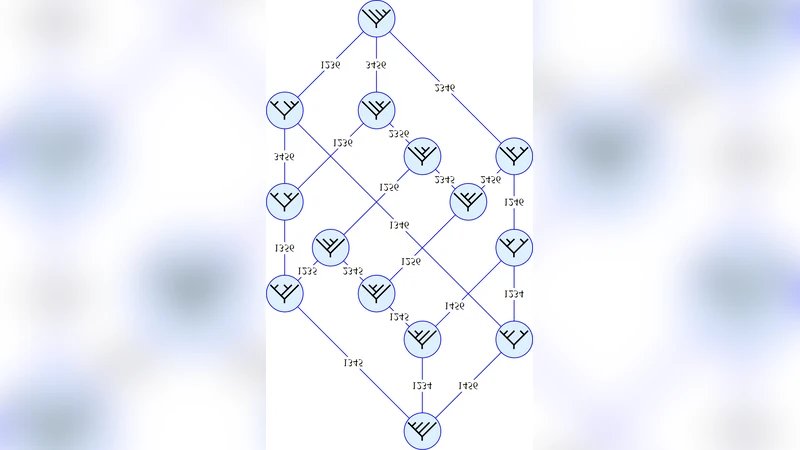
In a tropical approximation, any tree-shaped line soliton solution, a member of the simplest class of soliton solutions of the Kadomtsev-Petviashvili (KP-II) equation, determines a chain of planar rooted binary trees, connected by right rotation. More precisely, it determines a maximal chain of a Tamari lattice. We show that an analysis of these solutions naturally involves higher Bruhat and higher Tamari orders.
💡 Research Summary
The paper investigates a special class of line‑soliton solutions of the Kadomtsev‑Petviashvili II (KP‑II) equation, focusing on those whose spatial profile has a tree‑like shape. By applying a tropical (max‑plus) approximation to the τ‑function representation of the soliton, the authors replace exponential terms with piecewise‑linear functions. In this regime each exponential term corresponds to a linear phase, and the dominant phase at any point in the (x, y, t)‑space determines a region of the plane. The boundaries between regions are precisely the soliton fronts. When the soliton is of the “tree‑shaped” type, these fronts intersect in a pattern that can be identified with a planar rooted binary tree.
A key observation is that the evolution of the soliton in time corresponds to a sequence of right‑rotations of the binary tree. A right‑rotation is the elementary operation that moves a left child up and its parent down to the right, preserving the inorder traversal. This operation is exactly the covering relation in the Tamari lattice (also known as the associahedron). Consequently, the time‑ordered family of trees generated by a given soliton forms a maximal chain in a Tamari lattice: starting from a left‑associated bracketing, successive rotations gradually shift the bracketing to the right‑associated extreme.
The authors go further by embedding this picture into higher combinatorial structures. They note that the set of linear phases can be encoded as a permutation of the indices of the exponential terms. The order in which the phases become dominant as one moves across the plane defines a sequence of inversions, which is naturally ordered by inclusion. This inclusion order is precisely the (higher) Bruhat order on permutations. Each right‑rotation of the tree corresponds to adding a specific inversion, so the chain of trees is simultaneously a chain in the higher Bruhat order. By projecting the Bruhat order onto the space of binary trees, one obtains a higher‑dimensional analogue of the Tamari order, sometimes called the higher Tamari order. Thus the soliton dynamics furnishes a concrete physical realization of both higher Bruhat and higher Tamari lattices.
The paper’s contributions can be summarized as follows:
-
Tropical reduction of KP‑II line solitons – The authors rigorously justify the max‑plus approximation for tree‑shaped solitons and show how the resulting piecewise‑linear structure encodes a binary tree.
-
Identification with Tamari lattices – By tracking the sequence of right‑rotations induced by the time evolution, they prove that every such soliton determines a maximal chain in a Tamari lattice, thereby linking soliton dynamics to the geometry of the associahedron.
-
Connection to higher Bruhat and Tamari orders – They construct a permutation representation of the phase dominance order, demonstrate its compatibility with the Bruhat order, and show that the induced chain of trees is also a chain in the higher Tamari order.
-
Implications for integrable systems and combinatorics – The work provides a novel bridge between integrable PDEs and order theory, suggesting that other integrable hierarchies may admit similar tropical‑combinatorial descriptions. It also offers a concrete physical model for studying higher Bruhat and Tamari structures, which have appeared in cluster algebras, category theory, and algebraic geometry.
-
Future directions – The authors propose extending the analysis to multi‑soliton interactions, exploring numerical validation of the tropical approximation, and investigating possible quantizations of the associated lattices.
Overall, the study reveals that the seemingly simple dynamics of KP‑II line solitons encode rich combinatorial geometry. By interpreting soliton fronts as binary trees and their temporal evolution as lattice moves, the paper opens a pathway for applying sophisticated order‑theoretic tools to the analysis of nonlinear wave phenomena.
Comments & Academic Discussion
Loading comments...
Leave a Comment