Transversality theorems for the weak topology
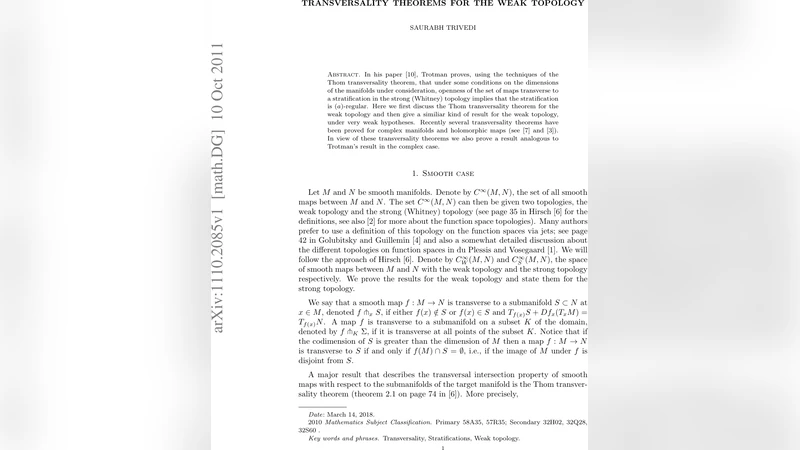
In his 1979 paper Trotman proves, using the techniques of the Thom transversality theorem, that under some conditions on the dimensions of the manifolds under consideration, openness of the set of maps transverse to a stratification in the strong (Whitney) topology implies that the stratification is $(a)$-regular. Here we first discuss the Thom transversality theorem for the weak topology and then give a similiar kind of result for the weak topology, under very weak hypotheses. Recently several transversality theorems have been proved for complex manifolds and holomorphic maps. In view of these transversality theorems we also prove a result analogous to Trotman’s result in the complex case.
💡 Research Summary
The paper revisits the classical relationship between transversality and stratification regularity, originally established by Trotman in 1979 for the strong (Whitney) topology, and extends it to the weak topology as well as to the complex-analytic setting. The author begins by recalling Thom’s transversality theorem, which guarantees that for smooth manifolds (M) and (N) the set of maps transverse to a given submanifold (or stratified set) is dense in the (C^\infty) topology. In the strong topology this set is also open, a fact that Trotman exploited to prove that if the set of maps transverse to a stratification (\Sigma) is open, then (\Sigma) must satisfy Mather’s ((a))-regularity condition, provided certain dimension inequalities hold.
The first major contribution of the paper is a careful formulation of Thom’s theorem for the weak topology on (C^\infty(M,N)). The weak topology is generated by the (C^0) convergence of maps together with convergence of a finite number of derivatives on compact subsets; it is strictly coarser than the Whitney topology, and openness of transverse maps is not automatic. By imposing mild dimensional hypotheses (essentially that the codimension of each stratum is large enough relative to the source dimension) and using a refined approximation technique—dubbed “delicate approximation”—the author shows that the set \
Comments & Academic Discussion
Loading comments...
Leave a Comment