Singular polynomials from orbit spaces
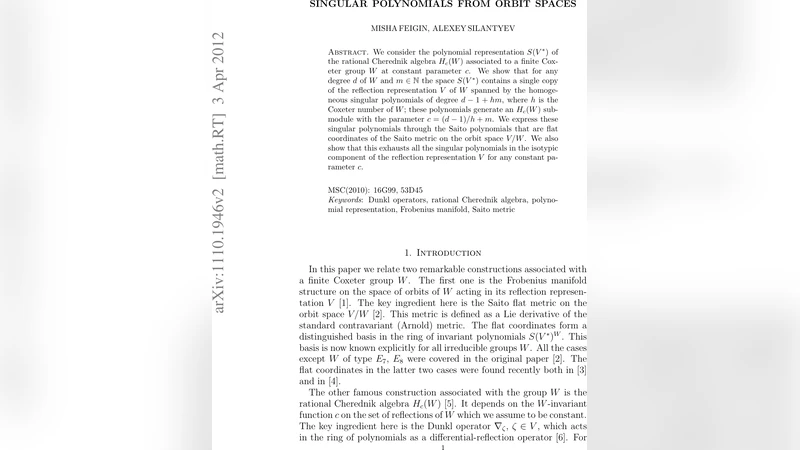
We consider the polynomial representation S(V*) of the rational Cherednik algebra H_c(W) associated to a finite Coxeter group W at constant parameter c. We show that for any degree d of W and nonnegative integer m the space S(V*) contains a single copy of the reflection representation V of W spanned by the homogeneous singular polynomials of degree d-1+hm, where h is the Coxeter number of W; these polynomials generate an H_c(W) submodule with the parameter c=(d-1)/h+m. We express these singular polynomials through the Saito polynomials that are flat coordinates of the Saito metric on the orbit space V/W. We also show that this exhausts all the singular polynomials in the isotypic component of the reflection representation V for any constant parameter c.
💡 Research Summary
The paper investigates singular polynomials in the polynomial representation S(V*) of the rational Cherednik algebra H_c(W) associated with a finite Coxeter group W, focusing on the case of a constant parameter c. A singular polynomial is defined as a polynomial annihilated by all Dunkl operators D_ξ (ξ∈V). The authors prove that for every basic degree d of W and any non‑negative integer m, there exists a unique copy of the reflection representation V inside S(V*) spanned by homogeneous singular polynomials of degree d‑1+hm, where h denotes the Coxeter number. These polynomials generate an H_c(W)‑submodule with the parameter c fixed to (d‑1)/h+m.
The construction relies on the Saito metric on the orbit space V/W. The flat coordinates of this metric are the Saito polynomials t_1,…,t_ℓ, which coincide with the basic W‑invariant polynomials of degrees d_1,…,d_ℓ. By differentiating these flat coordinates and multiplying by suitable powers of the t_i, the authors obtain explicit formulas for the singular polynomials: \
Comments & Academic Discussion
Loading comments...
Leave a Comment