Common Organizing Mechanisms in Ecological and Socio-economic Networks
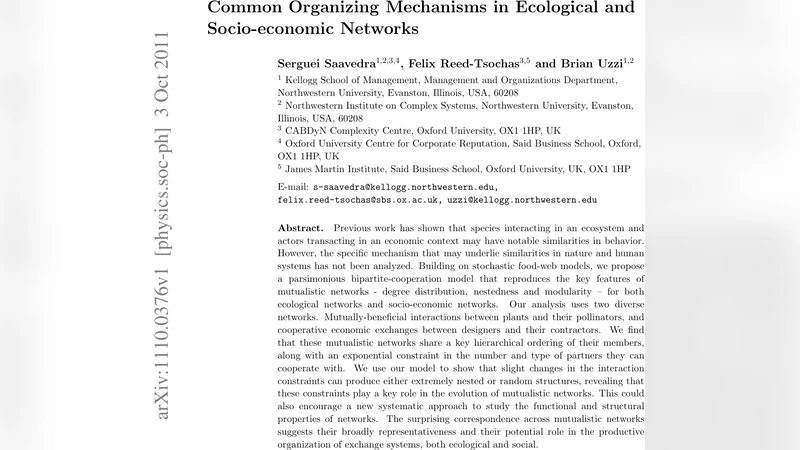
Previous work has shown that species interacting in an ecosystem and actors transacting in an economic context may have notable similarities in behavior. However, the specific mechanism that may underlie similarities in nature and human systems has not been analyzed. Building on stochastic food-web models, we propose a parsimonious bipartite-cooperation model that reproduces the key features of mutualistic networks - degree distribution, nestedness and modularity – for both ecological networks and socio-economic networks. Our analysis uses two diverse networks. Mutually-beneficial interactions between plants and their pollinators, and cooperative economic exchanges between designers and their contractors. We find that these mutualistic networks share a key hierarchical ordering of their members, along with an exponential constraint in the number and type of partners they can cooperate with. We use our model to show that slight changes in the interaction constraints can produce either extremely nested or random structures, revealing that these constraints play a key role in the evolution of mutualistic networks. This could also encourage a new systematic approach to study the functional and structural properties of networks. The surprising correspondence across mutualistic networks suggests their broadly representativeness and their potential role in the productive organization of exchange systems, both ecological and social.
💡 Research Summary
The paper investigates why two seemingly disparate systems—mutualistic ecological networks (plants and pollinators) and cooperative socio‑economic networks (designers and contractors)—exhibit remarkably similar structural properties. Both systems are bipartite: one set of agents (plants or designers) interacts only with the opposite set (pollinators or contractors). Empirical data show that these networks share three hallmark features: a highly skewed degree distribution, high nestedness (a “generalist‑specialist” pattern where generalist nodes interact with many specialists), and moderate modularity (clusters of tightly linked nodes).
To explain this convergence, the authors develop a parsimonious stochastic model called the bipartite‑cooperation model. The model proceeds in three steps. First, each node receives a random “priority score” (α) that represents its ecological or economic advantage; higher‑α nodes are more likely to acquire partners. Second, a cooperation‑constraint function C(k)=exp(‑βk) limits the number of partners a node can sustain, where k is the current degree and β controls the strength of the constraint. Third, connections are formed sequentially: a node i attempts to link to a node j of lower priority (αi>αj) with probability proportional to C(dj), where dj is j’s current degree. This mechanism captures two intuitive ideas: (a) hierarchically ordered agents tend to dominate partner acquisition, and (b) each agent faces an exponential cost for adding additional partners (time, energy, or resources).
When the model is run with parameter values calibrated to the two empirical datasets, it reproduces the observed degree distributions (right‑skewed, resembling a truncated power‑law), nestedness values (N≈0.70 for both networks), and modularity scores (Q≈0.30‑0.35). Sensitivity analysis shows that modest changes in β dramatically shift the network architecture: low β yields extremely nested, low‑modularity structures, whereas high β produces near‑random configurations with low nestedness. Thus, the cooperation constraint is a key driver of the emergent organization.
The authors interpret the priority score as a proxy for “dominance” or “resource holding power.” In ecology, dominant plant species attract many pollinators; in the design industry, well‑known designers secure many contracts. The exponential constraint reflects real‑world limits: a plant can only produce a finite amount of nectar, and a designer can only manage a limited number of projects simultaneously. By unifying these concepts, the model suggests that the same simple rules can generate the complex, yet comparable, topologies observed across natural and human‑made systems.
The paper also discusses broader implications. From a conservation perspective, manipulating β (e.g., through habitat restoration that reduces resource scarcity) could increase nestedness, which is often linked to greater resilience against species loss. In economic policy, supporting small firms or encouraging diversification could effectively lower β, fostering more nested collaboration structures that may enhance innovation diffusion.
Limitations are acknowledged. The model assumes unidirectional priority (higher‑α nodes always dominate) and does not incorporate reciprocal benefits, temporal dynamics (species extinctions, market entry/exit), or spatial constraints (geographic distance). Future work is proposed to embed these factors, test the model on additional domains such as supply‑chain networks or online collaboration platforms, and explore how dynamic perturbations propagate through the hierarchical‑constrained architecture.
In summary, the study provides strong evidence that ecological and socio‑economic mutualistic networks are organized by a common set of mechanisms: a hierarchical ordering of agents combined with an exponential limitation on the number of partners each can sustain. The bipartite‑cooperation model captures these mechanisms with minimal parameters, reproduces key empirical patterns, and highlights how slight adjustments to interaction constraints can drive networks toward either highly nested or random structures. This insight bridges disciplines, offering a unified framework for analyzing, managing, and designing resilient exchange systems in both nature and society.
Comments & Academic Discussion
Loading comments...
Leave a Comment