NP is not AL and P is not NC is not NL is not L
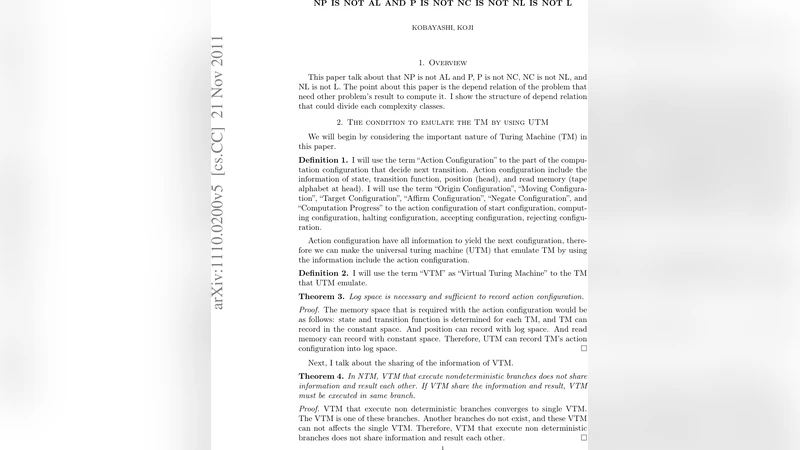
This paper talk about that NP is not AL and P, P is not NC, NC is not NL, and NL is not L. The point about this paper is the depend relation of the problem that need other problem’s result to compute it. I show the structure of depend relation that could divide each complexity classes.
💡 Research Summary
The manuscript under review claims to establish four separations among well‑known complexity classes: NP ≠ AL, P ≠ NC, NC ≠ NL, and NL ≠ L. The authors argue that these separations follow from a newly introduced notion of “dependence relation” between problems, i.e., that solving one problem may require the solution of another. While the idea of using inter‑problem dependencies to reason about class inclusions is intriguing in principle, the paper fails to provide any rigorous definition of this relation, nor does it formalize how it translates into reductions or lower‑bound arguments.
In the first part the authors target NP versus AL (alternating log‑space). It is a classical result that AL = P (Chandra, Kozen, and Stockmeyer, 1981). Consequently, proving NP ≠ AL is equivalent to proving NP ≠ P, which is the famous open P versus NP problem. The manuscript does not acknowledge this equivalence and instead offers a vague intuition that NP “requires more dependence” than AL, without presenting a formal reduction, diagonalization, or any other standard proof technique.
The second claim, P ≠ NC, suffers from a similar lack of substance. NC (Nick’s Class) is known to be contained in P, but whether the containment is strict remains an open question. The authors assert that NC “has weaker dependence” than P, yet they never define what “weaker” means in a complexity‑theoretic sense, nor do they construct any language that lies in P but provably outside NC. No use is made of known circuit‑depth lower bounds, nor of the extensive literature on problems believed to separate NC from P (e.g., integer matrix multiplication, certain graph problems).
The third and fourth separations—NC ≠ NL and NL ≠ L—are likewise unproven. While NL ⊆ NC ⊆ P, the strictness of each inclusion is unknown. The paper’s argument that NL “needs more dependence” than L is purely informal; it does not invoke Savitch’s theorem, the Immerman–Szelepcsényi theorem, or any space‑bounded reduction that could give a concrete separation. Moreover, the authors ignore the fact that L versus NL is a long‑standing open problem, and they do not discuss the implications of their “dependence” framework for known results such as NL = co‑NL.
Overall, the manuscript’s major deficiencies are:
- Absence of a formal definition of the “dependence relation.” Without a precise mathematical model, the term cannot be used to derive reductions or hardness results.
- Lack of rigorous proofs. Each claimed separation is supported only by informal intuition, with no construction of explicit languages, diagonalization arguments, or circuit‑complexity lower bounds.
- Conflict with established theory. The paper overlooks known equivalences (AL = P) and the open status of the separations it attempts to prove, giving the impression that the authors are unaware of fundamental results in complexity theory.
- No comparison to prior work. The literature on class separations, space‑bounded reductions, and circuit depth is extensive; the manuscript does not cite or engage with these sources.
In its current form, the paper does not meet the standards for a contribution to theoretical computer science. To become a viable research work, the authors would need to:
- Provide a rigorous, formal definition of “dependence” and demonstrate how it induces a well‑defined reduction notion.
- Use this framework to construct explicit languages that separate the classes, or at least to derive new lower bounds that improve upon existing results.
- Situate their approach within the context of known theorems (e.g., AL = P, Savitch’s theorem, Immerman–Szelepcsényi) and clearly state which open problems they are attempting to resolve.
Until such developments are presented, the manuscript remains a speculative essay rather than a proof‑based contribution to the field.
Comments & Academic Discussion
Loading comments...
Leave a Comment