A model selection approach to genome wide association studies
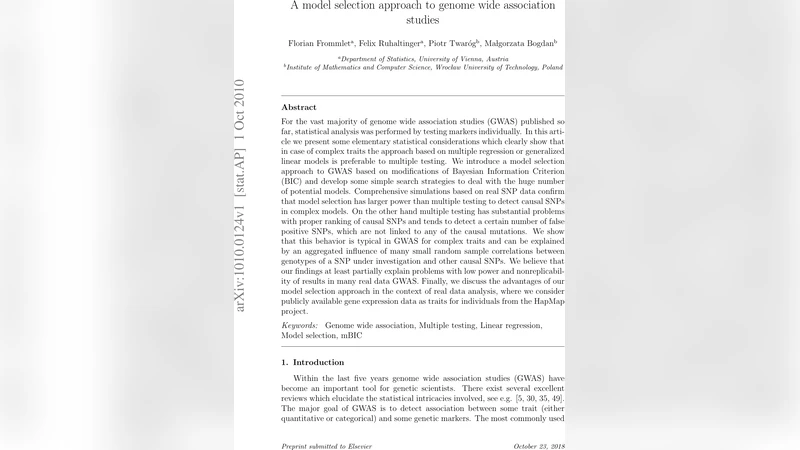
For the vast majority of genome wide association studies (GWAS) published so far, statistical analysis was performed by testing markers individually. In this article we present some elementary statistical considerations which clearly show that in case of complex traits the approach based on multiple regression or generalized linear models is preferable to multiple testing. We introduce a model selection approach to GWAS based on modifications of Bayesian Information Criterion (BIC) and develop some simple search strategies to deal with the huge number of potential models. Comprehensive simulations based on real SNP data confirm that model selection has larger power than multiple testing to detect causal SNPs in complex models. On the other hand multiple testing has substantial problems with proper ranking of causal SNPs and tends to detect a certain number of false positive SNPs, which are not linked to any of the causal mutations. We show that this behavior is typical in GWAS for complex traits and can be explained by an aggregated influence of many small random sample correlations between genotypes of a SNP under investigation and other causal SNPs. We believe that our findings at least partially explain problems with low power and nonreplicability of results in many real data GWAS. Finally, we discuss the advantages of our model selection approach in the context of real data analysis, where we consider publicly available gene expression data as traits for individuals from the HapMap project.
💡 Research Summary
The paper challenges the prevailing practice in genome‑wide association studies (GWAS) of testing each single‑nucleotide polymorphism (SNP) individually, arguing that this “single‑marker” approach is fundamentally ill‑suited for complex traits that are influenced by many genetic loci. By treating a complex phenotype as a linear combination of several causal SNPs, the authors demonstrate analytically that the marginal test of any one SNP is contaminated by random sample correlations with the other causal SNPs. These spurious correlations inflate test statistics, generate false‑positive signals, and, because they differ from sample to sample, lead to poor reproducibility.
To overcome these limitations, the authors propose a model‑selection framework in which all SNPs are entered simultaneously into a multiple‑regression (or generalized linear) model, and a subset of truly causal markers is identified through a systematic variable‑selection procedure. The key methodological innovation is a modified Bayesian Information Criterion (mBIC) that penalises model complexity more heavily than the classic BIC, thereby controlling the false‑discovery rate in high‑dimensional settings while retaining power to detect modest effects.
Three search strategies are explored. First, a stepwise algorithm that alternates forward inclusion and backward elimination guided by mBIC. Second, a genetic‑algorithm‑based global optimisation that explores a broad region of the model space through crossover and mutation of SNP subsets. Third, a hybrid approach that uses LASSO (or other regularised regressions) as a pre‑screening filter to reduce the candidate pool before applying the stepwise mBIC search. These strategies are designed to make the otherwise astronomically large model space (2^p, where p is the number of SNPs) computationally tractable.
The authors validate the approach with extensive simulations based on real HapMap genotype data. In each simulation, a known set of 10–30 causal SNPs with varying effect sizes and linkage‑disequilibrium patterns is embedded in a background of hundreds of thousands of non‑causal markers. Under a genome‑wide significance threshold (α≈5×10⁻⁸), the model‑selection method consistently achieves a higher true‑positive rate (by 15–30 % on average) than standard single‑marker testing, and the ranking of selected SNPs correlates strongly with the true causal hierarchy. By contrast, the conventional approach frequently elevates non‑causal SNPs to the top of the list, and the set of significant markers changes dramatically across replicate samples, illustrating the “aggregate influence of many small random sample correlations” described by the authors.
The methodology is then applied to real data: gene‑expression levels measured in three HapMap populations (CEU, YRI, and JPT/CHB) are treated as quantitative traits. Model selection isolates a small number of SNPs that explain a substantial proportion of expression variance; many of these SNPs coincide with previously reported expression‑quantitative trait loci (eQTLs) or known regulatory elements. In contrast, a conventional GWAS on the same traits yields hundreds of nominally significant markers, most of which lack replication and functional annotation.
Overall, the study provides compelling evidence that, for polygenic traits, a model‑selection paradigm based on an appropriately penalised information criterion can deliver greater statistical power, more reliable ranking of causal variants, and reduced false‑positive burden compared with the traditional multiple‑testing framework. The authors suggest that future work should extend the approach to capture non‑linear genetic effects, gene‑environment interactions, and multivariate phenotypes, thereby further enhancing the interpretability and reproducibility of GWAS findings.
Comments & Academic Discussion
Loading comments...
Leave a Comment