Universality for the focusing nonlinear Schroedinger equation at the gradient catastrophe point: Rational breathers and poles of the tritronquee solution to Painleve I
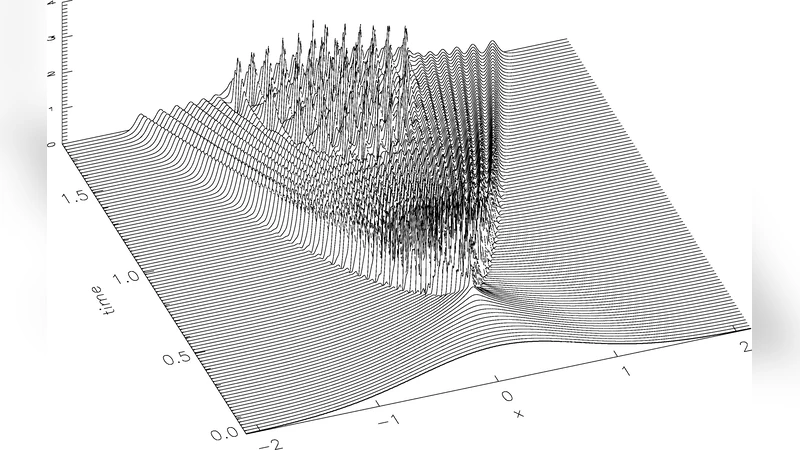
The semiclassical (zero-dispersion) limit of the one-dimensional focusing Nonlinear Schroedinger equation (NLS) with decaying potentials is studied in a full scaling neighborhood D of the point of gradient catastrophe (x_0,t_0). This neighborhood contains the region of modulated plane wave (with rapid phase oscillations), as well as the region of fast amplitude oscillations (spikes). In this paper we establish the following universal behaviors of the NLS solutions near the point of gradient catastrophe: i) each spike has the height 3|q_0(x_0,t_0,epsilon)| and uniform shape of the rational breather solution to the NLS, scaled to the size O(epsilon); ii) the location of the spikes are determined by the poles of the tritronquee solution of the Painleve I (P1) equation through an explicit diffeomorphism between D and a region into the Painleve plane; iii) if (x,t) belongs to D but lies away from the spikes, the asymptotics of the NLS solution q(x,t,epsilon) is given by the plane wave approximation q_0(x,t,epsilon), with the correction term being expressed in terms of the tritronquee solution of P1. The latter result confirms the conjecture of Dubrovin, Grava and Klein about the form of the leading order correction in terms of the tritronquee solution in the non-oscillatory region around (x_0,t_0). We conjecture that the P1 hierarchy occurs at higher degenerate catastrophe points and that the amplitudes of the spikes are odd multiples of the amplitude at the corresponding catastrophe point. Our technique is based on the nonlinear steepest descent method for matrix Riemann-Hilbert Problems and discrete Schlesinger isomonodromic transformations.
💡 Research Summary
The paper investigates the zero‑dispersion (semiclassical) limit of the one‑dimensional focusing nonlinear Schrödinger equation (NLS) with rapidly decaying initial data, concentrating on a full scaling neighbourhood D of the point of gradient catastrophe ((x_{0},t_{0})). In this neighbourhood two qualitatively different regions coexist: a modulated plane‑wave region where the solution is well approximated by a slowly varying amplitude‑phase pair ((A,\Phi)) with a rapidly oscillating phase of order (1/\epsilon), and a “spike’’ region where the amplitude exhibits sharp, localized peaks.
The authors prove three universal features of the NLS solution near the catastrophe point.
-
Spike profile and amplitude. Each spike has a height exactly three times the absolute value of the leading‑order plane‑wave amplitude at the catastrophe, i.e. (3|q_{0}(x_{0},t_{0},\epsilon)|). Moreover, after rescaling space by (\epsilon) the spike coincides with the rational breather (also called the Peregrine soliton) solution of the NLS. Thus the spike shape is universal: it is the rational breather scaled to size (O(\epsilon)).
-
Spike locations and Painlevé I tritronquée poles. The positions of the spikes are not arbitrary; they are determined by the poles of the tritronquée solution of the first Painlevé equation (P I). The authors construct an explicit diffeomorphism between the physical neighbourhood D and a region of the complex (\zeta)‑plane, (\zeta=\epsilon^{-2/5}\Phi_{}(x,t)), where (\Phi_{}) is a locally normalized phase. When (\zeta) approaches a pole (\zeta_{k}) of the tritronquée solution, the corresponding point ((x_{k},t_{k})) in D is the centre of a spike. Consequently the lattice of spikes is in one‑to‑one correspondence with the pole lattice of the tritronquée solution.
-
Non‑spike region and Painlevé‑I correction. Away from the spikes but still inside D, the solution admits the expansion
\
Comments & Academic Discussion
Loading comments...
Leave a Comment