Properties of Pseudo-Primitive Words and their Applications
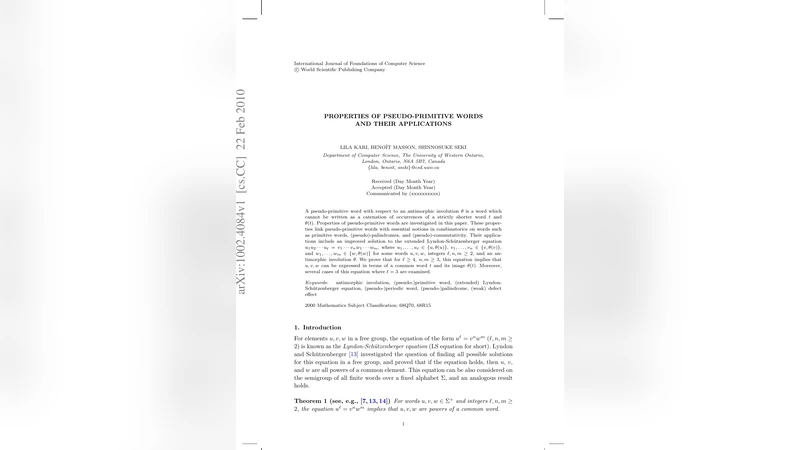
A pseudo-primitive word with respect to an antimorphic involution \theta is a word which cannot be written as a catenation of occurrences of a strictly shorter word t and \theta(t). Properties of pseudo-primitive words are investigated in this paper. These properties link pseudo-primitive words with essential notions in combinatorics on words such as primitive words, (pseudo)-palindromes, and (pseudo)-commutativity. Their applications include an improved solution to the extended Lyndon-Sch"utzenberger equation u_1 u_2 … u_l = v_1 … v_n w_1 … w_m, where u_1, …, u_l \in {u, \theta(u)}, v_1, …, v_n \in {v, \theta(v)}, and w_1, …, w_m \in {w, \theata(w)} for some words u, v, w, integers l, n, m \ge 2, and an antimorphic involution \theta. We prove that for l \ge 4, n,m \ge 3, this equation implies that u, v, w can be expressed in terms of a common word t and its image \theta(t). Moreover, several cases of this equation where l = 3 are examined.
💡 Research Summary
The paper introduces and studies pseudo‑primitive words with respect to an antimorphic involution (\theta). An antimorphic involution is a mapping on an alphabet (\Sigma) that satisfies (\theta^2 = \text{id}) and reverses the order of letters while simultaneously applying a letter‑wise substitution (e.g., the DNA complementarity map). A word (x) is called pseudo‑primitive if it cannot be expressed as a concatenation of a shorter word (t) and its image (\theta(t)) in an alternating fashion, i.e. (x\neq (t\theta(t))^k) and (x\neq (\theta(t)t)^k) for any (k\ge 2). This definition generalises the classical notion of primitive words to the setting where the symmetry induced by (\theta) is taken into account.
The authors first establish a series of structural results linking pseudo‑primitive words to well‑known concepts in combinatorics on words:
-
Relation to primitive and (\theta)‑palindromic words – they prove that a pseudo‑primitive word is either a primitive word that is not a (\theta)-palindrome, or it is a (\theta)-palindrome that is primitive in the usual sense. This clarifies how the new class sits between ordinary primitives and (\theta)-palindromes.
-
Pseudo‑commutativity – if two words (p) and (q) satisfy the equation (pq = \theta(q)\theta(p)), then both can be written as powers of a common word (t) and its image (\theta(t)). The proof adapts the classic Fine‑Wilf theorem to the (\theta)-setting, showing that a sufficiently long overlap forces a common (\theta)-period.
The central application concerns an extended Lyndon‑Schützenberger equation of the form
\
Comments & Academic Discussion
Loading comments...
Leave a Comment