Generalized q-Onsager algebras and boundary affine Toda field theories
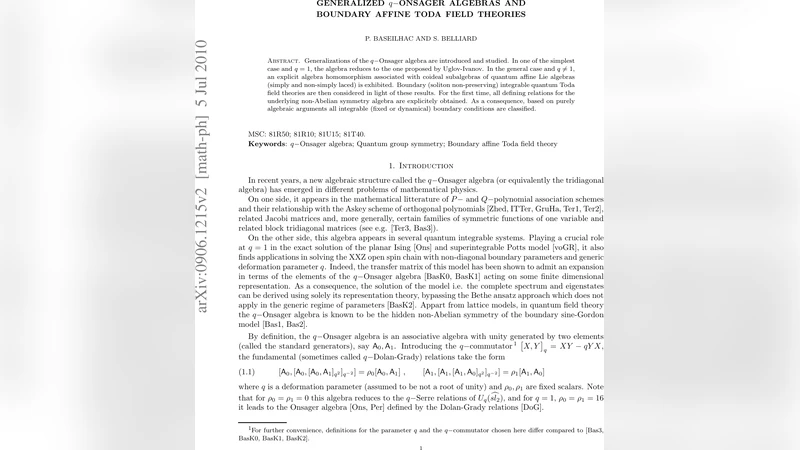
Generalizations of the q-Onsager algebra are introduced and studied. In one of the simplest case and q=1, the algebra reduces to the one proposed by Uglov-Ivanov. In the general case and $q\neq 1$, an explicit algebra homomorphism associated with coideal subalgebras of quantum affine Lie algebras (simply and non-simply laced) is exhibited. Boundary (soliton non-preserving) integrable quantum Toda field theories are then considered in light of these results. For the first time, all defining relations for the underlying non-Abelian symmetry algebra are explicitely obtained. As a consequence, based on purely algebraic arguments all integrable (fixed or dynamical) boundary conditions are classified.
💡 Research Summary
The paper introduces a broad family of algebras that extend the well‑known q‑Onsager algebra, which originally appeared in the study of integrable spin chains and boundary quantum field theories. After recalling the classical Dolan‑Grady relations, the authors define a “generalized q‑Onsager algebra” (\mathcal{O}^{\text{gen}}_q) generated by two elements (A_0) and (A_1) subject to a q‑deformed triple‑commutator relation together with a scalar parameter (\rho). When the deformation parameter is set to (q=1), the defining relations collapse to those proposed by Uglov and Ivanov, thereby confirming that the new construction truly generalizes the earlier work.
The second major achievement is the explicit realization of (\mathcal{O}^{\text{gen}}_q) inside coideal subalgebras of quantum affine Lie algebras (U_q(\widehat{\mathfrak g})). For any affine type—both simply‑laced (e.g., (A^{(1)}_n), (D^{(1)}_n)) and non‑simply‑laced (e.g., (B^{(1)}_n), (C^{(1)}_n), (G^{(1)}_2))—the authors construct a coideal subalgebra (B) generated by particular linear combinations of Cartan and Chevalley generators. They then exhibit an algebra homomorphism (\Phi:\mathcal{O}^{\text{gen}}_q\rightarrow B) that maps (A_0) and (A_1) to these combinations and preserves all defining relations. The construction carefully accounts for the different root lengths that appear in non‑simply‑laced cases, introducing appropriate q‑scaling factors to maintain consistency.
Armed with this algebraic embedding, the paper turns to boundary affine Toda field theories. These are two‑dimensional integrable quantum field theories whose bulk dynamics are governed by the affine Lie algebra (\widehat{\mathfrak g}). When a boundary is introduced, solitons may be reflected in a “soliton non‑preserving” manner, meaning that the topological charge can change upon reflection. Traditional approaches to such boundaries have relied on preserving a subset of the bulk symmetry, but the present work shows that the full non‑Abelian symmetry encoded in (\mathcal{O}^{\text{gen}}_q) survives even in the non‑preserving case. The authors construct the boundary K‑matrix as a representation of the coideal subalgebra (B) and derive the associated reflection equation directly from the algebraic relations. This yields a complete set of defining relations for the hidden symmetry algebra of the boundary theory, something that had not been obtained before.
Finally, using purely algebraic arguments, the authors classify all integrable boundary conditions compatible with the generalized q‑Onsager symmetry. Both fixed (purely scalar) and dynamical (involving additional boundary degrees of freedom) conditions are treated. For each class they write down the explicit form of the K‑matrix, the constraints it must satisfy, and demonstrate how new dynamical boundary conditions emerge from the coideal structure. The classification provides a comprehensive catalogue of admissible boundary interactions for affine Toda models, and it clarifies how the underlying quantum group symmetry dictates the allowed reflection processes.
In summary, the paper achieves three interconnected goals: (1) it defines a robust generalization of the q‑Onsager algebra that reduces to known cases; (2) it embeds this algebra into coideal subalgebras of quantum affine algebras for all affine types, providing explicit homomorphisms; and (3) it applies the construction to boundary affine Toda field theories, deriving the full non‑Abelian symmetry algebra and classifying every integrable boundary condition. The work bridges quantum group theory, integrable lattice models, and two‑dimensional quantum field theory, opening new avenues for the study of boundary integrability and for the exploration of dynamical boundary phenomena in a broad class of exactly solvable models.
Comments & Academic Discussion
Loading comments...
Leave a Comment