Minimal pseudocompact group topologies on free abelian groups
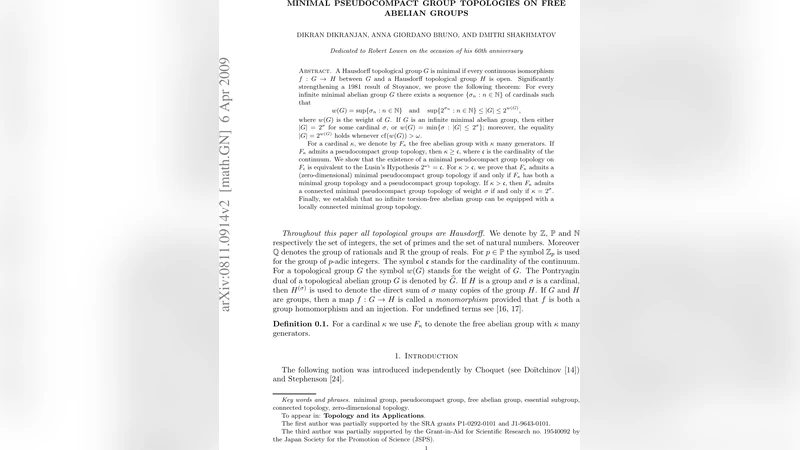
A Hausdorff topological group G is minimal if every continuous isomorphism f: G –> H between G and a Hausdorff topological group H is open. Significantly strengthening a 1981 result of Stoyanov, we prove the following theorem: For every infinite minimal abelian group G there exists a sequence {\sigma_n : n\in N} of cardinals such that w(G) = sup {\sigma_n : n \in N} and sup {2^{\sigma_n} : n \in N} \leq |G| \leq 2^{w(G)}, where w(G) is the weight of G. If G is an infinite minimal abelian group, then either |G| = 2^\sigma for some cardinal \sigma, or w(G) = min {\sigma: |G| \leq 2^\sigma}; moreover, the equality |G| = 2^{w(G)} holds whenever cf (w(G)) > \omega. For a cardinal \kappa, we denote by F_\kappa the free abelian group with \kappa many generators. If F_\kappa admits a pseudocompact group topology, then \kappa \geq c, where c is the cardinality of the continuum. We show that the existence of a minimal pseudocompact group topology on F_c is equivalent to the Lusin’s Hypothesis 2^{\omega_1} = c. For \kappa > c, we prove that F_\kappa admits a (zero-dimensional) minimal pseudocompact group topology if and only if F_\kappa has both a minimal group topology and a pseudocompact group topology. If \kappa > c, then F_\kappa admits a connected minimal pseudocompact group topology of weight \sigma if and only if \kappa = 2^\sigma. Finally, we establish that no infinite torsion-free abelian group can be equipped with a locally connected minimal group topology.
💡 Research Summary
The paper investigates the interplay between minimality and pseudocompactness in group topologies, focusing on free abelian groups. A Hausdorff topological group (G) is called minimal if every continuous isomorphism from (G) onto another Hausdorff group is automatically open. The authors first strengthen a classical result of Stoyanov (1981) by proving a precise cardinal‑theoretic description of any infinite minimal abelian group. They show that there exists a sequence of cardinals ({\sigma_n:n\in\mathbb N}) such that the weight (w(G)=\sup_n\sigma_n) and the size of the group satisfies (\sup_n2^{\sigma_n}\le|G|\le2^{w(G)}). Consequently, either (|G|=2^{\sigma}) for some cardinal (\sigma) or the weight is the smallest (\sigma) with (|G|\le2^{\sigma}). Moreover, when the cofinality of the weight exceeds (\omega), the equality (|G|=2^{w(G)}) holds. This gives a fine‑grained relationship between the algebraic size of a minimal abelian group and its topological weight.
Turning to free abelian groups (F_{\kappa}) (the free abelian group on (\kappa) generators), the authors examine when such groups admit a pseudocompact group topology. A basic necessary condition is (\kappa\ge\mathfrak c) (the continuum). For the critical case (\kappa=\mathfrak c) they prove an equivalence: the existence of a minimal pseudocompact topology on (F_{\mathfrak c}) is exactly the Lusin hypothesis (2^{\omega_1}=\mathfrak c). Thus a set‑theoretic statement about the size of the power set of (\omega_1) determines the topological algebraic structure of the free group of continuum rank.
For larger cardinals (\kappa>\mathfrak c) the paper establishes a clean dichotomy. It is shown that (F_{\kappa}) admits a (zero‑dimensional) minimal pseudocompact topology if and only if it already possesses both a minimal group topology and a pseudocompact group topology. In other words, the two properties are independent but can be combined whenever each is present separately. Moreover, a connected minimal pseudocompact topology of weight (\sigma) exists on (F_{\kappa}) precisely when (\kappa=2^{\sigma}). This gives a perfect correspondence between the cardinality of the generating set and the weight of the desired topology, and it shows that the weight can be prescribed arbitrarily (subject to the obvious cardinal arithmetic) by choosing (\kappa) appropriately.
Finally, the authors prove a negative result concerning torsion‑free abelian groups: no infinite torsion‑free abelian group can support a locally connected minimal group topology. This demonstrates that minimality imposes strong restrictions on the local connectedness of the underlying space, and that torsion‑free structure is incompatible with such a locally connected minimal topology.
Overall, the paper contributes three major advances: (1) a refined cardinal invariant description of infinite minimal abelian groups; (2) a complete characterization of when free abelian groups admit minimal pseudocompact topologies, linking the problem to classical set‑theoretic hypotheses; and (3) a clear obstruction for locally connected minimal topologies on torsion‑free groups. The results blend techniques from set theory (cardinal arithmetic, cofinality), general topology (pseudocompactness, weight, connectedness), and topological group theory (minimality, zero‑dimensionality), thereby deepening our understanding of how algebraic freedom interacts with delicate topological constraints.
Comments & Academic Discussion
Loading comments...
Leave a Comment