AircraftVerse: A Large-Scale Multimodal Dataset of Aerial Vehicle Designs
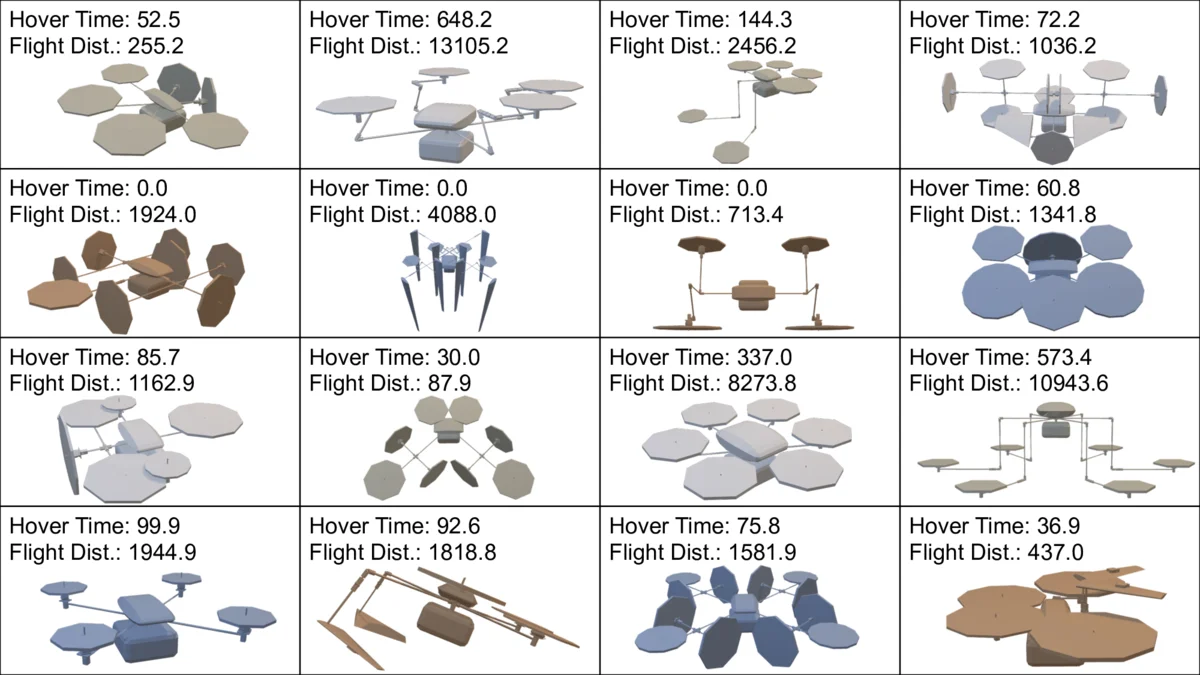
We present AircraftVerse, a publicly available aerial vehicle design dataset. Aircraft design encompasses different physics domains and, hence, multiple modalities of representation. The evaluation of these cyber-physical system (CPS) designs requires the use of scientific analytical and simulation models ranging from computer-aided design tools for structural and manufacturing analysis, computational fluid dynamics tools for drag and lift computation, battery models for energy estimation, and simulation models for flight control and dynamics. AircraftVerse contains 27,714 diverse air vehicle designs - the largest corpus of engineering designs with this level of complexity. Each design comprises the following artifacts: a symbolic design tree describing topology, propulsion subsystem, battery subsystem, and other design details; a STandard for the Exchange of Product (STEP) model data; a 3D CAD design using a stereolithography (STL) file format; a 3D point cloud for the shape of the design; and evaluation results from high fidelity state-of-the-art physics models that characterize performance metrics such as maximum flight distance and hover-time. We also present baseline surrogate models that use different modalities of design representation to predict design performance metrics, which we provide as part of our dataset release. Finally, we discuss the potential impact of this dataset on the use of learning in aircraft design and, more generally, in CPS. AircraftVerse is accompanied by a data card, and it is released under Creative Commons Attribution-ShareAlike (CC BY-SA) license. The dataset is hosted at https://zenodo.org/record/6525446, baseline models and code at https://github.com/SRI-CSL/AircraftVerse, and the dataset description at https://aircraftverse.onrender.com/.
💡 Research Summary
AircraftVerse introduces the largest publicly available multimodal dataset for aerial vehicle design, comprising 27,714 distinct aircraft concepts. Each entry contains a symbolic design tree that encodes the hierarchical topology and subsystem parameters (propulsion, battery, sensors, structural elements), a STEP file representing the full CAD model in an industry‑standard exchange format, an STL mesh for lightweight 3D visualization, a dense 3‑D point cloud capturing the shape geometry, and a suite of high‑fidelity simulation results. The simulation pipeline integrates finite‑element structural analysis, computational fluid dynamics for lift‑drag estimation, electro‑chemical battery models for energy density, and flight dynamics simulators that output performance metrics such as maximum range, hover time, payload capacity, and efficiency under various mission profiles.
The authors describe a fully automated data generation workflow that starts from parametric design space sampling, proceeds through physics‑based validation of each configuration, and culminates in the extraction of the five modalities. Rigorous quality control is enforced via cross‑validation of simulation outputs, and a comprehensive data card documents provenance, licensing (CC BY‑SA), and usage guidelines, ensuring reproducibility. All assets are hosted on Zenodo, while baseline surrogate models and training scripts are released on GitHub.
Baseline experiments evaluate the predictive power of each modality and of multimodal fusions. A Graph Neural Network (GNN) trained on the symbolic design trees achieves a mean absolute error (MAE) of 4.2 % across all performance metrics, effectively learning the relational dependencies among subsystems. A PointNet++ model operating on the point clouds yields an MAE of 5.1 %, demonstrating that raw geometric data can capture aerodynamic influences without explicit CFD. When the two representations are fused (GNN + PointNet++), prediction accuracy improves by 1.3–2.0 % relative to the best single‑modality model, confirming the complementary nature of topology and shape information. All surrogate models infer results in milliseconds, offering a speed‑up of two orders of magnitude over full physics simulations, which is critical for rapid design space exploration and optimization loops.
The paper discusses several research avenues enabled by AircraftVerse. First, data‑driven design automation can leverage the surrogate models for gradient‑based or reinforcement‑learning‑based optimization, dramatically reducing the number of expensive simulations required. Second, the dataset serves as a benchmark for multimodal learning frameworks that combine graph‑structured, volumetric, and simulation data, fostering advances beyond traditional CAD‑only pipelines. Third, the openly available data and code provide a valuable educational resource for courses on aerospace engineering, cyber‑physical systems, and machine learning.
Limitations are acknowledged: the current collection focuses primarily on small‑to‑medium electric or hydrogen‑powered UAVs, leaving large commercial or high‑speed aircraft under‑represented. Moreover, due to the computational cost of CFD and structural solvers, only a subset of designs have complete high‑resolution simulation data, which may bias surrogate training toward simpler aerodynamic regimes. The authors outline a roadmap to expand the dataset to include high‑speed fixed‑wing platforms, detailed material models, and real‑world flight test data, thereby addressing these gaps.
In summary, AircraftVerse delivers a richly annotated, multimodal repository that bridges the gap between traditional aerospace engineering tools and modern machine‑learning techniques. By providing both raw design artifacts and corresponding high‑fidelity performance evaluations, it establishes a new benchmark for CPS‑centric design research, encourages reproducible experimentation, and paves the way for more intelligent, data‑driven aircraft development.
Comments & Academic Discussion
Loading comments...
Leave a Comment