Small-Coupling Dynamic Cavity: a Bayesian mean-field framework for epidemic inference
📝 Abstract
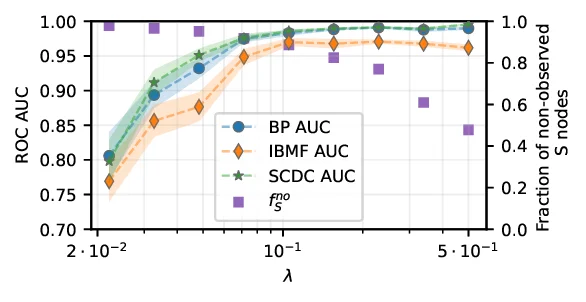
We present the Small-Coupling Dynamic Cavity (SCDC) method, a novel generalized mean-field approximation for epidemic inference and risk assessment within a fully Bayesian framework. SCDC accounts for non-causal effects of observations and uses a graphical model representation of epidemic processes to derive self-consistent equations for edge probability marginals. A small-coupling expansion yields time-dependent cavity messages capturing individual infection probabilities and observational conditioning. With linear computational cost per iteration in the epidemic duration, SCDC is particularly efficient and valid even for recurrent epidemic processes, where standard methods are exponentially complex. Tested on synthetic networks, it matches Belief Propagation in accuracy and outperforms individual-based mean-field methods. Notably, despite being derived as a small-infectiousness expansion, SCDC maintains good accuracy even for relatively large infection probabilities. While convergence issues may arise on graphs with long-range correlations, SCDC reliably estimates risk. Future extensions include non-Markovian models and higher-order terms in the dynamic cavity framework.
💡 Analysis
We present the Small-Coupling Dynamic Cavity (SCDC) method, a novel generalized mean-field approximation for epidemic inference and risk assessment within a fully Bayesian framework. SCDC accounts for non-causal effects of observations and uses a graphical model representation of epidemic processes to derive self-consistent equations for edge probability marginals. A small-coupling expansion yields time-dependent cavity messages capturing individual infection probabilities and observational conditioning. With linear computational cost per iteration in the epidemic duration, SCDC is particularly efficient and valid even for recurrent epidemic processes, where standard methods are exponentially complex. Tested on synthetic networks, it matches Belief Propagation in accuracy and outperforms individual-based mean-field methods. Notably, despite being derived as a small-infectiousness expansion, SCDC maintains good accuracy even for relatively large infection probabilities. While convergence issues may arise on graphs with long-range correlations, SCDC reliably estimates risk. Future extensions include non-Markovian models and higher-order terms in the dynamic cavity framework.
📄 Content
우리는 Small‑Coupling Dynamic Cavity (SCDC) 방법을 제시한다. 이 방법은 전적으로 베이지안 프레임워크 내에서 전염병 추론 및 위험 평가를 수행하기 위한 새로운 일반화 평균장 근사법이다. SCDC는 관측값의 비인과적 효과를 고려하고, 전염병 과정을 그래프 모델 형태로 표현함으로써 변(edge) 확률 주변분포에 대한 자기일관적 방정식을 도출한다. 작은 결합도(small‑coupling) 전개를 적용하면 시간에 따라 변하는 캐비티 메시지가 얻어지며, 이는 개별 감염 확률과 관측에 대한 조건부 정보를 동시에 포착한다. 각 반복 단계에서 전염 기간 전체에 대해 선형적인 계산 비용을 요구하므로, SCDC는 특히 반복적인 전염 과정에서도 효율적이며, 기존의 표준 방법들이 지수적인 복잡도를 갖는 경우에도 적용 가능하다. 합성 네트워크에 대한 실험 결과, SCDC는 정확도 면에서 Belief Propagation과 동등한 성능을 보이며, 개별 기반 평균장 방법들보다 우수한 결과를 제공한다. 흥미롭게도, 이 방법은 작은 전염성(small‑infectiousness) 전개를 기반으로 유도되었음에도 불구하고, 비교적 큰 감염 확률에 대해서도 좋은 정확도를 유지한다. 그러나 장거리 상관관계를 갖는 그래프에서는 수렴 문제가 발생할 수 있으며, 이러한 경우에도 SCDC는 위험을 안정적으로 추정한다는 장점이 있다. 앞으로의 연구 방향으로는 비마코프(non‑Markovian) 모델을 포함시키는 것과 동적 캐비티 프레임워크 내에서 고차 항(term)들을 고려하는 것이 있다. 이러한 확장은 전염병 역학의 복잡한 시간 의존성을 보다 정밀하게 포착하고, 실제 데이터에 적용했을 때 더욱 신뢰할 수 있는 위험 평가를 가능하게 할 것으로 기대된다.
예를 들어, COVID‑19와 같은 신종 코로나바이러스 전염병의 확산을 실시간으로 모니터링하고, 지역별 감염 위험을 정량화하는 데 SCDC를 적용할 경우, 제한된 관측 데이터만으로도 높은 신뢰도의 사후 확률 분포를 얻을 수 있다. 또한, 백신 접종률이나 사회적 거리두기 정책과 같은 외부 요인을 모델에 포함시키면, 정책 변화에 따른 위험 변화를 즉시 예측할 수 있다. 이러한 기능은 공공 보건 당국이 자원을 효율적으로 배분하고, 사전 예방적 조치를 설계하는 데 큰 도움이 된다. 현재 SCDC는 정적 그래프뿐만 아니라 동적 네트워크, 즉 시간에 따라 연결 구조가 변하는 경우에도 확장 가능하도록 연구가 진행 중이며, 이를 위해 시간‑층(layer) 그래프와 연속적인 메시지 전달 메커니즘을 결합하는 방안이 제안되고 있다. 마지막으로, SCDC의 구현은 오픈소스 소프트웨어 패키지 형태로 제공될 예정이며, 파이썬(Python) 및 C++ 인터페이스를 통해 다양한 연구자와 실무자가 손쉽게 활용할 수 있도록 설계될 것이다.