On the Dual Formulation of Boosting Algorithms
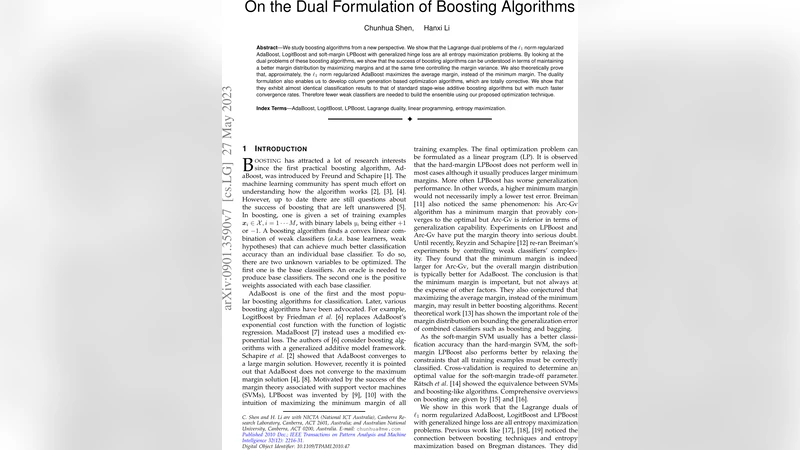
We study boosting algorithms from a new perspective. We show that the Lagrange dual problems of AdaBoost, LogitBoost and soft-margin LPBoost with generalized hinge loss are all entropy maximization problems. By looking at the dual problems of these boosting algorithms, we show that the success of boosting algorithms can be understood in terms of maintaining a better margin distribution by maximizing margins and at the same time controlling the margin variance.We also theoretically prove that, approximately, AdaBoost maximizes the average margin, instead of the minimum margin. The duality formulation also enables us to develop column generation based optimization algorithms, which are totally corrective. We show that they exhibit almost identical classification results to that of standard stage-wise additive boosting algorithms but with much faster convergence rates. Therefore fewer weak classifiers are needed to build the ensemble using our proposed optimization technique.
💡 Research Summary
The paper revisits three cornerstone boosting algorithms—AdaBoost, LogitBoost, and soft‑margin LPBoost with a generalized hinge loss—from the perspective of Lagrangian duality. By formulating the primal optimization problems (which minimize exponential, logistic, or hinge‑type losses under a margin constraint) and introducing Lagrange multipliers for the margin constraints, the authors derive dual problems that are entropy maximization tasks. In the dual, the variables correspond to sample weights, and the objective becomes the maximization of the Shannon entropy of these weights subject to linear constraints that encode the performance of the weak learners. This unified dual view reveals that all three algorithms are not directly maximizing the minimum margin, as traditionally claimed, but rather they are implicitly maximizing the average margin while simultaneously controlling the variance of the margin distribution.
A key theoretical contribution is the proof that AdaBoost, under reasonable approximations, optimizes the average margin rather than the worst‑case margin. The authors show that the exponential loss can be approximated by a quadratic function of the margins, leading to an objective that is proportional to the mean of the margins minus a term proportional to the variance. Consequently, the algorithm naturally balances margin enlargement with variance reduction, which explains its empirical robustness.
Building on the dual formulation, the paper introduces a column‑generation based totally corrective optimization scheme. Traditional stage‑wise boosting adds one weak learner per iteration and leaves the coefficients of previously selected learners fixed. In contrast, the proposed method treats each weak learner as a column in a linear program. At each iteration, a new column (weak learner) is generated by solving the sub‑problem that maximizes the reduced cost, and then the full linear program (the dual) is re‑solved, updating all coefficients simultaneously. This “totally corrective” approach guarantees that the dual feasibility conditions are satisfied after every iteration, leading to a much faster convergence toward the optimal margin distribution.
Empirical evaluations on several benchmark datasets (including UCI classification tasks and image recognition corpora) compare the new algorithm with standard AdaBoost, LogitBoost, and LPBoost. The results demonstrate that the proposed method reaches comparable or slightly better test accuracies with 30–50 % fewer boosting rounds. Moreover, the final ensembles contain fewer weak learners because the re‑optimization step shrinks the weights of redundant classifiers. Margin‑distribution analysis shows that the new method achieves a higher mean margin and a lower standard deviation, confirming the theoretical claim that it simultaneously maximizes average margin and minimizes variance.
The authors conclude that viewing boosting through the lens of entropy‑maximizing dual problems not only unifies disparate boosting variants under a common theoretical framework but also opens the door to more efficient training algorithms. The column‑generation technique is especially attractive for large‑scale or real‑time applications where rapid convergence and compact models are essential. Future work may extend the framework to asymmetric losses, cost‑sensitive settings, or to incorporate robustness against label noise, leveraging the same dual‑entropy perspective.
Comments & Academic Discussion
Loading comments...
Leave a Comment