Application of virtual seismology to DAS data in Groningen
💡 Research Summary
This paper investigates the feasibility of applying virtual seismology, based on the acoustic Marchenko redatuming method, to land‑based seismic data acquired in the Groningen province of the Netherlands. The authors use both conventional vertical‑component geophone recordings and distributed acoustic sensing (DAS) data obtained from straight and helically wound fiber‑optic cables. A seismic line of 750 m was surveyed with an electrically driven vibrator (2–180 Hz sweep) placed every 2 m. Along the same line, fiber‑optic cables were buried at the surface and at depth, providing DAS measurements at 1 m spacing (gauge length 2 m). Vertical geophones were deployed every 4 m for reference. At a borehole located at 375 m, dynamite charges were detonated at depths of 90, 95 and 100 m to serve as a ground‑truth source.
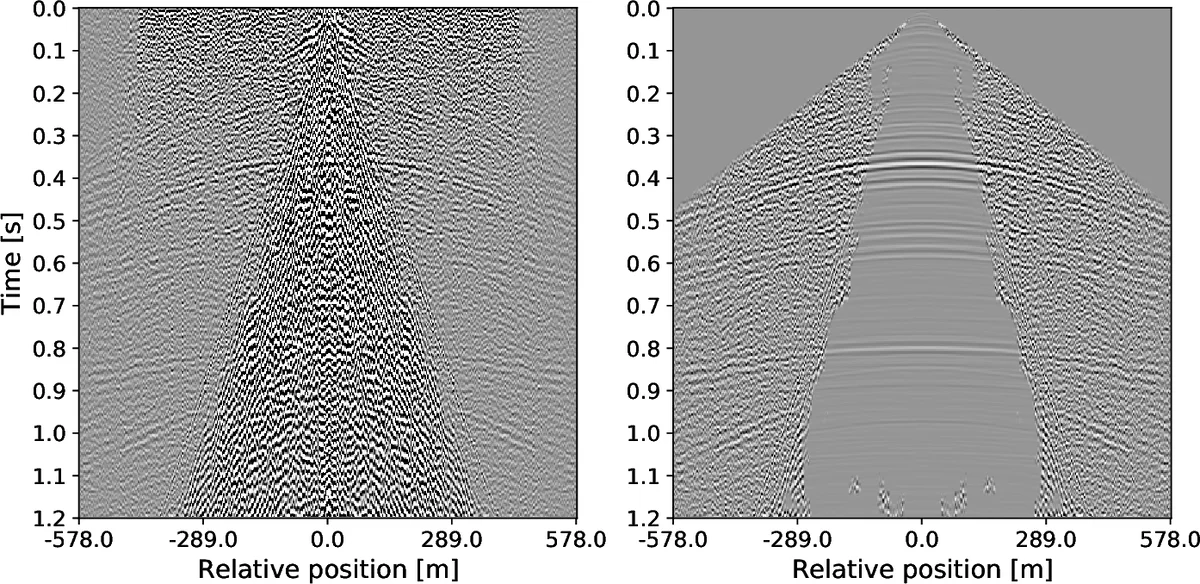
The workflow consists of several critical steps. First, raw data are correlated with the source sweep to obtain zero‑phase recordings. Surface‑generated direct arrivals and ground roll are removed by a strict mute; the resulting gaps are interpolated in the Radon domain, and normal‑move‑out (NMO) correction is applied and later undone to preserve the original time axis. Because DAS signal‑to‑noise ratios vary strongly with source position, the authors construct a 1.5‑D reflection response by selecting a single common‑source gather (CSG) from the helically wound fiber, mirroring it to create a symmetric gather, and then generating a full 578 × 578 m reflection matrix. This approach assumes that the same reflection wavefield applies to all source positions, which is acceptable for the relatively simple geology of the site.
Amplitude scaling is essential for Marchenko convergence. The authors first compensate for the difference between 3‑D (≈ 1/t) and 2‑D (≈ 1/√t) geometrical spreading by multiplying the data by √t. They then apply an additional gain of the form a · e^{bt}, where a is a linear factor and b a time‑dependent exponential, optimized by minimizing a cost function that accounts for source‑signature and absorption effects. The authors acknowledge that offset‑dependent gain, wave‑field damping, and imperfect source‑phase removal are not fully addressed, which may limit the accuracy of the final virtual responses.
With the scaled reflection data, the travel time between the surface and a focal point at x = 375 m, z = 100 m (the dynamite depth) is estimated using an acoustic finite‑difference model. The first arrival of this Green’s function is time‑reversed to generate an initial focusing function. An iterative Marchenko scheme (eight iterations) then yields up‑going and down‑going Green’s functions between the focal point and the surface. Summing these provides the two‑way acoustic Green’s function, which can be directly compared with the recorded dynamite shot.
Results show that the geophone‑based virtual source reproduces the primary reflection at 0.3 s and a secondary event at 0.8 s observed in the dynamite data. The DAS‑based 1.5‑D virtual source also captures the 0.4 s and 0.8 s reflections, though it lacks the fine detail after the direct arrival that is visible in the geophone results. The authors attribute this loss of detail to the 1.5‑D approximation and to the fact that DAS records a combination of vertical and horizontal strain rates, whereas geophones measure vertical particle velocity.
In the discussion, several limitations are highlighted. Removing surface waves inevitably destroys near‑surface reflections that often generate internal multiples, reducing the amount of information available for Marchenko redatuming. Scaling errors arise from imperfect geometrical spreading correction, offset‑dependent amplitude decay, wave‑field damping, and the mismatch between the dipole source/dipole receivers used in the field and the monopole/dipole assumptions of the Marchenko formulation. Moreover, the initial focusing function derived from the direct P‑wave arrival may be inaccurate in the presence of strong forward scattering (e.g., diffraction from sharp discontinuities). The current Marchenko implementation also neglects free‑surface multiples and elastic effects; while recent studies suggest that elastic corrections have limited impact on migrated sections, fully elastic Marchenko formulations are under development.
The paper concludes that virtual seismology can be successfully applied to both geophone and DAS land data to redatum wavefields and to synthesize responses to a subsurface dynamite source. However, robust preprocessing (especially surface‑wave removal), accurate amplitude scaling, preservation of near‑surface reflections, and incorporation of elastic and free‑surface effects are essential for reliable results. Future work should focus on systematic correction of linear, time‑dependent, and offset‑dependent scaling errors, improved handling of near‑surface multiples, and the development of elastic Marchenko schemes tailored to DAS measurements.
Comments & Academic Discussion
Loading comments...
Leave a Comment