A variational multiscale method derived from an adaptive stabilized conforming finite element method via residual minimization on dual norms
💡 Research Summary
This paper presents a novel numerical framework that unifies residual‑minimization‑based stabilized continuous finite‑element methods with the variational multiscale (VMS) paradigm, targeting convection‑dominated diffusion problems. Starting from a discontinuous Galerkin (DG) discretization on a mesh, the authors define two discrete spaces: a coarse, H¹‑conforming space (\bar V_h) and an enriched, discontinuous space V_h. By minimizing the residual of the governing PDE in a dual DG norm over (\bar V_h), they obtain a stable coarse‑scale solution (\bar u). This minimization is cast as a saddle‑point problem involving a residual representation function ε, which lives in the full discontinuous space.
The VMS viewpoint is then employed to decompose the full space V_h into three orthogonal subspaces: V₀_h (the annihilator of the bilinear form b_h with respect to (\bar V_h)), (\hat V_h) (the g‑inner‑product orthogonal complement of V₀_h), and (\tilde V_h) (the kernel of b_h when tested by (\hat V_h)). Consequently, the total solution splits as u = (\bar u + \tilde u), where (\bar u) solves a Petrov‑Galerkin coarse‑scale problem with optimal test functions, and (\tilde u) is reconstructed from the fine‑scale residual problem in V₀_h. The resulting formulation yields a symmetric saddle‑point system and a natural a‑posteriori error estimator given by the norm of ε. This estimator drives an on‑the‑fly adaptive mesh refinement loop that marks elements with large residual contributions and refines them, while simultaneously updating the subspace decompositions.
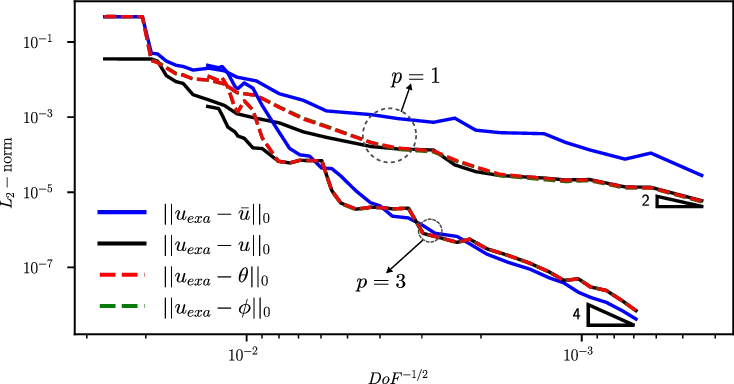
Numerical experiments cover a range of challenging scenarios: linear 2‑D and 3‑D convection‑diffusion equations with very high Peclet numbers, problems featuring sharp interior and boundary layers, and nonlinear scalar conservation laws (e.g., Burgers equation) where a Lax‑Friedrichs flux is incorporated within the DG context. In all cases the method achieves optimal convergence rates in the asymptotic regime and robust performance in the pre‑asymptotic regime. Compared with standard DG, the proposed approach attains comparable or lower errors with substantially fewer degrees of freedom because the coarse‑scale solution lives in a continuous space. Moreover, the need for user‑tuned stabilization parameters is eliminated; the dual‑norm residual minimization automatically provides the necessary stabilization.
An additional contribution is a heuristic dual‑term augmentation to the variational form for symmetric problems (pure diffusion), which improves the full‑scale approximation without compromising stability. The paper thus delivers a comprehensive, parameter‑free, adaptively refined stabilized finite‑element methodology that blends the strengths of residual minimization, VMS sub‑grid modeling, and DG‑based robustness, offering a powerful tool for a wide class of convection‑dominated PDEs.
Comments & Academic Discussion
Loading comments...
Leave a Comment