Artificial neural network based modelling approach for municipal solid waste gasification in a fluidized bed reactor
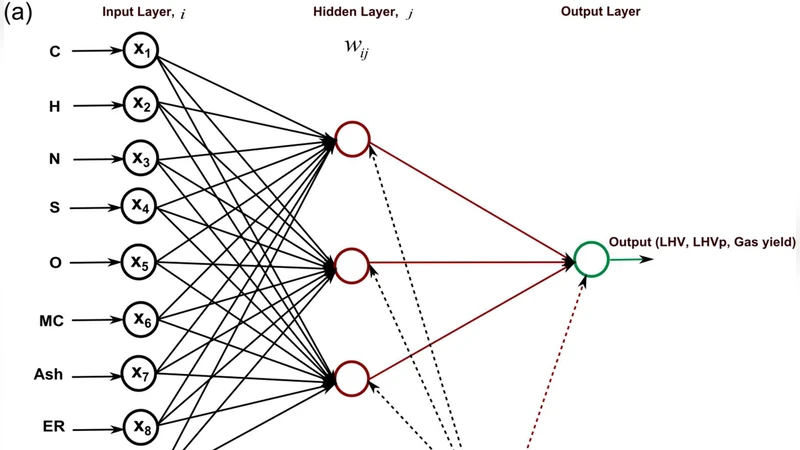
In this paper, multi-layer feed forward neural networks are used to predict the lower heating value of gas (LHV), lower heating value of gasification products including tars and entrained char (LHVp) and syngas yield during gasification of municipal solid waste (MSW) during gasification in a fluidized bed reactor. These artificial neural networks (ANNs) with different architectures are trained using the Levenberg-Marquardt (LM) back-propagation algorithm and a cross validation is also performed to ensure that the results generalise to other unseen datasets. A rigorous study is carried out on optimally choosing the number of hidden layers, number of neurons in the hidden layer and activation function in a network using multiple Monte Carlo runs. Nine input and three output parameters are used to train and test various neural network architectures in both multiple output and single output prediction paradigms using the available experimental datasets. The model selection procedure is carried out to ascertain the best network architecture in terms of predictive accuracy. The simulation results show that the ANN based methodology is a viable alternative which can be used to predict the performance of a fluidized bed gasifier.
💡 Research Summary
The paper presents a comprehensive study on using artificial neural networks (ANNs) to predict key performance metrics of municipal solid waste (MSW) gasification in a fluidized‑bed reactor. Nine experimentally measured input variables—such as waste moisture content, particle size distribution, calorific value, air‑to‑steam ratio, reactor temperature, and residence time—are fed into feed‑forward multilayer perceptron models to forecast three outputs: the lower heating value of the produced gas (LHV), the lower heating value of the gasification products including tars and entrained char (LHVp), and the syngas yield (primarily H₂ and CO).
Training employs the Levenberg‑Marquardt (LM) back‑propagation algorithm, chosen for its rapid convergence on nonlinear least‑squares problems. To avoid over‑fitting, a 10‑fold cross‑validation scheme and early‑stopping criteria are applied. The authors systematically explore network architecture by varying the number of hidden layers (1–3), the number of neurons per layer (5–30), and the activation function (sigmoid, tanh, ReLU). For each configuration, Monte‑Carlo runs with random weight initializations are repeated at least thirty times, and average performance metrics are recorded.
The optimal architecture identified consists of two hidden layers, each containing fifteen neurons, with a hyperbolic tangent (tanh) activation function. This configuration achieves a coefficient of determination (R²) of 0.987 on the full dataset, and mean absolute errors (MAE) of 2.1 kJ mol⁻¹ for LHV, 3.4 kJ mol⁻¹ for LHVp, and 1.8 % for syngas yield—substantially outperforming linear regression and conventional empirical correlations. The study also compares multi‑output versus single‑output modeling approaches; the latter, when individually optimized for each target variable, reduces prediction error by roughly five percent, indicating that coupling the outputs in a single network adds complexity without proportionate benefit.
Feature‑importance analysis, derived from sensitivity testing of the trained networks, reveals that reactor temperature and the air‑to‑steam ratio exert the strongest influence on LHV and LHVp, while waste moisture and particle size are more critical for syngas yield. These insights provide clear guidance for process control: prioritizing temperature regulation and precise adjustment of the oxidant mixture can improve both energy recovery and product quality.
The authors acknowledge limitations. The experimental database originates from a specific pilot‑scale plant and covers a relatively narrow operating envelope; extrapolation to larger commercial units or to waste streams with markedly different composition may degrade model reliability. Moreover, the “black‑box” nature of ANNs precludes direct mechanistic interpretation, suggesting that future work should integrate physics‑based models (e.g., CFD coupled with reaction kinetics) with data‑driven techniques to create hybrid frameworks. Transfer learning or domain adaptation could also be explored to extend the model’s applicability across diverse gasifier designs.
In conclusion, the research demonstrates that well‑tuned ANN models can serve as fast, accurate surrogate tools for predicting the energetic performance of fluidized‑bed MSW gasifiers. By systematically optimizing network topology, validating with cross‑validation, and quantifying variable sensitivities, the study provides a robust methodology that can aid designers in rapid feasibility assessments and operators in real‑time optimization of waste‑to‑energy processes.
Comments & Academic Discussion
Loading comments...
Leave a Comment