Can cold quark matter be solid?
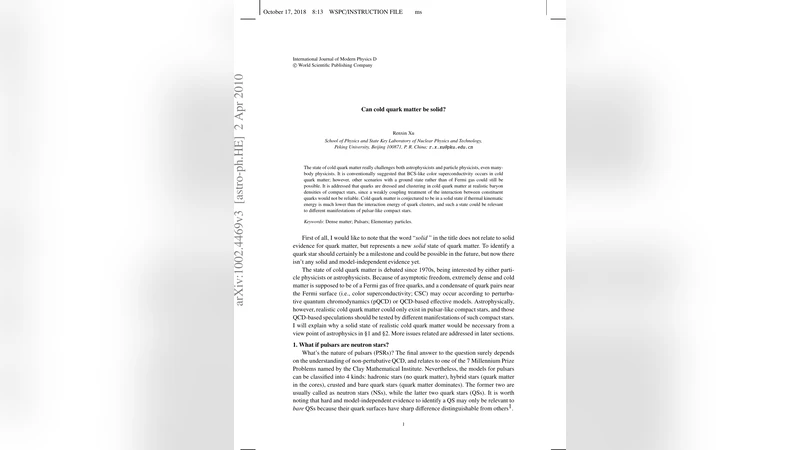
The state of cold quark matter really challenges both astrophysicists and particle physicists, even many-body physicists. It is conventionally suggested that BCS-like color superconductivity occurs in cold quark matter; however, other scenarios with a ground state rather than of Fermi gas could still be possible. It is addressed that quarks are dressed and clustering in cold quark matter at realistic baryon densities of compact stars, since a weakly coupling treatment of the interaction between constituent quarks would not be reliable. Cold quark matter is conjectured to be in a solid state if thermal kinematic energy is much lower than the interaction energy of quark clusters, and such a state could be relevant to different manifestations of pulsar-like compact stars.
💡 Research Summary
The paper tackles the long‑standing question of whether cold quark matter, as it may exist in the cores of compact stars, can assume a solid state rather than the traditionally assumed color‑superconducting (BCS‑like) phase. The authors begin by pointing out that the densities relevant for neutron‑star interiors (a few to ten times nuclear saturation density, ρ₀) lie well beyond the regime where a weak‑coupling treatment of quark interactions is justified. In such an environment quarks are expected to be “dressed” into constituent quarks that experience a strongly non‑linear color potential. Consequently, quarks are likely to cluster into multi‑quark bound states (e.g., 3‑, 6‑, 9‑quark clusters) rather than forming a free Fermi gas.
Using a Lagrangian that incorporates the non‑perturbative color interaction, the authors estimate the binding energy of these clusters to be of order a few MeV. By contrast, the thermal kinetic energy at the temperatures typical of mature neutron stars (T ≈ 10⁶ K, k_BT ≈ 10⁻⁴ MeV) is many orders of magnitude smaller. This large disparity satisfies the condition E_int ≫ k_BT required for a solid phase: the interaction energy dominates over thermal agitation, locking the clusters into a lattice or amorphous solid structure.
The solid‑quark‑matter hypothesis has several immediate astrophysical implications. First, the presence of a lattice implies phonon‑like excitations, which can modify the star’s elastic response and give rise to characteristic oscillation modes (r‑modes, f‑modes) observable through gravitational‑wave asteroseismology. Second, the rigidity of the solid can account for sudden changes in pulsar spin (glitches) as a result of crust‑like fracture or vortex pinning in the quark lattice. Third, magnetar‑type giant flares and rapid X‑ray variability could be interpreted as the release of elastic energy stored in the solid quark core when the lattice yields under magnetic stress.
To test the hypothesis, the authors propose three observational strategies. (i) High‑precision gravitational‑wave measurements of post‑merger remnants could reveal phase‑dependent tidal deformabilities that differ between fluid and solid interiors. (ii) Long‑term timing of pulsars with sub‑microsecond accuracy may uncover noise spectra characteristic of lattice defects moving within a solid core. (iii) Detailed modeling of magnetar flare light curves could be compared with predictions of elastic energy release from a solid quark lattice.
In conclusion, the paper argues that at realistic baryon densities and low temperatures, quark matter is more plausibly a solid composed of strongly bound quark clusters than a weakly coupled color superconductor. This solid state naturally explains several puzzling phenomena associated with pulsar‑like compact objects and offers concrete, testable predictions for upcoming gravitational‑wave detectors and high‑resolution X‑ray observatories.
Comments & Academic Discussion
Loading comments...
Leave a Comment