The Anderson-Weber strategy is not optimal for symmetric rendezvous search on K4
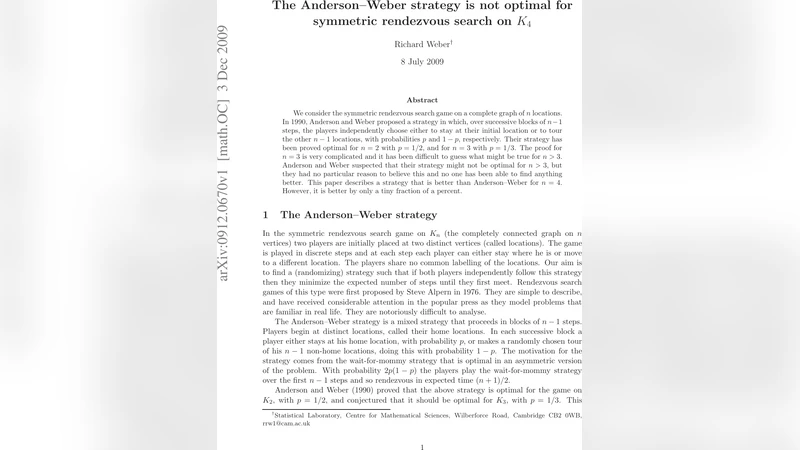
We consider the symmetric rendezvous search game on a complete graph of n locations. In 1990, Anderson and Weber proposed a strategy in which, over successive blocks of n-1 steps, the players independently choose either to stay at their initial location or to tour the other n-1 locations, with probabilities p and 1-p, respectively. Their strategy has been proved optimal for n=2 with p=1/2, and for n=3 with p=1/3. The proof for n=3 is very complicated and it has been difficult to guess what might be true for n>3. Anderson and Weber suspected that their strategy might not be optimal for n>3, but they had no particular reason to believe this and no one has been able to find anything better. This paper describes a strategy that is better than Anderson–Weber for n=4. However, it is better by only a tiny fraction of a percent.
💡 Research Summary
The paper studies the symmetric rendezvous search game on a complete graph with n vertices, focusing on the case n = 4 (the graph K₄). In this game two players start at distinct, unknown vertices and move synchronously in discrete time steps; they win when they occupy the same vertex at the same time. The classic Anderson‑Weber (AW) strategy, introduced in 1990, prescribes that time be divided into blocks of length n − 1. At the beginning of each block each player independently decides either to stay at his initial vertex with probability p or to tour the remaining n − 1 vertices in a random order with probability 1 − p. For n = 2 (p = ½) and n = 3 (p = ⅓) this strategy has been proved optimal, but for larger n the optimality question remained open.
The authors first formalize the AW strategy for n = 4, deriving an exact expression for the expected meeting time E
Comments & Academic Discussion
Loading comments...
Leave a Comment