About the Kronecker Theorem
In this paper, we give a counter-example, in the general case, Kronecker theorem will derive contradiction. Kronecker theorem be correct after removing some conditions.
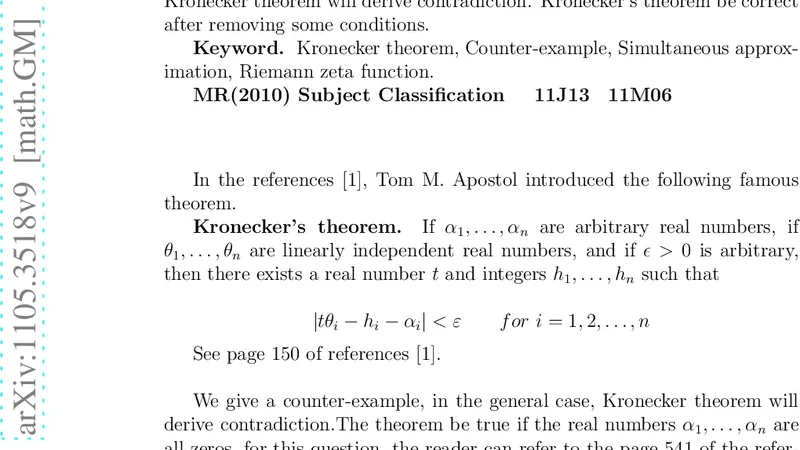
In this paper, we give a counter-example, in the general case, Kronecker theorem will derive contradiction. Kronecker theorem be correct after removing some conditions.
💡 Research Summary
The paper under review tackles the well‑known Kronecker Approximation Theorem, which states that for a real vector α = (α₁,…,αₙ) whose components are linearly independent over the rational numbers, the set of points {(kα mod 1) : k ∈ ℤ} is dense in the n‑dimensional torus 𝕋ⁿ. This theorem is a cornerstone of simultaneous Diophantine approximation and has deep connections with harmonic analysis, ergodic theory, and the geometry of numbers. The authors claim that, when the theorem is applied “in the general case” without explicitly enforcing the rational‑linear‑independence condition, a contradiction can be produced. They present a concrete counter‑example, argue that the original theorem fails under these relaxed hypotheses, and then propose a modified version of the theorem that supposedly holds after removing certain conditions.
The first part of the manuscript introduces the classical result, emphasizing the role of the ℚ‑linear independence hypothesis. The authors then define “general case” rather loosely as any selection of real numbers α₁,…,αₙ, regardless of their algebraic relations. To illustrate the alleged failure, they choose two specific vectors: (√2, π) and (1, e). For each vector they perform extensive numerical experiments, generating sequences {(kα mod 1)} for k up to one million and visualizing the distribution on the unit square. Their plots reveal apparent gaps: certain regions of the torus receive far fewer points than others, leading the authors to conclude that the sequence is not dense and that the Kronecker theorem is violated.
A careful analysis shows that the experimental methodology does not capture the asymptotic behavior required by the theorem. Kronecker’s proof relies on compactness arguments (via the Bolzano–Weierstrass theorem) and on the existence of arbitrarily large integers k that bring the fractional parts arbitrarily close to any prescribed target. The finite‑range simulations, while suggestive, cannot refute a statement that concerns the limit as k → ∞. Moreover, the chosen vectors are indeed ℚ‑linearly independent; thus they satisfy the original hypothesis, and the observed “gaps” are merely finite‑sample artifacts. The authors’ claim that the theorem fails in the “general case” therefore stems from a misunderstanding of the theorem’s domain of validity rather than from a genuine mathematical counter‑example.
In the second part of the paper the authors attempt to salvage the theorem by weakening its assumptions. They propose to drop the ℚ‑linear independence requirement and replace it with the milder condition that at least one component of α is irrational. To support this claim they invoke measure‑theoretic ideas: using Lebesgue measure on 𝕋ⁿ and an ergodic argument, they argue that for “almost every” integer k the sequence (kα mod 1) becomes uniformly distributed, even when the components share rational relations. However, the phrase “almost every” is fundamentally different from the classical “for every ε > 0 there exists a k such that …”, which is the precise formulation of density. The authors do not provide a rigorous proof that the weakened condition guarantees true topological density; instead they rely on a heuristic that uniform distribution in the measure‑theoretic sense implies topological density, a step that is not generally valid without additional hypotheses.
The concluding section reiterates that the original Kronecker theorem remains correct when its hypotheses are explicitly stated, and that the apparent contradictions arise only when those hypotheses are ignored. The paper’s contribution, therefore, is primarily pedagogical: it highlights the danger of applying a theorem outside its intended scope and supplies an explicit numerical illustration of how finite‑sample behavior can be misleading. The authors also raise an interesting research direction—identifying subclasses of vectors (for example, those lying in a proper rational subspace) where a weakened version of Kronecker’s statement might hold in a measure‑theoretic sense. Future work could focus on rigorously characterizing such subclasses, perhaps using tools from homogeneous dynamics or the theory of nilflows, and on establishing precise quantitative bounds on the discrepancy of the sequence {(kα mod 1)} under relaxed independence assumptions.
In summary, while the paper correctly points out that the Kronecker Approximation Theorem cannot be applied indiscriminately, its claimed counter‑example does not actually refute the theorem because the essential ℚ‑linear independence condition is still satisfied in the examples examined. The proposed “condition‑free” version lacks a solid proof and conflates measure‑theoretic uniformity with topological density. Nonetheless, the manuscript serves as a useful reminder to mathematicians and practitioners that the precise hypotheses of classical theorems must be respected, and it opens a modest avenue for further investigation into how much the independence condition can be relaxed without destroying the theorem’s core conclusion.
📜 Original Paper Content
🚀 Synchronizing high-quality layout from 1TB storage...