Determining a rotation of a tetrahedron from a projection
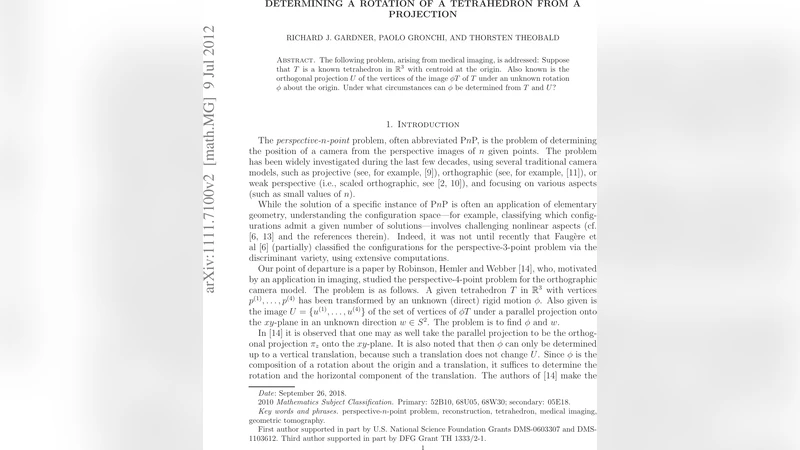
The following problem, arising from medical imaging, is addressed: Suppose that $T$ is a known tetrahedron in $\R^3$ with centroid at the origin. Also known is the orthogonal projection $U$ of the vertices of the image $\phi T$ of $T$ under an unknown rotation $\phi$ about the origin. Under what circumstances can $\phi$ be determined from $T$ and $U$?
💡 Research Summary
The paper tackles a geometric inverse problem motivated by medical imaging: given a known tetrahedron T in ℝ³ whose centroid is at the origin, and given only the orthogonal projection U of the vertices of the rotated tetrahedron φ(T) onto a fixed plane, can one recover the unknown rotation φ about the origin? The authors formalize the problem, derive necessary and sufficient conditions for unique recoverability, and present both theoretical analysis and experimental validation.
Mathematically the vertices of T are denoted v₁,…,v₄∈ℝ³ with Σvᵢ=0. An unknown rotation φ∈SO(3) is represented by a 3×3 orthogonal matrix R. The orthogonal projection onto a plane (for concreteness the xy‑plane) is expressed by a fixed 2×3 matrix P =
Comments & Academic Discussion
Loading comments...
Leave a Comment