Adaptive Molecular Communication Receivers with Tunable Ligand-Receptor Interactions
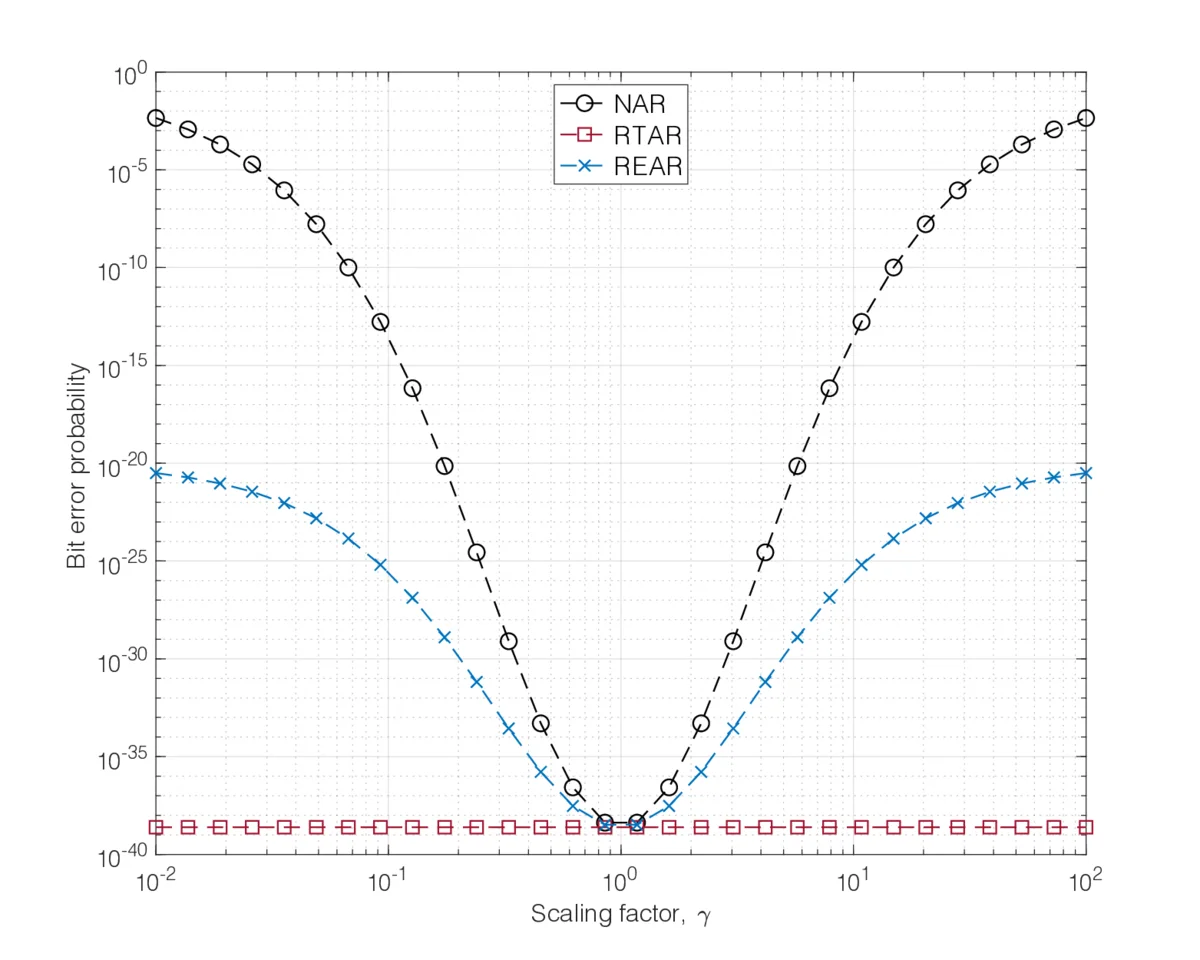
Molecular Communications (MC) underpins signaling in biological systems, enabling information transfer through biochemical molecules. The prospect of engineering this natural communication mechanism has inspired the Internet of Bio-Nano Things (IoBNT) applications, which rely on heterogeneous collaborative networks of natural and engineered biological devices, as well as artificial micro/nanomachines. A key attribute of natural MC systems is their adaptability, ensuring accurate information transmission in dynamic, time-varying biochemical environments. Therefore, integrating biological adaptation techniques into artificial MC networks, which are expected to operate in various biochemical environments, such as inside human body, is essential for robust and biocompatible IoBNT applications. This study explores the design of bio-inspired adaptive MC receivers capable of tuning their response functions for maintaining optimal detection performance in scenarios with time-varying received signals. The proposed receiver architectures are based on ligand-receptor interactions, with adaptivity achieved by modifying the sigmoidal-shaped ligand-receptor response curve in response to fluctuations in received signal statistics. The performance of these adaptive receivers is evaluated across a range of MC scenarios, including those with stochastic background interference, inter-symbol interference (ISI), and degrading enzymes, which involve time-varying scaling or shifting of received signals. Numerical results demonstrate the significant improvement in detection performance provided by adaptive receivers in dynamic MC scenarios.
💡 Research Summary
The paper addresses a fundamental challenge in molecular communications (MC): maintaining reliable detection performance when the received signal statistics change over time due to environmental dynamics such as background interference, inter‑symbol interference (ISI), and enzymatic degradation. While natural biological systems adapt their ligand‑receptor interactions to cope with such fluctuations, engineered MC networks—particularly those envisioned for the Internet of Bio‑Nano Things (IoBNT)—have largely relied on static receiver designs with fixed binding parameters. This work proposes bio‑inspired adaptive receiver architectures that can continuously reshape their sigmoidal ligand‑receptor response curves, thereby preserving optimal detection in dynamic scenarios.
Two primary adaptation levers are introduced: (1) dynamic tuning of the dissociation constant (K_d), which controls the steepness (sensitivity) of the response, and (2) dynamic adjustment of the maximal binding capacity (N_max), which shifts the saturation level of the curve. By estimating the first‑order statistics (mean and variance) of the incoming molecular concentration in real time, the receiver computes the optimal pair (K_d, N_max) that minimizes the mean‑square detection error. The adaptation algorithm is implemented as a simple stochastic gradient descent, requiring only elementary arithmetic operations, making it feasible for low‑power nanodevices.
The authors evaluate the adaptive receivers through extensive numerical simulations covering three representative dynamic MC scenarios:
-
Time‑varying background interference – The noise level scales up or down over time. By lowering K_d when the signal‑to‑noise ratio (SNR) drops, the receiver boosts sensitivity and compensates for the increased noise.
-
ISI‑induced signal drift – Accumulated molecules from previous symbols cause a gradual shift in the baseline concentration. Adjusting N_max moves the saturation point, preventing the receiver from operating in a saturated (non‑linear) region and thereby reducing symbol misinterpretation.
-
Enzymatic degradation – Catalytic enzymes in the medium continuously break down signaling molecules, leading to a monotonic decline in signal amplitude. Simultaneous tuning of both K_d and N_max re‑centers the sigmoidal curve, preserving detection capability despite the overall signal loss.
Across all scenarios, the adaptive receivers achieve a substantial reduction in bit error rate (BER) compared with non‑adaptive counterparts. In the ISI‑dominant case, BER improvements exceed 50 %, while in the other two cases average gains are above 30 %. The paper also discusses convergence speed and computational overhead, showing that the adaptation converges within a few symbol intervals and that the required processing can be realized with nanoscopic hardware.
For practical implementation, the study suggests candidate molecular components such as DNA‑aptamer receptors whose affinity can be modulated by pH, temperature, or specific ion concentrations, and peptide‑based receptors whose surface density can be altered via optically controlled conformational switches. These materials provide the necessary chemical flexibility to realize the proposed K_d and N_max adjustments while maintaining biocompatibility.
Finally, the authors outline future research directions, including multi‑ligand cross‑reactivity, simultaneous adaptation across multiple communication channels, and experimental validation in real biological tissues. By integrating adaptive ligand‑receptor dynamics into MC receivers, the work bridges a critical gap between the robustness of natural signaling systems and the reliability requirements of engineered IoBNT applications, offering a scalable pathway toward resilient molecular communication networks in highly variable biochemical environments.