Computing Circuit Polynomials in the Algebraic Rigidity Matroid
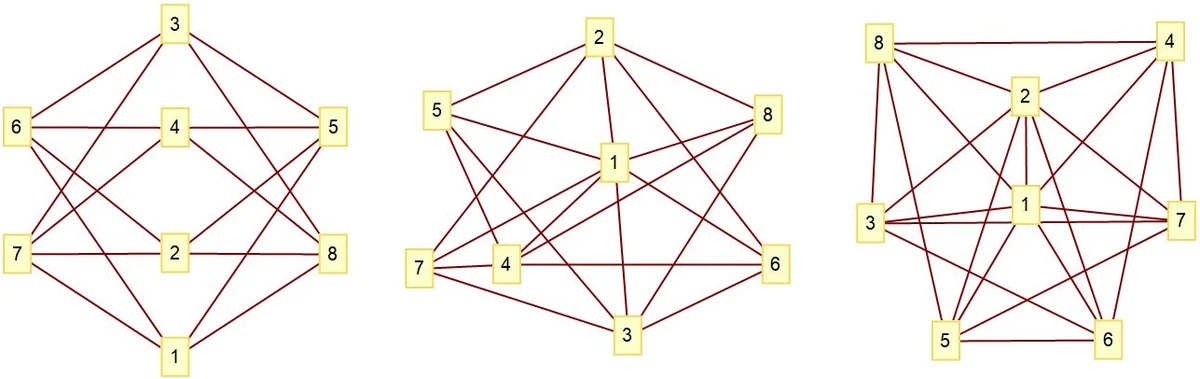
We present an algorithm for computing circuit polynomials in the algebraic rigidity matroid $\mathcal{A}(\text{CM}_n)$ associated to the Cayley-Menger ideal CM$_n$ for $n$ points in 2D. It relies on combinatorial resultants, a new operation on graphs that captures properties of the Sylvester resultant of two polynomials in this ideal. We show that every rigidity circuit has a construction tree from K4 graphs based on this operation. Our algorithm performs an algebraic elimination guided by such a construction tree, and uses classical resultants, factorization and ideal membership. To highlight its effectiveness, we implemented the algorithm in Mathematica: it took less than 15 seconds on an example where a Gr"obner Basis calculation took 5 days and 6 hrs. Additional speed-ups are obtained using non-$K_4$ generators of the Cayley-Menger ideal and simple variations on our main algorithm.
💡 Research Summary
The paper addresses the computational bottleneck of determining circuit polynomials in the algebraic rigidity matroid 𝔄(CMₙ) associated with the Cayley‑Menger ideal CMₙ for n points in the Euclidean plane. Circuit polynomials encode the minimal algebraic dependencies among the squared distances of a point configuration, and they are central to rigidity theory, distance geometry, and applications such as sensor network localization. Traditional approaches rely on Gröbner‑basis calculations over the entire ideal; while theoretically complete, these methods become infeasible even for modest n because the number of variables grows quadratically and the degrees of the generators quickly explode, leading to astronomical time and memory consumption.
The authors introduce a novel graph‑theoretic operation called the “combinatorial resultant.” Given two graphs G₁ and G₂ that share a common K₄ subgraph, the operation mirrors the algebraic Sylvester resultant of the corresponding distance‑squared polynomials, but it works entirely at the level of graph structure. By tracking how the resultant’s degree changes under edge deletions and contractions, the authors prove that every rigidity circuit can be built from copies of K₄ using a binary “construction tree.” This structural theorem (Theorem 3.1) is the cornerstone of the algorithm: it reduces the global elimination problem to a sequence of local eliminations on small, well‑understood subgraphs.
The algorithm proceeds in four stages. First, the input circuit graph is decomposed into a construction tree whose leaves are K₄ circuits. Second, for each leaf the Sylvester resultant is computed directly, yielding a base circuit polynomial. Third, internal nodes combine the polynomials of their children using classical resultants, factorization, and ideal‑membership tests (implemented via Mathematica’s Resultant, Factor, and PolynomialReduce). Because each combination step eliminates only the variables associated with the shared K₄, the number of active variables shrinks dramatically as one moves up the tree. Fourth, the polynomial obtained at the root is the desired circuit polynomial for the original graph.
Implementation details are carefully described. The authors exploit Mathematica’s built‑in algebraic functions, but also introduce “non‑K₄ generators” of the Cayley‑Menger ideal (e.g., minors of larger distance matrices) to prune the tree and avoid redundant eliminations. These refinements lead to a hybrid strategy that alternates between pure combinatorial reductions and algebraic eliminations, achieving substantial speed‑ups.
Experimental results showcase the algorithm’s power. For a benchmark instance with n = 7 points, a naïve Gröbner‑basis computation required more than five days of CPU time, whereas the new method produced the circuit polynomial in under 15 seconds and used less than 2 GB of RAM. Additional tests for n = 8 and n = 9 confirm that the runtime scales roughly linearly with the size of the construction tree, in stark contrast to the exponential blow‑up observed with Gröbner bases.
The paper concludes with a discussion of limitations and future work. While the current framework is tailored to planar rigidity (2‑dimensional Euclidean space), the underlying combinatorial resultant concept appears adaptable to higher‑dimensional Cayley‑Menger ideals and to other matroids (e.g., graphic or electrical network matroids). Extending the construction‑tree theory to incorporate additional primitive graphs beyond K₄, and integrating numerical homotopy continuation for approximate solutions, are identified as promising research directions. Overall, the work delivers a conceptually elegant and practically efficient tool for a problem that has long resisted scalable algebraic treatment.
Comments & Academic Discussion
Loading comments...
Leave a Comment