Lifex-cfd: an Open-source Computational Fluid Dynamics Solver for Cardiovascular Applications
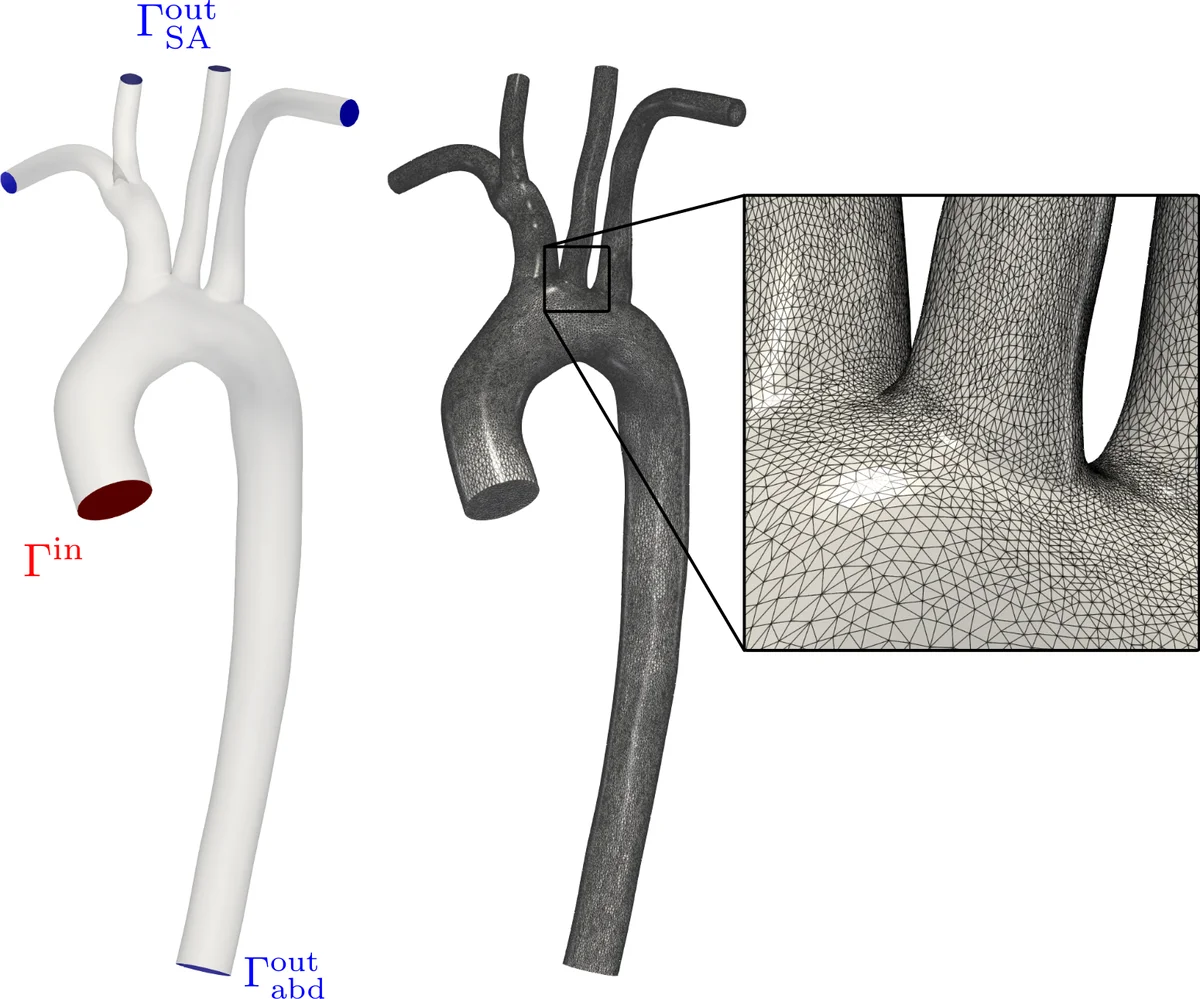
Computational fluid dynamics (CFD) is an important tool for the simulation of the cardiovascular function and dysfunction. Due to the complexity of the anatomy, the transitional regime of blood flow in the heart, and the strong mutual influence between the flow and the physical processes involved in the heart function, the development of accurate and efficient CFD solvers for cardiovascular flows is still a challenging task. In this paper we present lifex-cfd, an open-source CFD solver for cardiovascular simulations based on the lifex finite element library, written in modern C++ and exploiting distributed memory parallelism. We model blood flow in both physiological and pathological conditions via the incompressible Navier-Stokes equations, accounting for moving cardiac valves, moving domains, and transition-to-turbulence regimes. In this paper, we provide an overview of the underlying mathematical formulation, numerical discretization, implementation details and examples on how to use lifex-cfd. We verify the code through rigorous convergence analyses, and we show its almost ideal parallel speedup. We demonstrate the accuracy and reliability of the numerical methods implemented through a series of idealized and patient-specific vascular and cardiac simulations, in different physiological flow regimes. The lifex-cfd source code is available under the LGPLv3 license, to ensure its accessibility and transparency to the scientific community, and to facilitate collaboration and further developments.
💡 Research Summary
The paper presents lifex‑cfd, an open‑source computational fluid dynamics (CFD) solver specifically designed for cardiovascular applications. Built on the modern C++ (C++17+) lifex library, which itself extends the deal.II finite‑element framework, lifex‑cfd exploits MPI‑based distributed‑memory parallelism to achieve near‑ideal scaling on thousands of cores. The physical model treats blood as an incompressible Newtonian fluid governed by the Navier‑Stokes equations formulated in an Arbitrary Lagrangian‑Eulerian (ALE) reference frame, thereby accommodating moving cardiac chambers and deformable vessels. Domain displacement is obtained either by harmonic extension or by solving a fictitious linear‑elastic problem, with user‑controllable stiffness weighting to preserve mesh quality near moving boundaries. Cardiac valves are represented using the Resistive Immersed Implicit Surface (RIIS) method: each valve is described by a signed distance function, a thin layer thickness, and a resistance coefficient, which weakly enforces a no‑slip condition without explicit structural meshes. Numerically, the solver employs continuous finite elements (tetrahedral or hexahedral) with SUPG/PSPG stabilization for laminar flow and a Variational Multiscale Large‑Eddy Simulation (VMS‑LES) model for transitional‑to‑turbulent regimes. Time integration supports BDF of orders 1–3 and the Generalized‑α scheme, while non‑linear iterations use Picard or predictor‑corrector approaches. Linear systems can be solved with Trilinos, PETSc, or deal.II back‑ends, offering GMRES, FGMRES, CG and a variety of preconditioners (AMG, BoomerAMG, additive Schwarz, etc.). The code is driven by human‑readable parameter files, includes checkpoint/restart capabilities, and provides a flexible boundary‑condition framework. Verification is performed through classical convergence tests and the Beltrami flow benchmark, demonstrating the expected order of accuracy and almost perfect parallel efficiency. A suite of idealized and patient‑specific cases—ranging from simple pipe flows to full heart chambers with moving valves and transition‑to‑turbulence—illustrates the solver’s accuracy, robustness, and applicability to real clinical scenarios. Compared with existing open‑source tools (FEBio, CHeart, simVascular, IBAMR, Oasis, ExaDG, Lethe, OpenFOAM, FEniCS), lifex‑cfd uniquely integrates moving domains, immersed valve modeling, and multi‑physics coupling (electrophysiology, mechanics, FSI) within a single, high‑performance framework. Released under the LGPL‑v3 license, the source code, binaries, and all test data are publicly available, promoting reproducibility, community collaboration, and further development. The authors conclude that lifex‑cfd offers a comprehensive, accurate, and scalable solution for cutting‑edge cardiovascular CFD research.
Comments & Academic Discussion
Loading comments...
Leave a Comment