Large orbits, projective Fraisse limits, and the pseudo-arc
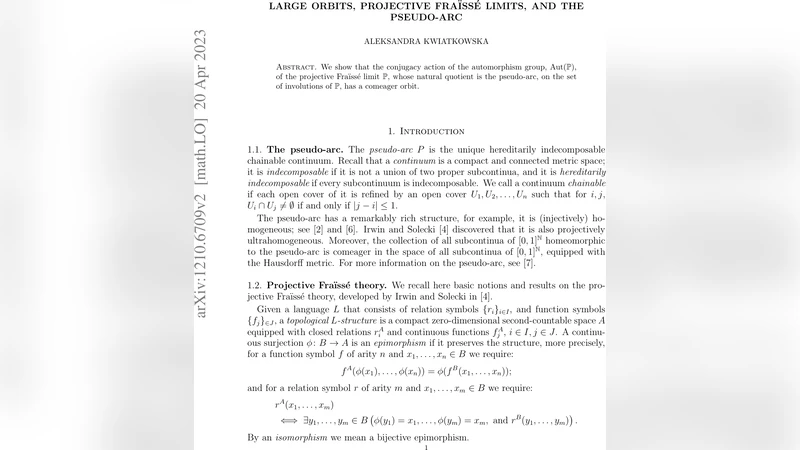
We show that the conjugacy action of the automorphism group ${\rm Aut}(\mathbb{P})$, of the projective Fra"{i}ss'{e} limit $\mathbb{P}$, whose natural quotient is the pseudo-arc, on the set of involutions of $\mathbb{P}$, has a comeager orbit.
💡 Research Summary
The paper investigates the dynamical properties of the automorphism group of a projective Fraïssé limit whose natural quotient is the pseudo‑arc, a classic hereditarily indecomposable continuum. The authors first construct the projective Fraïssé limit 𝔓 by considering an inverse system of finite discrete structures together with surjective bonding maps that satisfy the joint embedding and amalgamation properties in the projective sense. This inverse limit is a compact metrizable space equipped with a rich relational language; its canonical equivalence relation collapses 𝔓 onto the pseudo‑arc, thereby providing a concrete combinatorial model for that continuum.
Having established 𝔓, the authors turn to its automorphism group Aut(𝔓). As a closed subgroup of the Polish group of homeomorphisms of a compact metric space, Aut(𝔓) itself is Polish and acts continuously on 𝔓. The focus is on the set Inv(𝔓) of involutions—elements of order two—in Aut(𝔓). Involutions are natural “mirrors” of the structure, and understanding their conjugacy dynamics sheds light on the overall symmetry of the limit.
The main theorem states that the conjugacy action of Aut(𝔓) on Inv(𝔓) possesses a comeager orbit. In descriptive set‑theoretic terms, there exists a single conjugacy class that is a dense Gδ subset of Inv(𝔓). To prove this, the authors adapt the Kechris‑Rosendal framework for large orbits in Polish groups. They show that for any two involutions σ, τ ∈ Inv(𝔓) and any non‑empty open neighbourhood U of σ, one can find an involution ρ ∈ U that extends a sufficiently large common finite substructure of σ and τ. This “extension property” relies heavily on the projective amalgamation property of the underlying Fraïssé system, which guarantees the existence of a finite structure embedding both σ‑ and τ‑restrictions while preserving the involution condition. By iterating this construction and applying the Baire Category Theorem, they obtain a dense Gδ set of involutions all conjugate to each other, establishing the comeager orbit.
The theorem has two immediate consequences. First, it shows that Aut(𝔓) is topologically “turbulent” in the sense that its action on involutions is highly homogeneous; generic involutions are indistinguishable up to conjugacy. Second, it links the extreme topological homogeneity of the pseudo‑arc (every non‑degenerate subcontinuum is homeomorphic to the whole) with a strong algebraic homogeneity of its combinatorial model. This bridges the gap between continuum theory and modern descriptive dynamics.
In the final section the authors discuss potential extensions. The same technique should apply to other projective Fraïssé limits whose quotients are well‑studied continua, such as the Lelek fan or the pseudo‑circle. Moreover, the existence of a comeager conjugacy class of involutions suggests that similar large‑orbit phenomena may hold for other finite‑order elements or even for the full automorphism group acting on the space of all self‑embeddings. The paper thus opens a promising line of research at the intersection of model theory, continuum topology, and Polish group dynamics.
Comments & Academic Discussion
Loading comments...
Leave a Comment