Least Squares estimation of two ordered monotone regression curves
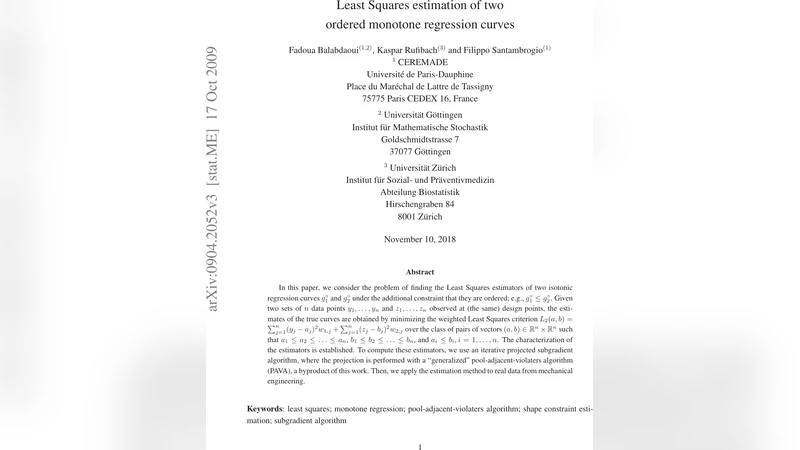
In this paper, we consider the problem of finding the Least Squares estimators of two isotonic regression curves $g^\circ_1$ and $g^\circ_2$ under the additional constraint that they are ordered; e.g., $g^\circ_1 \le g^\circ_2$. Given two sets of $n$ data points $y_1, …, y_n$ and $z_1, >…,z_n$ observed at (the same) design points, the estimates of the true curves are obtained by minimizing the weighted Least Squares criterion $L_2(a, b) = \sum_{j=1}^n (y_j - a_j)^2 w_{1,j}+ \sum_{j=1}^n (z_j - b_j)^2 w_{2,j}$ over the class of pairs of vectors $(a, b) \in \mathbb{R}^n \times \mathbb{R}^n $ such that $a_1 \le a_2 \le …\le a_n $, $b_1 \le b_2 \le …\le b_n $, and $a_i \le b_i, i=1, …,n$. The characterization of the estimators is established. To compute these estimators, we use an iterative projected subgradient algorithm, where the projection is performed with a “generalized” pool-adjacent-violaters algorithm (PAVA), a byproduct of this work. Then, we apply the estimation method to real data from mechanical engineering.
💡 Research Summary
The paper tackles the problem of jointly estimating two monotone (non‑decreasing) regression curves, (g^{\circ}_1) and (g^{\circ}_2), under the additional requirement that they are ordered point‑wise, i.e., (g^{\circ}1(x_i)\le g^{\circ}2(x_i)) for all design points (x_i). The data consist of two response vectors (\mathbf y=(y_1,\dots ,y_n)) and (\mathbf z=(z_1,\dots ,z_n)) observed at the same covariate locations. Each observation is weighted by positive factors (w{1,i}) and (w{2,i}), reflecting differing measurement precisions. The authors formulate a weighted least‑squares criterion
\
Comments & Academic Discussion
Loading comments...
Leave a Comment