b-coloring is NP-hard on co-bipartite graphs and polytime solvable on tree-cographs
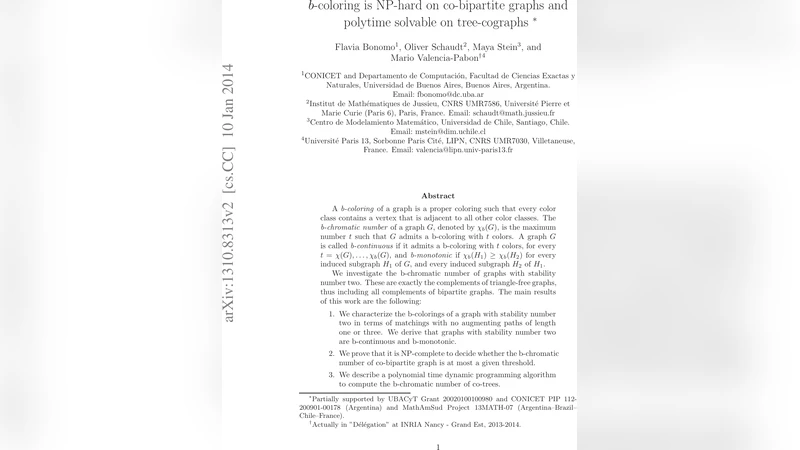
A b-coloring of a graph is a proper coloring such that every color class contains a vertex that is adjacent to all other color classes. The b-chromatic number of a graph G, denoted by \chi_b(G), is the maximum number t such that G admits a b-coloring with t colors. A graph G is called b-continuous if it admits a b-coloring with t colors, for every t = \chi(G),\ldots,\chi_b(G), and b-monotonic if \chi_b(H_1) \geq \chi_b(H_2) for every induced subgraph H_1 of G, and every induced subgraph H_2 of H_1. We investigate the b-chromatic number of graphs with stability number two. These are exactly the complements of triangle-free graphs, thus including all complements of bipartite graphs. The main results of this work are the following: - We characterize the b-colorings of a graph with stability number two in terms of matchings with no augmenting paths of length one or three. We derive that graphs with stability number two are b-continuous and b-monotonic. - We prove that it is NP-complete to decide whether the b-chromatic number of co-bipartite graph is at most a given threshold. - We describe a polynomial time dynamic programming algorithm to compute the b-chromatic number of co-trees. - Extending several previous results, we show that there is a polynomial time dynamic programming algorithm for computing the b-chromatic number of tree-cographs. Moreover, we show that tree-cographs are b-continuous and b-monotonic.
💡 Research Summary
This paper investigates the b‑coloring problem on graphs whose stability number (the size of a maximum independent set) is at most two. Such graphs are precisely the complements of triangle‑free graphs, which include all complements of bipartite graphs. The authors develop a deep structural connection between b‑colorings and matchings in these graphs, showing that a proper coloring is a b‑coloring if and only if the set of edges joining vertices of the same color forms a strongly maximal matching—a matching that admits no augmenting paths of length one or three.
Using this characterization, they prove two fundamental properties for the whole class: (i) b‑continuity – every integer between the chromatic number χ(G) and the b‑chromatic number χ_b(G) can be realized by a b‑coloring; (ii) b‑monotonicity – deleting any vertex never increases χ_b. Both results follow from the ability to increase or decrease the size of a strongly maximal matching by a single edge via a minimum‑length augmenting path, which can be found in polynomial time by a slight modification of Edmonds’ blossom algorithm.
The paper then turns to computational complexity. By reducing from the Minimum Maximal Matching problem (known to be NP‑complete even on bipartite graphs, due to Yannakakis and Gavril), the authors construct, for any bipartite graph G, a larger bipartite graph H_G in which each original edge is replaced by a gadget of eight new vertices and nine new edges. They prove that H_G possesses a strongly maximal matching of size at most k if and only if the original co‑bipartite graph (the complement of G) admits a b‑coloring with at least k colors. Consequently, deciding whether a co‑bipartite graph admits a b‑coloring with a given number of colors is NP‑complete (Theorem 7).
Despite this hardness, the authors identify two important subclasses where χ_b can be computed efficiently. For co‑trees (the complements of trees) they devise a dynamic‑programming scheme that processes the tree decomposition bottom‑up, storing for each subtree the feasible pairs (matching size, number of colors). The algorithm runs in polynomial time (roughly O(n·Δ²)) and yields the exact b‑chromatic number.
Extending this approach, they handle tree‑cographs, a family obtained by recursively combining trees and cographs (complement‑reducible graphs). By exploiting the cotree representation of cographs together with the tree decomposition, they construct a DP that merges the information of modules according to well‑defined composition rules. The resulting algorithm runs in O(n³) time (or better with refined implementations) and also guarantees b‑continuity and b‑monotonicity for tree‑cographs.
In summary, the paper makes four major contributions:
- A precise matching‑based characterization of b‑colorings for graphs with stability number two.
- Proof that this class is both b‑continuous and b‑monotonic.
- An NP‑completeness proof for the b‑coloring decision problem on co‑bipartite graphs via a gadget reduction from Minimum Maximal Matching.
- Polynomial‑time dynamic‑programming algorithms for computing χ_b on co‑trees and tree‑cographs, together with the derived structural properties.
These results deepen the theoretical understanding of b‑colorings, delineate the boundary between tractable and intractable instances, and provide practical algorithms for important graph families that arise in applications such as scheduling, frequency assignment, and network design.
Comments & Academic Discussion
Loading comments...
Leave a Comment