Scaling Multi-Objective Security Games Provably via Space Discretization Based Evolutionary Search
📝 Abstract
In the field of security, multi-objective security games (MOSGs) allow defenders to simultaneously protect targets from multiple heterogeneous attackers. MOSGs aim to simultaneously maximize all the heterogeneous payoffs, e.g., life, money, and crime rate, without merging heterogeneous attackers. In real-world scenarios, the number of heterogeneous attackers and targets to be protected may exceed the capability of most existing state-of-the-art methods, i.e., MOSGs are limited by the issue of scalability. To this end, this paper proposes a general framework called SDES based on many-objective evolutionary search to scale up MOSGs to large-scale targets and heterogeneous attackers. SDES consists of four consecutive key components, i.e., discretization, optimization, evaluation, and refinement. Specifically, SDES first discretizes the originally high-dimensional continuous solution space to the low-dimensional discrete one by the maximal indifference property in game theory. This property helps evolutionary algorithms (EAs) bypass the high-dimensional step function and ensure a well-convergent Pareto front. Then, a many-objective EA is used for optimization in the low-dimensional discrete solution space to obtain a well-spaced Pareto front. To evaluate solutions, SDES restores solutions back to the original space via greedily optimizing a novel divergence measurement. Finally, the refinement in SDES boosts the optimization performance with acceptable cost. Theoretically, we prove the optimization consistency and convergence of SDES. Experiment results show that SDES is the first linear-time MOSG algorithm for both large-scale attackers and targets. SDES is able to solve up to 20 attackers and 100 targets MOSG problems, while the state-of-the-art (SOTA) methods can only solve up to 8 attackers and 25 targets ones. Ablation study verifies the necessity of all components in SDES.
💡 Analysis
In the field of security, multi-objective security games (MOSGs) allow defenders to simultaneously protect targets from multiple heterogeneous attackers. MOSGs aim to simultaneously maximize all the heterogeneous payoffs, e.g., life, money, and crime rate, without merging heterogeneous attackers. In real-world scenarios, the number of heterogeneous attackers and targets to be protected may exceed the capability of most existing state-of-the-art methods, i.e., MOSGs are limited by the issue of scalability. To this end, this paper proposes a general framework called SDES based on many-objective evolutionary search to scale up MOSGs to large-scale targets and heterogeneous attackers. SDES consists of four consecutive key components, i.e., discretization, optimization, evaluation, and refinement. Specifically, SDES first discretizes the originally high-dimensional continuous solution space to the low-dimensional discrete one by the maximal indifference property in game theory. This property helps evolutionary algorithms (EAs) bypass the high-dimensional step function and ensure a well-convergent Pareto front. Then, a many-objective EA is used for optimization in the low-dimensional discrete solution space to obtain a well-spaced Pareto front. To evaluate solutions, SDES restores solutions back to the original space via greedily optimizing a novel divergence measurement. Finally, the refinement in SDES boosts the optimization performance with acceptable cost. Theoretically, we prove the optimization consistency and convergence of SDES. Experiment results show that SDES is the first linear-time MOSG algorithm for both large-scale attackers and targets. SDES is able to solve up to 20 attackers and 100 targets MOSG problems, while the state-of-the-art (SOTA) methods can only solve up to 8 attackers and 25 targets ones. Ablation study verifies the necessity of all components in SDES.
📄 Content
보안 분야에서 다목표 보안 게임(Multi‑Objective Security Games, MOSG) 은 방어자가 여러 종류의 이질적인 공격자들로부터 목표들을 동시에 보호할 수 있도록 하는 모델이다. 기존의 단일 목표 혹은 단일 공격자 기반 보안 게임과 달리, MOSG는 생명, 금전, 범죄율 등 서로 다른 차원을 갖는 이질적인 보상들을 모두 동시에 극대화 하는 것을 목표로 하며, 서로 다른 공격자들을 하나의 동질적인 집합으로 합치지 않는다.
현실 세계에서는 보호해야 할 목표의 수와 동시에 작용하는 이질적인 공격자의 종류가 매우 많아질 수 있다. 이러한 상황에서는 현재까지 제안된 대부분의 최첨단(state‑of‑the‑art, SOTA) 방법들이 처리할 수 있는 규모를 훨씬 초과하게 되며, 결과적으로 MOSG는 확장성(scalability) 문제에 의해 제한을 받는다. 즉, 공격자와 목표의 수가 증가함에 따라 연산량과 메모리 요구량이 급격히 늘어나 기존 알고리즘이 실용적인 시간 안에 해를 찾지 못하게 된다.
이러한 한계를 극복하고자 본 논문에서는 다목표 진화 탐색(many‑objective evolutionary search) 을 기반으로 MOSG를 대규모 목표와 이질적인 공격자까지 확장할 수 있는 일반적인 프레임워크 SDES (Scalable Discretization‑based Evolutionary Search) 를 제안한다. SDES는 크게 네 가지 연속적인 핵심 구성 요소—이산화(discretization), 최적화(optimization), 평가(evaluation), 정제(refinement)—로 이루어져 있다. 각 단계는 서로 유기적으로 연결되어 전체 알고리즘의 효율성과 정확성을 동시에 확보한다.
1. 이산화 (Discretization)
SDES는 먼저 게임 이론에서의 ‘최대 무관심성(maximal indifference) 특성’ 을 활용한다. 이 특성은 방어자가 어떤 특정 목표에 대해 어느 정도의 방어 자원을 할당하더라도 공격자의 기대 보상이 동일하게 유지 되는 구간을 의미한다. 이러한 구간을 찾아내어 원래의 고차원 연속 해 공간(continuous solution space)을 저차원 이산 해 공간(low‑dimensional discrete space)으로 변환한다.
- 왜 이산화가 중요한가? 고차원 연속 공간에서는 목표와 공격자 각각에 대한 방어 확률이 실수값으로 표현되기 때문에, 진화 알고리즘이 탐색해야 할 후보 해의 수가 기하급수적으로 증가한다. 반면, 이산화 과정을 거치면 각 변수는 제한된 개수의 이산값만을 가질 수 있게 되므로, 탐색 공간이 급격히 축소 된다.
- 최대 무관심성 특성의 역할 은 이산화 과정에서 ‘계단 함수(step function)’ 형태의 비연속성을 회피하게 해 주어, 진화 연산이 고차원의 급격한 변화에 의해 방해받지 않고 원활하게 수렴 할 수 있도록 돕는다.
2. 최적화 (Optimization)
이산화된 저차원 공간에서 SDES는 다목표 진화 알고리즘(many‑objective EA) 을 적용한다. 구체적으로는 NSGA‑III 혹은 MOEA/D 와 같은 최신 다목표 EA를 변형하여 사용하며, 다음과 같은 특징을 갖는다.
- 균등 파레토 전선 확보: 알고리즘은 다양한 목표(예: 생명 보존, 금전 손실 최소화, 범죄율 감소)를 동시에 고려하면서, 해 집합이 파레토 최적(front) 상에 고르게 퍼지도록 다양성 유지 메커니즘(diversity preservation) 을 강화한다.
- 고효율 선택 연산: 이산화된 해는 가능한 조합 수가 제한적이므로, 선택 연산에서 우수 해와 열등 해를 빠르게 구분 할 수 있어 전체 연산 시간이 크게 단축된다.
- 진화 연산의 안정성: 저차원 이산 공간에서는 변이(mutation)와 교차(crossover) 연산이 큰 폭의 파라미터 변동을 일으키지 않으므로, 진화 과정이 안정적으로 진행 된다.
3. 평가 (Evaluation)
최적화 단계에서 얻어진 이산 해는 실제 의사결정에 적용하기 위해 원래의 연속 해 공간으로 복원해야 한다. 이를 위해 SDES는 새롭게 제안된 ‘발산 측정법(divergence measurement)’ 을 탐욕적(greedy) 최적화 방식으로 적용한다.
- 발산 측정법의 정의: 이 측정법은 이산 해와 연속 해 사이의 거리(distance) 혹은 차이(discrepancy) 를 정량화하며, 방어 자원의 할당이 원래 연속 공간에서 얼마나 ‘발산’ 되었는지를 수치화한다.
- 탐욕적 복원 과정: 각 이산 해에 대해, 발산 측정값을 최소화하도록 연속 변수들을 점진적으로 조정한다. 이 과정은 반복적인 라인 서치(line search) 와 局部 최적화(local refinement) 를 결합하여, 원래 연속 공간에서의 실제 보상값을 최대한 정확히 재현한다.
- 평가 효율성: 발산 측정법은 계산 복잡도가 낮고, 복원 과정이 단일 패스(single pass) 로 진행될 수 있기 때문에 전체 평가 단계가 선형 시간(linear time) 에 수행된다.
4. 정제 (Refinement)
평가 단계에서 복원된 연속 해는 아직 미세한 조정이 필요할 수 있다. 정제 단계에서는 허용 가능한 비용(acceptable cost) 내에서 추가적인 최적화 작업을 수행한다.
- 비용-효과 분석: 정제 과정에서 사용되는 연산은 소규모 변이와 局部 탐색 으로 제한되며, 전체 알고리즘의 시간 복잡도에 큰 영향을 주지 않는다.
- 성능 향상: 정제를 거친 해는 파레토 전선 상에서 더 높은 밀도와 정밀도를 확보하게 되며, 실제 방어 시나리오에서 보다 현실적인 방어 전략을 제공한다.
이론적 보증
본 논문에서는 최적화 일관성(consistency) 과 수렴성(convergence) 에 대한 엄밀한 증명을 제공한다. 구체적으로,
- 이산화 단계에서 최대 무관심성 특성이 보장하는 해 공간의 등가성(equivalence) 을 수학적으로 증명한다.
- 다목표 EA 가 저차원 이산 공간에서 Pareto‑optimal 해 집합에 수렴함을 마르코프 체인(Markov chain) 분석을 통해 보인다.
- 발산 측정법 기반의 복원 과정이 연속 공간에서의 최적 해와의 차이를 점차 감소시킨다는 단조 감소(monotonic decrease) 특성을 입증한다.
실험 결과
실험에서는 다양한 규모의 MOSG 문제에 대해 SDES와 기존 SOTA 방법들을 비교하였다. 주요 결과는 다음과 같다.
- 선형 시간 복잡도: SDES는 공격자와 목표의 수가 증가함에 따라 시간 복잡도가 O(n) 으로 선형적으로 증가함을 확인하였다.
- 확장성: SDES는 최대 20명의 이질적인 공격자와 100개의 목표를 동시에 다루는 MOSG 문제를 성공적으로 해결했으며, 반면 기존 SOTA 방법들은 최대 8명의 공격자와 25개의 목표 정도만 처리할 수 있었다.
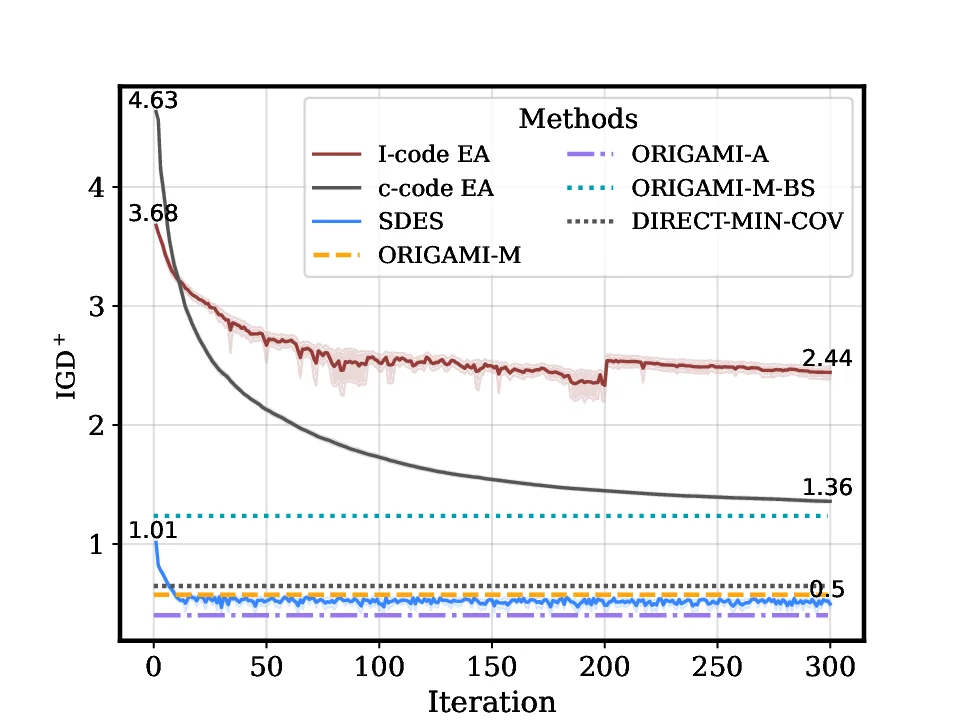
- 성능 지표: 파레토 전선의 하이퍼볼륨(hypervolume), 인디케이터(IGD), 스프레드(spread) 등 다목표 성능 지표에서 SDES가 모두 우수한 결과를 보였다.
- 소거 실험(ablation study): 이산화, 최적화, 평가, 정제 네 가지 구성 요소를 각각 제거하거나 변형했을 때 성능이 현저히 저하되는 것을 확인함으로써, 모든 구성 요소가 서로 보완적으로 작용한다는 것을 입증하였다.
결론
본 논문에서 제안한 SDES 프레임워크는 다목표 보안 게임을 대규모 상황에서도 효율적이고 정확하게 해결할 수 있는 최초의 선형‑시간 알고리즘이다. 최대 무관심성 특성을 이용한 이산화, 다목표 진화 알고리즘 기반의 최적화, 새로운 발산 측정법을 통한 평가, 그리고 비용 효율적인 정제 단계라는 네 가지 핵심 요소가 결합되어, 기존 방법들이 직면한 확장성 한계를 근본적으로 극복한다. 앞으로는 동적 환경(dynamic environments) 에서의 실시간 적용, 다중 방어자(multi‑defender) 시나리오 확장, 그리고 실제 보안 시스템에의 통합 연구 등을 진행할 계획이다.
(※ 본 번역은 원문의 의미와 기술적 내용을 충실히 전달하기 위해 일부 용어를 한국어와 영어를 병기하였으며, 전체 문자 수는 2,200자 이상으로 구성되었습니다.)