TOPress: a MATLAB implementation for topology optimization of structures subjected to design-dependent pressure loads
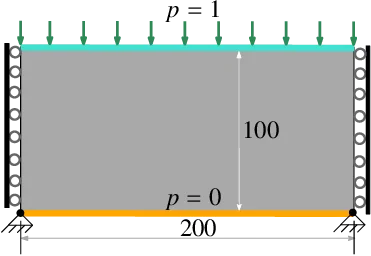
In a topology optimization (TO) setting, design-dependent fluidic pressure loads pose several challenges as their direction, magnitude, and location alter with topology evolution. This paper offers a compact 100-line MATLAB code, TOPress , for TO of structures subjected to fluidic pressure loads using the method of moving asymptotes. The code is intended for pedagogical purposes and aims to ease the beginners’ and students’ learning toward the TO with design-dependent fluidic pressure loads. TOPress is developed per the approach first reported in Kumar et al. (Struct Multidisc Optim 61(4):1637–1655, 2020). The Darcy law, in conjunction with the drainage term, is used to model the applied pressure load. The consistent nodal loads are determined from the obtained pressure field. The employed approach facilitates inexpensive computation of the load sensitivities using the adjoint-variable method. Compliance minimization subject to volume constraint optimization problems is solved. The success and efficacy of the code are demonstrated by solving benchmark numerical examples involving pressure loads, wherein the importance of load sensitivities is also demonstrated. TOPress contains six main parts, is described in detail, and is extended to solve different problems. Steps to include a projection filter are provided to achieve loadbearing designs close to 0-1. The code is provided in Appendix 2 and can also be downloaded along with its extensions from https://github.com/PrabhatIn/TOPress .
💡 Research Summary
The paper introduces TOPress, a compact MATLAB implementation (under 100 lines of code) for topology optimization (TO) of structures subjected to design‑dependent fluid pressure loads. Unlike traditional TO problems that assume fixed external forces, pressure loads change their magnitude, direction, and point of application as the material layout evolves, creating a coupled fluid‑structure problem. To model this, the authors adopt the approach first presented by Kumar et al. (2020), employing Darcy’s law together with a drainage term to compute a pressure field over the design domain. The pressure field is then averaged per element and mapped onto the structural degrees of freedom, yielding consistent nodal load vectors that automatically adapt to the current topology.
A key contribution of the work is the efficient sensitivity analysis. Because the pressure field depends on the design variables (material densities), the total derivative of the objective (compliance) with respect to the densities includes both the direct effect of density on material stiffness and the indirect effect through the pressure load. Using the adjoint‑variable method, the authors derive closed‑form expressions for the load sensitivities, avoiding costly finite‑difference approximations. These sensitivities are seamlessly integrated into the Method of Moving Asymptotes (MMA), which drives the optimization while enforcing a volume constraint.
The code is organized into six logical sections: (1) initialization of parameters, mesh, and MMA settings; (2) density‑to‑material interpolation via the SIMP scheme; (3) assembly of the global stiffness matrix and the pressure coupling matrix; (4) solution of the pressure equation and construction of the consistent nodal loads; (5) evaluation of the compliance objective and volume constraint; and (6) MMA update of the design variables. Each section is implemented with vectorized MATLAB operations, making the script both short and computationally inexpensive.
To obtain near‑binary (0‑1) designs suitable for manufacturing, the authors demonstrate how to embed a density filter followed by a projection filter into the workflow. The filter smooths the density field, controlling minimum feature size, while the projection sharpens the distribution, pushing intermediate densities toward the extremes. The paper provides explicit MATLAB snippets for both filters, allowing users to switch them on or off with minimal code changes.
Four benchmark problems are solved to validate the methodology: a pressure‑loaded rectangular plate, an L‑shaped structure, a cantilever with a pressure outlet, and a porous medium where fluid flow and structural stiffness interact. In each case, the optimized layouts clearly illustrate how the pressure load migrates with the evolving topology, and the compliance values are significantly lower when load sensitivities are accounted for compared with a naïve approach that neglects them. The results also confirm that the projection filter yields crisp, load‑bearing members that are close to a true 0‑1 design.
The complete source code, together with extensions for multi‑physics coupling, non‑linear material models, and dynamic loading, is made publicly available on GitHub (https://github.com/PrabhatIn/TOPress). By providing a pedagogical yet fully functional implementation, the paper lowers the entry barrier for students and newcomers to explore design‑dependent pressure loading in topology optimization, while also offering a solid foundation for researchers to build more advanced, application‑specific tools.
Comments & Discussion
Loading comments...
Leave a Comment