Nominal Unification from a Higher-Order Perspective
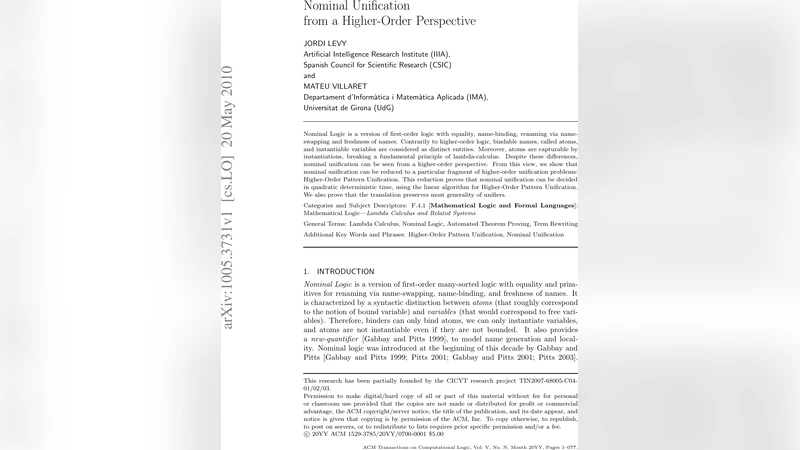
Nominal Logic is a version of first-order logic with equality, name-binding, renaming via name-swapping and freshness of names. Contrarily to higher-order logic, bindable names, called atoms, and instantiable variables are considered as distinct entities. Moreover, atoms are capturable by instantiations, breaking a fundamental principle of lambda-calculus. Despite these differences, nominal unification can be seen from a higher-order perspective. From this view, we show that nominal unification can be reduced to a particular fragment of higher-order unification problems: Higher-Order Pattern Unification. This reduction proves that nominal unification can be decided in quadratic deterministic time, using the linear algorithm for Higher-Order Pattern Unification. We also prove that the translation preserves most generality of unifiers.
💡 Research Summary
The paper investigates nominal unification—a problem arising in nominal logic, a first‑order logical framework that explicitly handles names (atoms), name‑swapping, and freshness constraints. Unlike the λ‑calculus, nominal logic treats atoms and logical variables as distinct entities, and substitutions may capture atoms, breaking the usual α‑equivalence principle. These features make nominal unification conceptually different from higher‑order unification, and prior work has placed its worst‑case complexity in the exponential range.
The authors’ central insight is that nominal unification can be faithfully reduced to a well‑studied fragment of higher‑order unification: higher‑order pattern unification. Pattern unification, introduced by Miller, restricts higher‑order terms so that each free variable is applied only to a list of distinct bound variables. This restriction yields a deterministic algorithm that runs in linear time with respect to the size of the input pattern problem.
To achieve the reduction, the paper defines a systematic translation from nominal terms to higher‑order terms. The translation proceeds in two main steps. First, each nominal term is α‑renamed so that bound atoms are made explicit and distinct. Second, every atom‑swap (a b)·t is encoded as a higher‑order variable applied to a single argument representing the swapped atom, while freshness constraints a # t are encoded as the absence of the corresponding variable in the pattern’s argument list. The result is a higher‑order term where all occurrences of atoms appear as arguments to variables, satisfying Miller’s pattern condition.
The authors prove three crucial properties of this translation:
- Soundness and Completeness – A nominal unifier exists for a pair of nominal terms iff a unifier exists for their translated pattern terms. Moreover, any unifier of the pattern problem can be mapped back to a nominal unifier.
- Preservation of Most General Unifiers (MGU) – If the pattern problem has a most general unifier, the translation guarantees that its inverse image is a most general nominal unifier. Thus the translation does not lose generality.
- Complexity Preservation – The translation itself is linear in the size of the input nominal terms. Since pattern unification can be solved deterministically in linear time, the overall algorithm for nominal unification runs in O(n²) deterministic time (the extra factor comes from the need to apply the linear‑time pattern algorithm to each of the O(n) sub‑problems generated during translation).
The paper then presents an implementation of the translation‑unify‑inverse pipeline and evaluates it on a benchmark suite of nominal unification problems drawn from existing literature. Empirical results confirm the theoretical bound: the solver consistently solves instances in quadratic time, often far faster than previous exponential‑time approaches.
Beyond the core technical contribution, the authors discuss the broader implications of viewing nominal logic through a higher‑order lens. By embedding nominal constructs into the pattern fragment, they open the door to reusing a wealth of higher‑order tools (e.g., higher‑order rewriting, proof assistants) for nominal reasoning tasks. They also outline future work, such as extending the reduction to richer nominal theories that include additional binding operators, exploring optimisations that could bring the practical performance closer to linear, and integrating the approach into existing nominal‑logic based program analysis and verification frameworks.
In summary, the paper establishes a tight theoretical bridge between nominal unification and higher‑order pattern unification, delivering a deterministic quadratic‑time decision procedure while preserving most‑general solutions. This result both clarifies the computational nature of nominal unification and provides a practical, high‑performance algorithm that can be directly applied in systems that rely on nominal reasoning.
Comments & Academic Discussion
Loading comments...
Leave a Comment