Stochastic Eulerian Lagrangian Methods for Fluid-Structure Interactions with Thermal Fluctuations
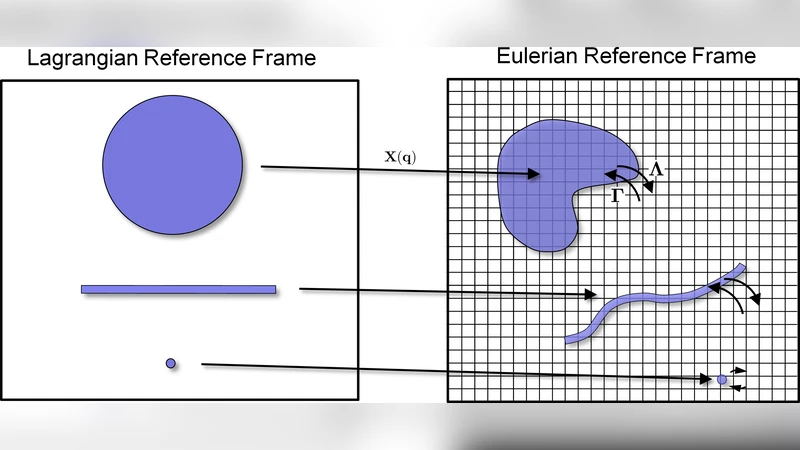
We present approaches for the study of fluid-structure interactions subject to thermal fluctuations. A mixed mechanical description is utilized combining Eulerian and Lagrangian reference frames. We establish general conditions for operators coupling these descriptions. Stochastic driving fields for the formalism are derived using principles from statistical mechanics. The stochastic differential equations of the formalism are found to exhibit significant stiffness in some physical regimes. To cope with this issue, we derive reduced stochastic differential equations for several physical regimes. We also present stochastic numerical methods for each regime to approximate the fluid-structure dynamics and to generate efficiently the required stochastic driving fields. To validate the methodology in each regime, we perform analysis of the invariant probability distribution of the stochastic dynamics of the fluid-structure formalism. We compare this analysis with results from statistical mechanics. To further demonstrate the applicability of the methodology, we perform computational studies for spherical particles having translational and rotational degrees of freedom. We compare these studies with results from fluid mechanics. The presented approach provides for fluid-structure systems a set of rather general computational methods for treating consistently structure mechanics, hydrodynamic coupling, and thermal fluctuations.
💡 Research Summary
The paper introduces a comprehensive framework for simulating fluid‑structure interactions (FSI) when thermal fluctuations play a non‑negligible role, such as in micro‑ and nano‑scale systems. Traditional deterministic FSI methods either neglect stochastic forces or treat them as an after‑thought, which is insufficient for phenomena dominated by Brownian motion. To overcome this limitation, the authors construct a mixed Eulerian–Lagrangian description: the fluid variables (velocity, pressure, etc.) are represented on a fixed Eulerian grid, while the structural variables (position, orientation, deformation) are tracked on moving Lagrangian points.
Coupling operators and general conditions
The core of the formulation lies in two linear operators, ( \mathcal{A} ) (Eulerian → Lagrangian) and ( \mathcal{B} ) (Lagrangian → Eulerian), that mediate momentum exchange between the two frames. Rather than prescribing a specific discretisation (e.g., immersed boundary, distributed Lagrange multiplier), the authors derive a set of abstract algebraic conditions that any admissible pair must satisfy: (i) symmetry ( \mathcal{B}= \mathcal{A}^{\top} ), (ii) invertibility ( \mathcal{A}\mathcal{B}=I ), and (iii) positive‑definiteness of the combined friction operator. These constraints guarantee conservation of mass, momentum, and, crucially, the correct thermodynamic balance.
Statistical‑mechanics‑based stochastic driving
Thermal fluctuations are introduced via a stochastic forcing term whose covariance is dictated by the Fluctuation‑Dissipation Theorem (FDT). By demanding that the stationary probability density of the full system be the Gibbs distribution ( \propto \exp(-\mathcal{H}/k_{B}T) ), the authors obtain a noise covariance matrix directly proportional to the total friction operator ( \Gamma ):
\