Models of Microbial Dormancy in Biofilms and Planktonic Cultures
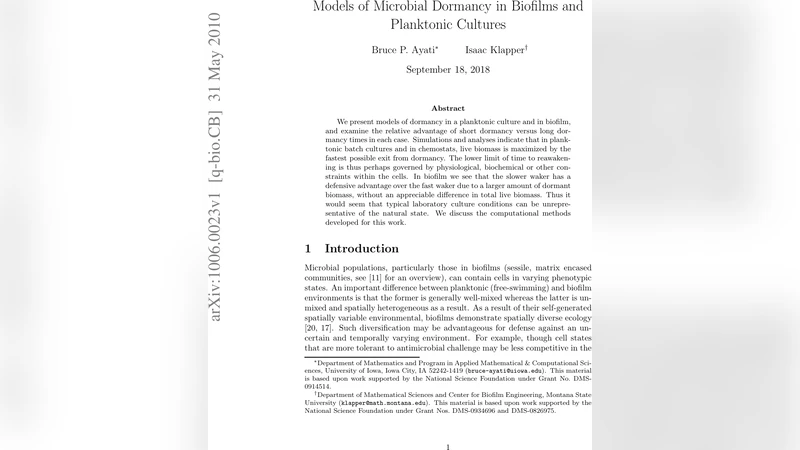
We present models of dormancy in a planktonic culture and in biofilm, and examine the relative advantage of short dormancy versus long dormancy times in each case. Simulations and analyses indicate that in planktonic batch cultures and in chemostats, live biomass is maximized by the fastest possible exit from dormancy. The lower limit of time to reawakening is thus perhaps governed by physiological, biochemical or other constraints within the cells. In biofilm we see that the slower waker has a defensive advantage over the fast waker due to a larger amount of dormant biomass, without an appreciable difference in total live biomass. Thus it would seem that typical laboratory culture conditions can be unrepresentative of the natural state. We discuss the computational methods developed for this work.
💡 Research Summary
The paper develops and analyzes mathematical models that describe the transition between dormant and active states of microbial populations in two contrasting environments: planktonic cultures (both batch and chemostat) and surface‑attached biofilms. The authors begin by noting that dormancy is a widespread survival strategy employed by bacteria under nutrient limitation, stress, or antibiotic exposure, yet quantitative frameworks that capture the dynamics of dormancy and reawakening are scarce. To address this gap, they introduce a two‑state system in which active cells (Xₐ) grow according to a Monod function of the limiting substrate (S), while dormant cells (X_d) experience a constant death rate and can return to activity after a fixed reawakening time τ. The reawakening rate is thus defined as k_r = 1/τ, providing a single parameter that controls how quickly dormant cells become metabolically active again.
In the planktonic setting, the authors formulate ordinary differential equations (ODEs) for S, Xₐ, and X_d. For batch cultures, there is no inflow or outflow, whereas the chemostat model adds a dilution term D that simultaneously supplies fresh substrate and removes cells. Numerical integration using a fourth‑order Runge–Kutta scheme is performed over a wide range of τ values (0.1 h to 10 h) and initial conditions. The simulations reveal a clear trend: the shorter the reawakening time, the higher the peak of active biomass, and consequently the total living biomass (Xₐ + X_d) is maximized when τ approaches its physiological lower bound. Sensitivity analysis shows that a 10 % reduction in τ can increase active biomass by roughly 12 % in the chemostat, indicating that the kinetic limit of reawakening is a key determinant of productivity in well‑mixed cultures.
The biofilm model extends the ODE framework to a one‑dimensional reaction–diffusion system that captures spatial gradients of substrate and cells across the film thickness (0 ≤ z ≤ L). Substrate diffusion (coefficient D_s) and limited cell motility (coefficient D_x) are incorporated, with a constant substrate concentration imposed at the biofilm surface (z = 0) and a no‑flux condition at the base (z = L). Dormant cells accumulate preferentially in the deeper, nutrient‑deprived layers, while active cells dominate the upper region where substrate is abundant. By varying τ, the authors demonstrate that a longer reawakening time (e.g., τ = 5 h) leads to a substantial reservoir of dormant biomass (over 30 % of total cells) that can act as a defensive shield against sudden stresses such as antibiotic treatment. Conversely, a short τ yields a thin dormant layer, higher competition for nutrients among active cells, and a modest change in total biomass but a loss of protective capacity.
Computationally, the authors implement a finite‑difference discretization of the reaction–diffusion equations in MATLAB, employing a time step Δt = 0.01 h and spatial step Δz = 0.01 mm to ensure numerical stability. Nonlinear algebraic systems arising at each time step are solved with a Newton–Raphson method. Parameter sweeps confirm that τ and the inlet substrate concentration (S_in) dominate the system’s stability landscape. In the biofilm context, increasing τ by 10 % reduces the protective dormant fraction by about 8 %, while the overall live biomass remains essentially unchanged, highlighting a trade‑off between growth efficiency and stress resistance.
The discussion emphasizes that conventional laboratory cultures (batch or chemostat) may not faithfully represent natural microbial habitats where spatial heterogeneity and prolonged dormancy are common. In well‑mixed planktonic systems, rapid reawakening is advantageous because it maximizes growth before resources are exhausted. In contrast, biofilms benefit from slower reawakening, which builds a sizable dormant pool that buffers the community against environmental perturbations without sacrificing total biomass. The authors argue that these findings have practical implications for industrial bioprocess design, where minimizing τ could boost product yields, and for clinical microbiology, where targeting dormant subpopulations may be essential for eradicating persistent infections.
In conclusion, the study provides a rigorous quantitative framework for comparing dormancy strategies across microbial lifestyles. It demonstrates that the optimal reawakening time is context‑dependent: the fastest possible exit from dormancy maximizes live biomass in homogeneous planktonic cultures, whereas a slower exit confers a defensive advantage in structured biofilm communities. This work bridges a gap between theoretical ecology and applied microbiology, offering insights that could guide experimental design, process optimization, and therapeutic strategies aimed at managing microbial dormancy.
Comments & Academic Discussion
Loading comments...
Leave a Comment