Near-Optimal Experimental Design Under the Budget Constraint in Online Platforms
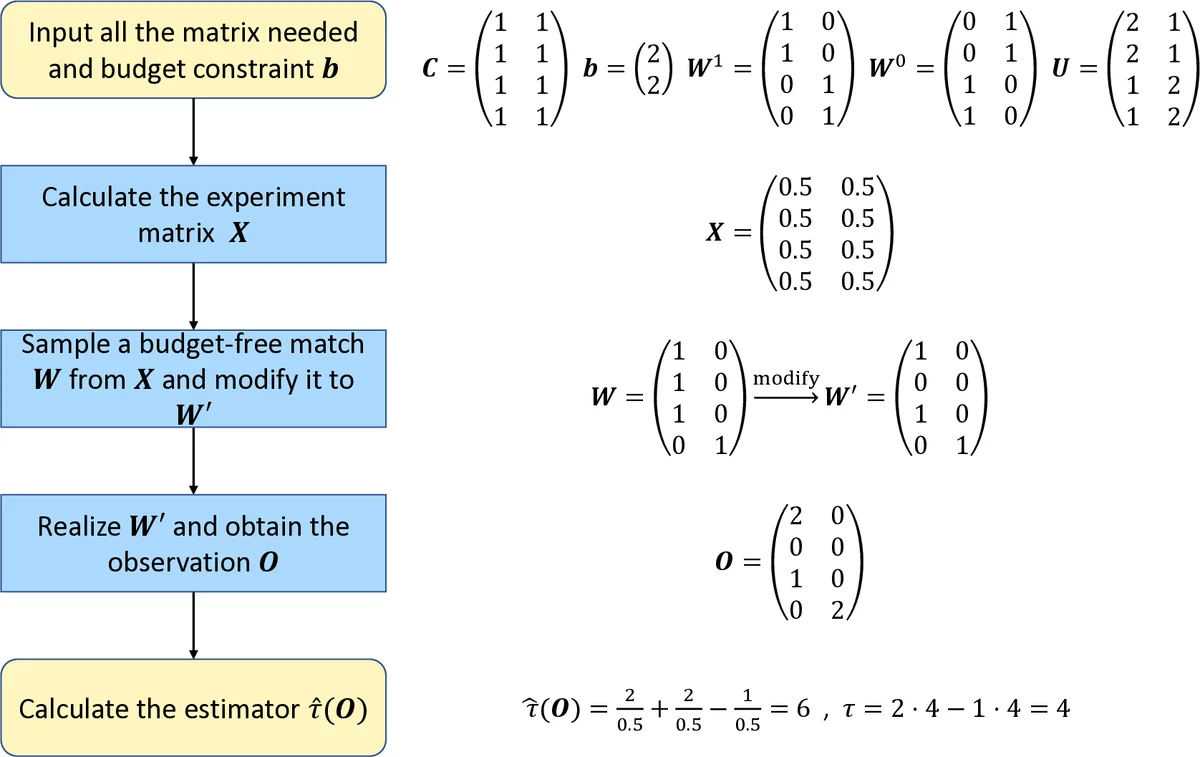
A/B testing, or controlled experiments, is the gold standard approach to causally compare the performance of algorithms on online platforms. However, conventional Bernoulli randomization in A/B testing faces many challenges such as spillover and carryover effects. Our study focuses on another challenge, especially for A/B testing on two-sided platforms – budget constraints. Buyers on two-sided platforms often have limited budgets, where the conventional A/B testing may be infeasible to be applied, partly because two variants of allocation algorithms may conflict and lead some buyers to exceed their budgets if they are implemented simultaneously. We develop a model to describe two-sided platforms where buyers have limited budgets. We then provide an optimal experimental design that guarantees small bias and minimum variance. Bias is lower when there is more budget and a higher supply-demand rate. We test our experimental design on both synthetic data and real-world data, which verifies the theoretical results and shows our advantage compared to Bernoulli randomization.
💡 Research Summary
The paper tackles a fundamental obstacle in running A/B tests on two‑sided online platforms—budget constraints on one side of the market (e.g., advertisers on an ad exchange, drivers on a ride‑hailing service, or sellers on an e‑commerce marketplace). In such settings, each buyer j has a fixed budget b_j and each potential assignment of an item i to that buyer incurs a known cost c_{ij}. The platform wishes to compare two allocation algorithms, the incumbent W₀ and a new candidate W₁, by estimating the total treatment effect (TTE)
\
Comments & Academic Discussion
Loading comments...
Leave a Comment