Exact traveling wave solutions of one-dimensional models of cancer invasion
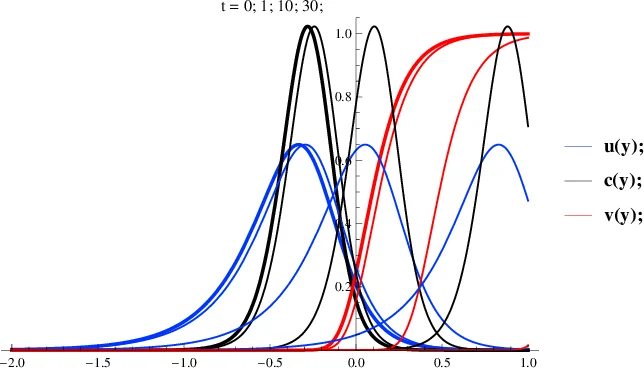
In this paper we consider continuous mathematical models of tumour growth and invasion based on the model introduced by Chaplain and Lolas \cite{Chaplain&Lolas2006}, for the case of one space dimension. The models consist of a system of three coupled nonlinear reaction-diffusion-taxis partial differential equations describing the interactions between cancer cells, the matrix degrading enzyme and the tissue. For these models under certain conditions on the model parameters we obtain exact analytical solutions in terms of traveling wave variables. These solutions are smooth positive definite functions for some of which whose profiles agree with those obtained from numerical computations \cite{Chaplain&Lolas2006} for not very large time intervals.
💡 Research Summary
The paper addresses the analytical treatment of a class of one‑dimensional cancer invasion models that were originally introduced by Chaplain and Lolas. The underlying system consists of three coupled nonlinear partial differential equations describing the spatio‑temporal evolution of cancer cell density (c), extracellular matrix (ECM) density (v), and the concentration of a matrix‑degrading enzyme (u). The equations incorporate diffusion of cells and enzyme, chemotaxis (movement toward chemical gradients of u), haptotaxis (movement toward ECM gradients), logistic proliferation of cancer cells, and ECM degradation by the enzyme.
The authors first consider a simplified version of the model in which the logistic proliferation terms are omitted, focusing solely on the migration mechanisms. They introduce a traveling‑wave coordinate y = x − νt, where ν is the wave speed, and transform the PDE system into a set of ordinary differential equations. By integrating the first two equations they obtain a relationship between v and u in the form F = v^{1‑p}/(1‑p), where p∈(0,1) is a non‑linear exponent governing ECM degradation.
To make the remaining equation tractable, the authors impose several parameter constraints: (i) χ_c D_c = 1, (ii) ν² = β D_c² D_u − D_c (requiring D_u > D_c), and (iii) a specific relation between p, ξ_c, D_u and D_c (equation (9) in the manuscript). Under these conditions the second‑order nonlinear ODE can be reduced to a first‑order equation using Lie symmetry analysis. Introducing new variables z and w, the reduced equation becomes a quadratic algebraic relation in w(z), which can be solved explicitly. After back‑substitution the authors obtain closed‑form expressions for the three fields:
c(y) = C_c exp
Comments & Academic Discussion
Loading comments...
Leave a Comment