Password Cracking and Countermeasures in Computer Security: A Survey
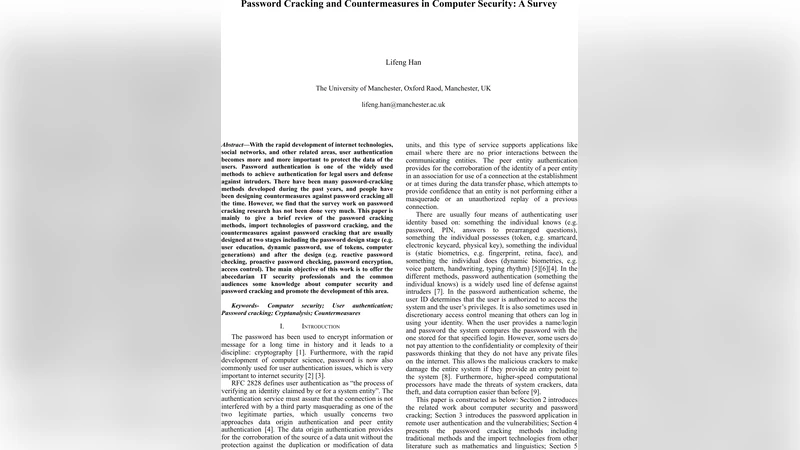
With the rapid development of internet technologies, social networks, and other related areas, user authentication becomes more and more important to protect the data of users. Password authentication is one of the widely used methods to achieve authentication for legal users and defense against intruders. There have been many password-cracking methods developed during the past years, and people have been designing countermeasures against password cracking all the time. However, we find that the survey work on password cracking research has not been done very much. This paper is mainly to give a brief review of the password cracking methods, import technologies of password cracking, and the countermeasures against password cracking that are usually designed at two stages including the password design stage (e.g. user education, dynamic password, use of tokens, computer generations) and after the design (e.g. reactive password checking, proactive password checking, password encryption, access control). The main objective of this work is to offer the abecedarian IT security professionals and the common audiences some knowledge about computer security and password cracking and promote the development of this area. Keywords- Computer security; User authentication; Password cracking; Cryptanalysis; Countermeasures
💡 Research Summary
The surveyed paper provides a comprehensive overview of password‑based authentication, the evolving landscape of password‑cracking techniques, and the spectrum of countermeasures that can be applied both during password creation and after deployment. Beginning with a motivation that highlights the ubiquity of passwords despite the rise of alternative authentication methods, the authors note a gap in systematic surveys of password‑cracking research.
The core of the work classifies cracking methods into four major categories. Dictionary attacks exploit common user‑chosen words, phrases, and predictable patterns; their success hinges on the quality and size of the wordlists used. Brute‑force attacks enumerate every possible character combination, with computational cost growing exponentially with password length. Rainbow‑table attacks pre‑compute hash chains to dramatically reduce the time required for reversal, especially when salts are weak or absent. Finally, hybrid attacks that leverage modern high‑performance hardware—GPUs, FPGAs, and cloud‑based compute services—have lowered the economic barrier to large‑scale cracking, enabling attackers to test billions of guesses per second. The authors also discuss side‑channel techniques (e.g., timing, power analysis) and social engineering vectors that augment pure cryptanalytic attacks.
In the “Import Technologies” section, the paper reviews the cryptographic primitives that underpin password storage. Early systems relied on fast, insecure hash functions such as MD5 and SHA‑1, which are now considered obsolete. Modern best practice recommends memory‑hard, key‑stretching algorithms—PBKDF2, bcrypt, scrypt, and the newer Argon2—each of which introduces configurable work factors to thwart parallel hardware attacks. The role of salts is explained in detail: unique per‑user salts prevent pre‑computed tables, while the misuse of static salts or inadequate length undermines their effectiveness. Additional secret values (pepper) and hardware‑backed secure modules (TPM, HSM) are presented as further layers of protection.
Countermeasures are organized into two temporal stages. At the password design stage, the authors advocate for user education to avoid predictable patterns, enforce minimum length and complexity, and promote the use of dynamic passwords (OTP/TOTP) and hardware tokens (smart cards, USB keys). They also discuss the integration of biometrics and multi‑factor authentication (MFA) to reduce reliance on a single secret, and the adoption of newer generation hardware that can securely store and process credentials.
Post‑design defenses include reactive and proactive password checking. Reactive checking triggers mandatory password changes after a breach is detected, while proactive checking evaluates password strength in real time, checks against known breached password lists, and enforces policies before acceptance. Encryption of stored passwords using dedicated cryptographic modules, fine‑grained access control (role‑based and attribute‑based), and the promotion of password managers to eliminate reuse are also covered. The paper emphasizes that these measures, when combined, significantly shrink the attack surface.
The discussion identifies several challenges. First, the rapid commoditization of GPU and cloud resources means that traditional length‑and‑complexity policies are insufficient on their own. Second, implementation mistakes—such as fixed salts, low iteration counts, or reliance on deprecated hash functions—remain common and erode theoretical security guarantees. Third, balancing usability with security continues to be a major usability research problem; users often circumvent strong policies if they perceive them as burdensome. Fourth, the impending arrival of quantum‑resistant hash functions and authentication protocols calls for forward‑looking research.
In conclusion, the authors argue that passwords will persist as a core authentication factor for the foreseeable future, but only within a layered security model that blends technical hardening, user‑centric education, and multi‑factor mechanisms. The survey aims to serve as a reference point for both novice security professionals and seasoned researchers, encouraging further investigation into more resilient password schemes, better user‑interface designs, and the integration of emerging cryptographic primitives.