Mobile Power Network for Ultimate Mobility without Battery Life Anxiety
Similar to the evolution from the wired Internet to mobile Internet (MI), the growing demand for power delivery anywhere and anytime appeals for power grid transformation from wired to mobile domain. We propose here the next generation of power deliv…
Authors: Mingqing Liu, Qingwen Liu, Mingliang Xiong
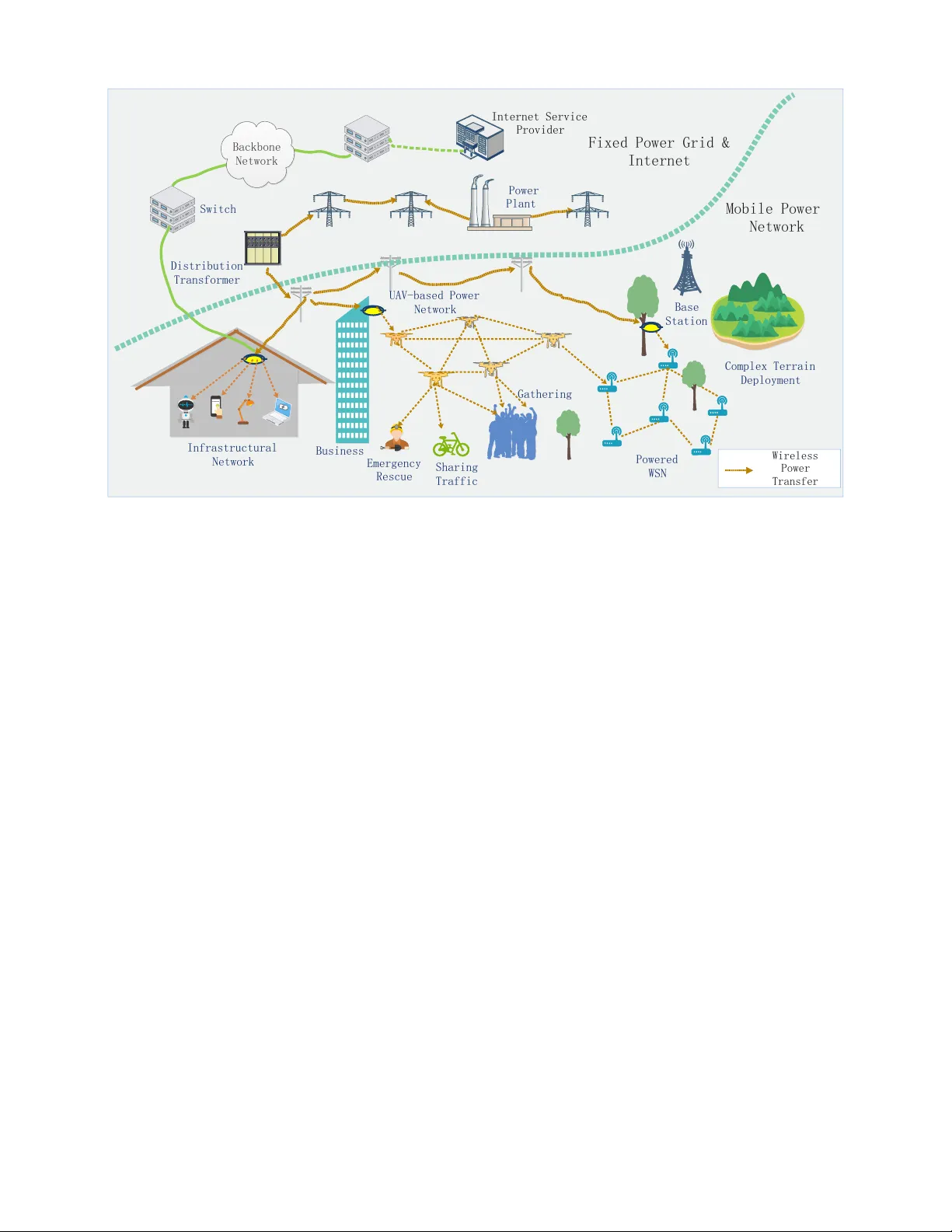
1 Mobile Po wer Network for Internet of Things without Battery Life Anxiety Mingqing Liu, Qingwen Liu, Mingliang Xiong, Hao Deng, and Xinhe W ang Abstract —Similar to the ev olution from the wir ed Internet to mobile Internet (MI), the gr owing demand f or power deliv ery anywhere and anytime appeals for power grid transformation from wired to mobile domain. W e propose here the next genera- tion of power delivery network – mobile power network (MPN) for wireless power transfer within a mobile range from several meters to tens of meters. At first, we overview the moti vation f or proposing MPN and pr esent the MPN’ s concept ev olution. Then, we report the MPN’s supporting technologies, and particularly introduce resonant beam charging (RBC). As a long-range wireless power transfer (WPT) method, RBC can safely deliver multi-W att power to multiple devices concurrently . Meanwhile, the r ecent progr ess in RBC resear ch has been summarized. Next, we specify the MPN’ s architecture to provide the wide-area WPT coverage. Finally , we present the MPN’ s application scenarios and discuss k ey issues in MPN. MPN can enable the ultimate mobility by cutting the final cord of mobile devices, realizing the “last-mile” mobile power delivery . Index T erms —Mobile Power Network, Wireless Po wer T rans- fer , Resonant Beam Charging, Smart City . I . I N T RO D U C T I O N More recently , the Internet of Things (IoT), the interconnec- tion of computing devices embedded in everyday objects, has gone from a futuristic concept to an actual industry concern. It is estimated that the number of IoT devices connected to the Internet is growing to billions. Howe ver , continuity is one of the top challenges of IoT as ensuring and extending battery life is an essential consideration for IoT de vices. T o deal with the abov e challenge, one solution is to optimize the power consumption of IoT de vices, while the other is to power IoT de vices wirelessly . As ultra-lo w power consumption technology is not feasible for de vices such as smartphones, vir - tual reality (VR) / augmented reality (AR) devices, unmanned aerial vehicles (U A V), etc., which are necessary parts of IoT , wireless power transfer (WPT) seems to be a possible way for lev eraging permanent battery life of IoT devices. Since the concept of IoT was proposed, new dev elopments hav e been shaking up old and ne w industries, where the smart factory is one of the critical demonstrations. Especially under the influence of CO VID-19, the deployment of IoT not only realizes remote monitoring solutions to help improv e manufac- turing efficienc y and workshop automation to assist personnel but also helps improve employees’ health monitoring lev els. In terms of transportation and logistics, intelligent logistics tracking relying on IoT technologies dramatically improv es This work has been submitted to the IEEE for possible publication. Copyright may be transferred without notice, after which this version may no longer be accessible. Fig. 1. RBC Application in Wireless Charging AR Glasses Over the Air operational efficiency and provides a foundation for the phar- maceutical supply chain. Besides, smart homes, smart offices, intelligent medical, etc., ha ve brought enormous demands and markets. Moreover , smartphones, VR/AR devices, and wearable devices that are closely related to everyone e very day consist of the IoT as a considerable part. Howe ver , cutting the last electric wire while pro viding a permanent energy supply without batteries for IoT devices is a vision for future IoT . T o realize the actual connectivity of e verything, WPT is a promising supporting method. The existing WPT technologies include inductive coupling, magnetic resonance, capaciti ve coupling, etc., which are ca- pable of providing watt-lev el power ov er centimeter-le vel distance, and radio frequenc y (RF) char ging, laser char ging, etc., which can transfer wireless power over se veral meters distance with milliwatt-lev el po wer limited by safety require- ment or with beam-steering control for alignment. After more than ten years of de velopment in academia and industry , WPT is still facing a bottleneck in simultaneously achie ving high transmission efficienc y and self-alignment between the WPT transmitter and the recei ver . Resonant beam charging (RBC), also kno wn as distrib uted laser charging (DLC), can simultaneously realize high-power , long-range, and mobile power transfer for IoT de vices without the need for mechanical alignment control as in Fig. 1, which is capable of solving the “last-mile” mobile power deliv ery problem and providing power anytime and anywhere. V arious WPT can be applied in various scenarios which enable mobile power transfer in the energy domain similar to wireless information transfer (WIT) in the information domain [1, 2]. Howe ver , to realize “mobile power deli very” anywhere and anytime, providing wide-area 2 Information Fixed Mobile Wireless Communication Power Grid Mobile Internet Internet Mobile Power Network Wireless Power Transfer Energy Fig. 2. Concept Evolution mobile charging services is vital. On the one hand, the power grid is accessed to supply energy in the mobile realm. On the other hand, the Internet is connected to provide wide-area services such as access, resource scheduling, deployment, etc. Giv en such motiv ations, we propose the paradigm of a mobile power network (MPN), to extend power deli very to the mobile realm. As shown in Fig. 2, the concept of MPN is deriv ed from the e volv ement of the Internet to mobile Internet (MI). W ireless communications enable the ev olution from the Internet to the MI. MI realizes the information dissemination ov er the air and solves the “last-mile” information delivery problem. Mobile information deliv ery an ywhere and anytime brings a free lifestyle of study , work, entertainment, and busi- ness. Similarly , MPN is presented to transfer po wer ov er the air and solve the “last-mile” power deliv ery problem based on WPT technologies. MPN can pro vide wireless po wer to mobile terminals which is similar to wireless information deliv ery in MI. Therefore, MPN is the extension of the power grid for mobile po wer deli very . People will get mobile po wer no longer restricted by safety , time, space, and other limitations, bringing anywhere and an ytime power supply into reality [2]. I I . S U P P O RT I N G T E C H N O L O G I E S WPT technologies are the foremost supporting technologies to realize MPN. Nikola T esla inv ented the “T esla coil” for the initial wireless power transmission test one hundred years ago. In recent years, the dev elopment of wireless charging technologies has made great strides [3]. WPT technologies that draw significant attention in industry and academia include inductiv e coupling, magnetic resonance, capaciti ve coupling, RF charging, laser char ging, etc. Howe ver , the abov e WPT technologies face the challenges of simultaneously satisfy- ing mobility , high po wer, and safety requirements in MPN applications. Thus, we will particularly introduce the RBC technology , which can safely transfer watt-le vel power over sev eral meters [4]. PV PV PV PV PV PV Retro - reflector2: 70% Ref lectivity Transmitter Receiver Resonant Cavity Power Input P in Mobile Transmission Channel Powe r Output P out Pump Source P hotovol taic Panel External - Cavity Beam Ener gy Ha rvesting Retro - reflector1: 100% Reflectivity Gain Medi um Transmi tte r Receiver Receiver Receiver Intrinsic Safet y Pump Gain Over - the - Air/Energy - Concentrat ion (a) (b) Fig. 3. Resonant Beam Charging Principle and Features A. Existing WPT T echnologies WPT mainly uses an electromagnetic field as a carrier to transmit energy in open space, including near-field and far -field technologies. Near -field technologies, using the non- radiativ e magnetic field (also known as an ev anescent wa ve) of the transcei ver coil to realize the coupling and transfer of energy between coils, are mainly divided into two coupling modes: magnetic induction and magnetic resonance. The well- known wireless charging pads generally adopt the abov e near- field technologies. Far -field technologies, which use radiated electromagnetic fields (also called electromagnetic waves) to transmit energy from the transmitter to the receiv er, are broadly divided into the follo wing two kinds: non-directional and directional radiation. Among them, the transmission car- riers of non-directional far-field WPT are non-directional RF and solar energy , while the transmission carriers of directional far -field WPT are directional RF and laser . Near-field WPT is generally safe for humans while the charging distance and tight alignment are the defects re- stricting mobility . T o this end, near-field WPT can hardly empower applications such as metav erse in the next generation of networks. Recently , efforts in both academia and industry are turning to focus on far-field WPT , which can achiev e tens of meters transmission distance. Meanwhile, research on safety and high-power transfer has been explored in far -field WPT . V ikram Iyer et al. used protective beam technology to transmit energy through traditional lasers and provide radiation safety guarantees [5]. Xu Zhang et al. published a secure ener gy harvesting technology in the Wi-Fi frequency band, using 3 - 0.2 - 0.1 0 0.1 0.2 Move ment alo ng x - axis (m) 0 2 4 6 Outp ut beam power (W ) 0 0.2 0.4 0.6 0.8 1 Outp ut elect rical po wer (W) Theret ical bea m Measur ed beam Theret ical ele ctricity Measur ed elect ricity - 0.2 - 0.1 0 0.1 0.2 Move ment alo ng x - axis (m) 0 2 4 6 Outp ut beam power (W ) 0 0.2 0.4 0.6 0.8 1 Outp ut elect rical po wer (W) Theret ical bea m Measur ed beam Theret ical ele ctricity Measur ed elect ricity Move ment alo ng x - axis (m) Over - the - air efficien cy Move ment alo ng z - axis (m) Over - the - air efficien cy 0.2 0.8 1.4 2 2.6 3.2 Move ment alo ng z - axis (m) 0 2 4 6 Outp ut beam power (W ) 0 0.5 1 1.5 Outp ut elect rical po wer (W) 0.2 0.8 1.4 2 2.6 3.2 Move ment alo ng z - axis (m) 0 2 4 6 Outp ut beam power (W ) 0 0.5 1 1.5 Outp ut elect rical po wer (W) 0.2 0.8 1.4 2 2.6 3.2 Move ment alo ng z - axis (m) 0 2 4 6 Outp ut beam power (W ) 0 0.5 1 1.5 Outp ut elect rical po wer (W) x y z Retro - reflector1 Gain Retro - reflector2 Fig. 4. Simulation and Experimental Results (Figs. 7-10 in Ref. [10]) MoS2 enhanced silicon rectifier diode antennas to achieve 0 . 156 mW power wireless charging at a distance of 1 m [6]. Additionally , the theoretical research and experiment of RBC hav e verified the wireless charging with a power of 2 W at a distance of 2 . 6 m [7], demonstrating its potential in providing wireless power supply services in the IoT era. B. Resonant Beam Charging 1) RBC Principle and F eatur es: Figure 3 (a) illustrates the RBC system diagram. A retro-reflector, a gain medium, and the pump source are integrated at the transmitter , while the other retro-reflector and a photovoltaic (PV) panel are integrated at the receiv er . The transmitter and the receiv er jointly form a resonant cavity to generate a resonant beam, through which the power is transferred wirelessly . The retro-reflector ensures that the resonant beam entering from a wide range of angles can be returned back to its incoming direction [4]. In this system, the pump source at the transmitter first stimulates the gain medium to generate a resonant beam. The beam reflected by the two retro-reflectors is folded back into the gain medium multiple times to be amplified. Thus, a continuous resonant beam of stimulated radiation exists within the resonator (i.e., the transmitter and receiv er). Subsequently , the resonant beam partially passes through the partially reflectiv e retro-reflector 2 at the receiver to form a laser beam. Finally , the laser beam is con verted into the output electrical power with a photovoltaic (PV) panel, which can be readily used to charge electronic devices. The unique features of RBC’ s mobile transmission channel rely on the generation principles of lasers: giv en a certain pump source to the gain medium and a resonant cavity within which beams can propagate back and forth, resonant beams in the mobile transmission channel can be formed. Thus, in the RBC system, the alignment between the transmitter and the recei ver is automatically generated so that the recei vers can still be charged while mo ving [8]. Moreov er , any foreign object that enters the line of sight, i.e., the beam path, will block the photons in the path, disrupt positiv e feedback for resonance, and automatically shut of f the resonant beam. Thus, the requirements of high-po wer transmission and safe charging can be guaranteed. In addition, the resonant beam is essentially an intra-ca vity laser inheriting the advantages of lasers such as energy-concentrated narro w-beam transmission. Thus, the transmission efficienc y of the resonant beam is significantly high compared to RF supporting long transmission distances. Moreov er , RBC also has the characteristics of high-power , concurrent-charging, and compact size as specified in [4]. The receiv er can be integrated into various IoT devices, which leads to the feasibility of practical implementation. 2) Recent Pr ogr ess in RBC Researc h: Since RBC has been proposed [4], RBC has made great strides in both theoretical research and testbed establishment. W e summarize the RBC progress in the following three aspects with the consideration of IoT architecture as physical, access, and networking. In terms of the physical layer , we in vestigate the principle and features of the RBC deeply . At first, core features of RBC including long transfer distance, mobility , and inherent safety hav e been studied [8, 9]. RBC’ s theoretical transmission dis- tance can reach hundreds of meters. The mobility mechanism of the RBC has been re vealed, with which the simultaneous lightwa ve information and power system (SLIPT) extended by RBC is demonstrated to hav e the capability of supplying over 3 W power ov er 2 m distance within over 20 ◦ field of view (FoV) [8]. Moreov er , the inherent safety has been presented and verified through theoretical analysis that 1 W power can be transferred o ver 5 m distance under the skin-safe re gulations for laser products [9]. Besides, we hav e b uilt a testbed that v erified the watt-lev el power transfer ov er meter-le vel distances within a large FoV with the premise of human safety [10] as in Fig. 4. The smartphone can be charged ov er-the-air while it is moving. Over -the-air transmission efficiency of RBC is nearly 100%, and the mobile transmission channel remains with the receiv er’ s mov ement within a specific cov erage. In terms of the access layer , to av oid power waste and acci- dental dangers, the adaptiv e resonant beam charging (ARBC) design is presented for adaptiv ely controlling the transmitting power from the transmitter according to the charging require- ments of the receiver . Consequently , the ef ficiency of RBC has also been enhanced by significantly cutting energy waste. Based on RBC, for better charging services, a wireless power scheduling algorithm according to battery charging profile for fairly keeping all devices working as long as possible is proposed. Moreover , the scheduling algorithm for earning maximization with quality of charging service guarantee, and the TDMA-based WPT scheduling algorithm for ef ficient WPT in ARBC are put forth [11]. These efforts are to drive the progress and implementation of wireless charging services. In terms of the networking layer , a wide-area deployment al- gorithm is proposed for providing wide-area wireless charging 4 Access Backbone User Equipment Internet Internet Power Grid Power Grid Wir eless E n e rgy Access point Management Entity Fig. 5. MPN Architecture services, which also provides the foundation of a large-scale power schedule. Besides, a wireless charging application has been dev eloped to control and visualize users’ charging time, charging fees, and charging performance. Abov e all, research on RBC basically co vers all aspects of network construction, contributing to the design and imple- mentation of MPN. Moreov er, many researchers hav e joined us to carry out RBC-related theoretical and experimental research, further confirming the feasibility of RBC [12 – 14]. I I I . M O B I L E P O W E R N E T W O R K A R C H I T E C T U R E The MPN architecture requires not only far-field wireless charging technologies but also near-field wireless charging technologies for their respective application scenarios. For example, inductiv e coupling and magnetic resonance tech- nology can be applied in the MPN infrastructural network to supply power for home appliances and electric vehicles. Laser charging or RF charging may be used in the MPN- powered WSNs. Based on comparing these WPT technologies, we can find that RBC is the MPN’ s enabling technology for mobile applications [4]. W e designed the mobile power network (MPN) architecture based on RBC to provide wide- area mobile charging services. Relying on the features of RBC technology , one transmitter can charge sev eral recei vers simultaneously , while one receiver can be served by se veral transmitters. Thus, the control functions such as access con- trol, scheduling control, and mobility management should be provided by the MPN. A. Major Components In Fig. 5, the MPN architecture is separated into two layers: the access layer and the backbone layer . The access layer takes charge of wireless power transfer for the user equipment. Moreov er , the entities in the access layer can operate control of user access, scheduling, and channel switching. In the backbone layer, wireless power access points are connected to the power grid to get source po wer . Furthermore, Internet access is significant in providing signaling transmission for centralized management. The major components in the MPN architecture are as follows: 1) User Equipment: User equipment (UE) represents de- vices such as smartphones that acquire mobile charging ser- vices by accessing MPN. UE has a b uilt-in RBC receiv er to receiv e the wireless power and then con vert the wireless power to electrical po wer so that UE can be charged wirelessly . In addition, UE should be able to exchange information with the wireless power/data access point to support the control functions they needed. 2) W ir eless P ower/Data Access P oint: W ireless power/data access point (hereinafter called access point, AP) provides wireless power for recei vers by a built-in RBC transmitter . It connects to the fixed power grid for the source power and accesses to the Internet for centralized management. AP assists UE in accessing and ensuring mobile charging quality . It also assists resource scheduling of MPN. According to the signaling from the management entity , AP relies on the power controller to determine the power allocation in a multi-user scenario. Moreov er , AP is responsible for switching po wer transfer channels when UE moves from one AP charging area to another like handover in mobile communication networks. 3) Management Entity: It is responsible for centralized information processing such as transaction data, real-time status, and resource management in the network, to provide the best decision for power transmission, access control, and resource allocation. It contains the functions of authentication, authorization, accounting (AAA), and location-based service (LBS) for mobility management. Furthermore, it takes charge of handover control for wide-area cov erage. It also provides the application interfaces for value-added enhancement. B. F eatures and Opportunities The wireless charging networks relying on near-field WPT technologies can only be deployed in a small area with limited mobility and safety [15]. The concept of MPN, which is based on RBC as enabling technology , can highlight the character- istics of mobility and safety . In addition to the advantages of 5 Infrastructural Network Emergency Rescue Sharing Traffic Gathering Business Complex Terrain Deployment Powered WSN Switch Power Plant Internet Service Provider Backbone Network UAV-based Power Network Fixed Power Grid & Internet Mobile Power Network Distribution Transformer Base Station Wireless Power Transfer Fig. 6. MPN Application Scenarios the RBC system mentioned earlier , the main features of MPN can be summarized as follo ws: 1) Mobility: RBC architecture ensures the receiv ers are charged while mo ving without the assistance of specific aiming or tracking [4]. On the other hand, MPN enables WPT transmitters to be connected and centrally managed to provide wireless power in a wide range. MPN expands the power transfer o ver distance so that users can ha ve a mobile W iFi-like experience to obtain wireless charging services with mobility . 2) Safety: When encountering an obstruction within the resonant beam path in the RBC system, the resonation ceases at the speed of light since the photons are block ed by the obsta- cle. Thus, the po wer transfer is curtailed immediately without any software or decision-making circuitry in volv ement, which can ensure the coexistence of high po wer and safety . W ith the unique features of the RBC system, MPN can provide a wide-area wireless power supply with safety . 3) P ower: As the mobility-enabling technology , RBC can provide watt-lev el po wer ov er meter-le vel distance with the premise of safety . The power transferred by RBC is sufficient for charging mobile devices like smartphones. Thus, MPN is a high-power network that can support various high-power mobile charging scenarios. In summary , MPN will bring con venience with enhanced charging experiences to human life in various aspects, such as medical treatment and smart homes. It breaks the development bottlenecks in dealing with the power supply problems for IoT devices. The simultaneous wireless information and power transfer (SWIPT) can be promoted with MPN. Furthermore, MPN will moti vate ne w ideas to find solutions and possibilities for a more imaginative world. New business models will be built, and ne w lifestyles will be created. I V . A P P L I C A T I O N S C E N A R I O S A N D D I S C U S S I O N S The intelligent interconnection of cloud-edge-terminal in- frastructure has become a significant dev elopment trend, such as smart-city IoT , industrial IoT , smart connected cars, etc. Howe ver , the intelligent and networked development of cloud- side-end infrastructure is facing various resource constraints such as bandwidth, computing power , storage, and energy consumption, which restricts the de velopment of mobile- side intelligent interconnection. Nowadays, the landing of 5G technology and the research of 6G technology alleviate the bandwidth problem of mobile networking of smart terminals. Moreov er , the dev elopment of cloud computing, edge com- puting, and collaborativ e computing technology alleviated the problem of computing power , while distributed storage tech- nology (including blockchain technology) alleviated storage problems. Ho we ver , in terms of energy consumption, there is still a lack of mature mobile power supply solutions for the mobile side. The proposed MPN is one of the technical systems that can deal with the above problems. W e depict the MPN’ s application scenarios in this context as in Fig. 6 and discuss critical issues to be solved. A. Applications A dividing line separates the fixed po wer grid and the Internet from MPN, while the right part sho ws the mobile essence of MPN: solving the mobile po wer transmission problems of the last few meters or tens of meters. Different from the existing fixed power grid, MPN focuses on wireless power transmission ov er the air and delivers power primarily depending on a variety of WPT technologies, so that po wer can be obtained without restrictions of fixed infrastructures. 6 MPN includes the centralized control and management of WPT relying on mobile communication technologies. The power in MPN is initially provided by the fixed power grid, while the information such as the control signaling in MPN is upward transferred through the Internet. In the mobile realm, the application scenarios of MPN are as follows. 1) Smart Home: Smart home devices can be supplied with wireless po wer through an MPN infrastructural network, where the wireless power transmitters can be embedded in light bulbs on the ceiling. The transmitter is connected to the Internet, and the client-server management system may be offered by the MPN supplier so that wireless power can be managed centrally and conv eniently providing an integrated service e xperience. The network can also be deployed in public places such as cof fee shops, airport terminals, and theatres to provide charging services covering the room. 2) Logistics: In industrial IoT scenarios where power lines are incon venient to connect, logistics robots, po wer monitoring cameras, and other equipment can be po wered by MPN. On the one hand, the non-interference RBC system can satisfy the re- quirements of safely supplying high power over long distances. On the other hand, networking allows edge intelligence as path planning, resource scheduling, deployment scheme, etc, can be provided through MPN. 3) Extr eme En vironment: W ireless sensor network (WSN) is widely deployed with the demands of monitoring the en vironment in forests, deserts, or oceans. MPN can be applied to deal with the power endurance challenges of WSN, to save the cost of replacing a large number of batteries and av oid risks to humans. The powered WSN can self-determined the power resource schedule according to the architecture of MPN. 4) Gatherings: The MPN ad-hoc network aims at pro viding wireless char ging services in temporarily established outdoor situations. It can serve scenarios such as large gatherings, shared traf fic, and emer gency rescues. U A Vs, integrated with the wireless power transmitter, can provide power to each other to ensure the stability and long-term functionality of the power supply network. Meanwhile, U A Vs can serve devices with mobile charging requirements within their charging cov- erage. The remote management system controls the U A V -based power network. 5) U A V Communication Networks: The U A V base station is expected to become a fle xible and reliable communication base station (including for 5G), especially as an emergenc y plan under typhoons, landslides, earthquakes, natural disas- ters, and extreme conditions. MPN can be applied to assist U A V communication networks in dealing with power supply problems, where both the RBC transmitter and receiver can be embedded in the U A V . The specific base station pro vides power for them. B. Discussions From the application of MPN, we can summarize the ke y issues that MPN should focus on. 1) WPT with Safety , Mobility , and Long Distance: As illustrated above, MPN will be deployed in the human en- vironment. Thus, ensuring safety is the primary condition that the WPT technology adopted in the MPN needs to meet. On the other side, to realize mobile power transfer in various scenarios, long-distance power transfer with the self-alignment of the WPT is required. 2) Smart Grid Access: MPN is supposed to access the smart grid for obtaining conv enient control as deployment, schedule, etc. Howe ver , compatibility issues in the process of smart grid access need to be resolved and feasible middle ware needs to be designed and implemented. Besides, some access hardware designs may also be needed. 3) Intelligent Deployment and Resour ce Sc heduling: Ran- dom access of massiv e mobile terminals leads to dynamic changes in the temporal and spatial distrib ution of electricity demand, which poses challenges to MPN energy ef ficiency optimization and load balancing. Thus, we can adopt the behavioral cognition method of massi ve power consumption terminals and the prediction theory of power consumption terminal behavior based on information entropy , to inv estigate data-driv en po wer supply optimization strate gies. V . C O N C L U S I O N S Driv en by the demand of solving the power -hungry problem for mobile and IoT devices, we propose the mobile po wer network (MPN) based on wireless power transfer (WPT) technologies. W e first present the MPN’ s concept ev olution and application scenarios. W e then introduce the MPN’ s supporting technology – resonant beam charging (RBC), and demonstrate its features, performance, and recent progress. Next, we present the MPN architecture to provide wide-area mobile charging services. Finally , we illustrate the application scenarios of MPN and discuss the challenges and open issues. MPN will solv e the “last-mile” mobile power deli very problem in the next generation of the Internet so that the ultimate mobility without “battery life anxiety” can be realized. R E F E R E N C E S [1] C. W ang, F . Haider , X. Gao, X. Y ou, Y . Y ang, D. Y uan, H. M. Aggoune, H. Haas, S. Fletcher , and E. Hepsay- dir , “Cellular architecture and key technologies for 5G mobile communication networks, ” IEEE Commun. Mag. , vol. 52, no. 2, pp. 122–130, 2014. [2] K. David and H. Berndt, “6G vision and requirements: Is there any need for beyond 5G?” IEEE V eh. T echnol. Mag. , vol. 13, no. 3, pp. 72–80, Sept. 2018. [3] X. Lu, P . W ang, D. Niyato, D. I. Kim, and Z. Han, “W ire- less charging technologies: Fundamentals, standards, and network applications, ” IEEE Commun. Surveys T uts. , vol. 18, no. 2, pp. 1413–1452, 2016. [4] Q. Liu, J. W u, P . Xia, S. Zhao, W . Chen, Y . Y ang, and L. Hanzo, “Charging unplugged: W ill distributed laser charging for mobile wireless po wer transfer w ork?” IEEE V eh. T echnol. Mag. , vol. 11, no. 4, pp. 36–45, Dec. 2016. [5] V . Iyer , E. Bayati, R. Nandakumar , A. Majumdar, and S. Gollakota, “Charging a smartphone across a room using lasers, ” Pr oceedings of the Acm on Interactive Mobile W earable & Ubiquitous T echnologies , vol. 1, no. 4, pp. 1–21, 2018. 7 [6] X. Zhang, J. Grajal, J. Luis V azquez-Roy , U. Radhakr- ishna, X. W ang, W . Chern, L. Zhou, Y . Lin, P . C. Shen, and X. Ji, “T wo-dimensional mos2-enabled flex- ible rectenna for wi-fi-band wireless energy harvesting, ” Natur e , v ol. 566, no. 7744, pp. 368–372, 2019. [7] W . W ang, Q. Zhang, H. Lin, M. Liu, X. Liang, and Q. Liu, “W ireless energy transmission channel modeling in resonant beam charging for iot devices, ” IEEE Internet of Things Journal , vol. 6, no. 2, pp. 3976–3986, Jan. 2019. [8] M. Liu, H. Deng, Q. Liu, J. Zhou, M. Xiong, L. Y ang, and G. B. Giannakis, “Simultaneous mobile information and po wer transfer by resonant beam, ” IEEE T ransac- tions on Signal Processing , vol. 69, pp. 2766–2778, May 2021. [9] W . Fang, H. Deng, Q. Liu, M. Liu, Q. Jiang, L. Y ang, and G. B. Giannakis, “Safety analysis of long-range and high-power wireless power transfer using resonant beam, ” IEEE T ransactions on Signal Pr ocessing , v ol. 69, pp. 2833–2843, May 2021. [10] Q. Liu, M. Xiong, M. Liu, Q. Jiang, W . Fang, and Y . Bai, “Mobile wireless power transfer using a self- aligned resonant beam, ” 2021. [11] W . Fang, Q. Zhang, M. Liu, Q. Liu, and P . Xia, “Earning maximization with quality of charging service guarantee for IoT de vices, ” IEEE Internet Things J . , vol. 6, no. 1, pp. 1114–1124, Feb. 2019. [12] J. Lim, T . S. Khwaja, and J. Ha, “Wireless optical power transfer system by spatial wa velength division and distributed laser cavity resonance, ” Opt. Expr ess , vol. 27, no. 12, pp. A924–A935, Jun 2019. [13] Q. Sheng, M. W ang, H. Ma, Y . Qi, J. Liu, D. Xu, W . Shi, and J. Y ao, “Continuous-wav e long-distributed- cavity laser using cat-e ye retroreflectors, ” Opt. Express , vol. 29, no. 21, pp. 34 269–34 277, Oct 2021. [14] J. Liu, A. W ang, Q. Sheng, Y . Qi, S. W ang, M. W ang, D. Xu, S. Fu, W . Shi, and J. Y ao, “Large-range alignment-free distributed-ca vity laser based on an im- prov ed multi-lens retroreflector , ” Chinese Optics Letters , vol. 20, no. 3, p. 031407, 2022. [15] Xiao Lu, D. Niyato, Ping W ang, Dong In Kim, and Zhu Han, “W ireless charger networking for mobile devices: fundamentals, standards, and applications, ” IEEE W ir e- less Commun. , vol. 22, no. 2, pp. 126–135, Apr . 2015. B I O G R A P H I E S Mingqing Liu (clare@tongji.edu.cn) received the B.S. degree in com- puter science and technology from the Northwest A&F Uni versity , Y angling, China, in 2018. She is currently pursuing the Ph.D. degree with the College of Electronics and Information Engineering, T ongji Univ ersity , Shanghai, China. Her research interests lie in the areas of wireless power transfer , development of remote wireless charging technology , and the Internet of Things. Qingwen Liu (M’07–SM’15) recei ved the B.S. degree in electrical engineering and information science from the University of Science and T echnology of China, Hefei, China, in 2001 and the M.S. and Ph.D. degrees from the Department of Electrical and Computer Engineering, Uni versity of Minnesota, Minneapolis, MN, USA, in 2003 and 2006, respectively . He is currently a professor with the Col- lege of Electronics and Information Engineering, T ongji Univ ersity , Shanghai, China. His research interests lie in the areas of wireless power transfer and Internet of Things. He is a Senior Member of the IEEE. Hao Deng (denghao1984@tongji.edu.cn) receiv ed his B.S. and Ph.D. degrees from the Department of Physical Electronics, Uni versity of Electronic Science & T echnology , Chengdu, China, in 2007 and 2015, respectiv ely . He is currently an Assistant Professor with the School of Software Engineering, T ongji Uni versity , Shanghai, China. His research interests focus on the areas of optical critical dimension measurement for semiconductors, wireless power transfer and Internet of Things. Mingliang Xiong (xiongml@tongji.edu.cn) recei ved the B.S. degree in communication engineering from the Nanjing Uni versity of Posts and T elecommunications, Nanjing, China, in 2017. He is currently pursuing the Ph.D. degree with the College of Electronics and Information Engineering, T ongji University , Shanghai, China. His research interests include optical wireless communications, wireless power transfer, and the Internet of Things. Xinhe W ang (xinhelz1007@gmail.com) received the B.S. degree in Computer Science and T echnology from Xi’an Jiaotong Uni versity , Xi’an, China, in 2017, and the M.S. Degree from Donald Bren School of Information & Computer Science, Univ ersity of California, Irvine, CA, USA, in 2019. She is currently pursuing the Ph.D. degree with the College of Electronics and Information Engineering, T ongji Univ ersity , Shanghai, China.
Original Paper
Loading high-quality paper...
Comments & Academic Discussion
Loading comments...
Leave a Comment