A minimal-length approach unifies rigidity in under-constrained materials
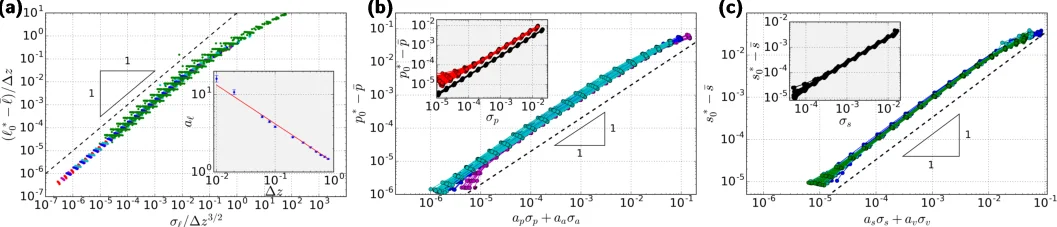
We present a novel approach to understand geometric-incompatibility-induced rigidity in under-constrained materials, including sub-isostatic 2D spring networks and 2D and 3D vertex models for dense biological tissues. We show that in all these models a geometric criterion, represented by a minimal length $\bar\ell_\mathrm{min}$, determines the onset of prestresses and rigidity. This allows us to predict not only the correct scalings for the elastic material properties, but also the precise {\em magnitudes} for bulk modulus and shear modulus discontinuities at the rigidity transition as well as the magnitude of the Poynting effect. We also predict from first principles that the ratio of the excess shear modulus to the shear stress should be inversely proportional to the critical strain with a prefactor of three, and propose that this factor of three is a general hallmark of geometrically induced rigidity in under-constrained materials and could be used to distinguish this effect from nonlinear mechanics of single components in experiments. Lastly, our results may lay important foundations for ways to estimate $\bar\ell_\mathrm{min}$ from measurements of local geometric structure, and thus help develop methods to characterize large-scale mechanical properties from imaging data.
💡 Research Summary
In this paper the authors introduce a unifying geometric framework for rigidity transitions in a broad class of under‑constrained systems, ranging from sub‑isostatic two‑dimensional spring networks to two‑ and three‑dimensional vertex and Voronoi models of dense biological tissues. The central concept is the “minimal average length” (\bar\ell_{\min}), defined as the network‑wide average of the actual element lengths (spring lengths, cell perimeters, or cell surface areas) normalized by their intrinsic rest lengths. When external deformation or internal fluctuations drive (\bar\ell_{\min}) to a critical value (\ell^{*}_{0}), the system becomes geometrically incompatible with its preferred local geometry, self‑stresses appear, and the material acquires rigidity.
The authors first demonstrate that, despite differences in microscopic details, all four models exhibit the same qualitative response to isotropic dilation: a discontinuous jump in the bulk modulus (B) at (\ell^{}{0}) and a floppy regime ((B=G=0)) for larger preferred lengths. For spring networks the transition point depends linearly on the distance to isostaticity, (\Delta z = z{c}-z), following (\ell^{}{0}=1.506-0.378,\Delta z). In the tissue models the presence or absence of area (or volume) elasticity ((k{A},k_{V})) shifts (\ell^{*}_{0}) but does not alter the overall picture.
To capture the effect of shear, the authors expand (\bar\ell_{\min}) to second order in two observables: the variance of element lengths (\sigma_{\ell}^{2}) and the applied shear strain (\gamma^{2}): \
Comments & Academic Discussion
Loading comments...
Leave a Comment