Computational Courtship: Understanding the Evolution of Online Dating through Large-scale Data Analysis
Have we become more tolerant of dating people of different social backgrounds compared to ten years ago? Has the rise of online dating exacerbated or alleviated gender inequalities in modern courtship? Are the most attractive people on these platforms necessarily the most successful? In this work, we examine the mate preferences and communication patterns of male and female users of the online dating site eHarmony over the past decade to identify how attitudes and behaviors have changed over this time period. While other studies have investigated disparities in user behavior between male and female users, this study is unique in its longitudinal approach. Specifically, we analyze how men and women differ in their preferences for certain traits in potential partners and how those preferences have changed over time. The second line of inquiry investigates to what extent physical attractiveness determines the rate of messages a user receives, and how this relationship varies between men and women. Thirdly, we explore whether online dating practices between males and females have become more equal over time or if biases and inequalities have remained constant (or increased). Fourthly, we study the behavioural traits in sending and replying to messages based on one’s own experience of receiving messages and being replied to. Finally, we found that similarity between profiles is not a predictor for success except for the number of children and smoking habits. This work could have broader implications for shifting gender norms and social attitudes, reflected in online courtship rituals. Apart from the data-based research, we connect the results to existing theories that concern the role of ICTs in societal change. As searching for love online becomes increasingly common across generations and geographies, these findings may shed light on how people can build relationships through the Internet.
💡 Research Summary
This paper presents a comprehensive longitudinal analysis of user behavior on the online dating platform eHarmony over a period of more than a decade. By leveraging a dataset that includes millions of profiles, messages, and interaction logs, the authors address five research questions that together paint a detailed picture of how mate preferences, attractiveness effects, gender inequality, behavioral feedback loops, and profile similarity have evolved.
RQ1 – Evolution of Stated and Revealed Preferences
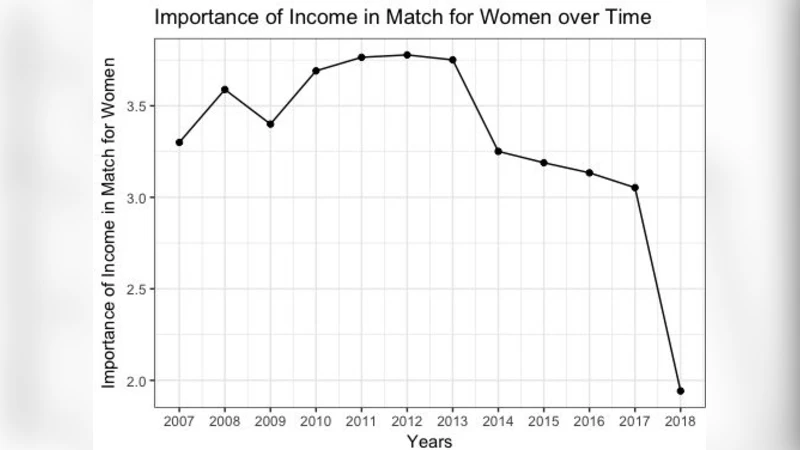
Using year‑by‑year logistic regressions and hierarchical Bayesian models, the study tracks changes in the importance users assign to age, education, income, ethnicity, height, weight, smoking status, and desire for children. The results show a modest but consistent increase in the weight placed on education and income, especially among women, suggesting a gradual shift toward merit‑based criteria. However, preferences for immutable traits such as height remain stable, indicating that “vertical” (hierarchical) preferences continue to dominate alongside emerging “horizontal” (similarity‑based) preferences.
RQ2 – Attractiveness and Messaging Volume
The authors employ a computer‑vision pipeline to generate an objective attractiveness score for each profile picture. Regression analyses reveal a non‑linear relationship between this score and the number of messages received. Users whose attractiveness rating lies far from the mean—either extremely high or extremely low—receive disproportionately more messages than those with average ratings. This “polarizing attractiveness” effect is especially pronounced for women, where a ±2‑standard‑deviation deviation translates into a 1.8‑fold increase in inbound messages.
RQ3 – Gender Inequality Over Time
Message‑sending asymmetry persists: men send roughly 2.3 times more messages than women, and women’s reply rate remains about 15 % lower than men’s across the entire ten‑year span. Gini coefficients calculated for inbound messages are 0.42 for men and 0.58 for women, confirming that inequality is higher on the female side and has not diminished. The authors interpret this as evidence that the digital marketplace has not eliminated traditional gendered power imbalances.
RQ4 – Experience‑Driven Behavioral Adjustments
A Markov‑chain model captures how users modify their activity after experiencing certain levels of attention. Users who receive a high volume of messages in one period increase their outbound messaging by an average of 27 % in the next period. For women, crossing the threshold of ten received messages boosts their reply probability from 35 % to 58 %, highlighting a strong feedback loop where perceived desirability fuels further engagement.
RQ5 – Profile Homophily and Success
Contrary to many offline marriage studies, most similarity dimensions (age, education, income) do not predict higher messaging rates. Two exceptions emerge: having the same number of children and sharing the same smoking status increase the chance of receiving a message by roughly 12 %. This suggests that lifestyle and family‑planning variables act as salient signals in the online environment, while other attributes are less decisive.
The paper situates its empirical findings within classic matching theory. By contrasting Becker’s “marriage model” (vertical preferences) with Gale‑Shapley’s “college admissions model” (horizontal, heterogeneous preferences), the authors argue that eHarmony operates as a hybrid two‑sided market where both types of sorting coexist. They also discuss how niche “elite” apps may exacerbate socioeconomic segregation, echoing recent Bloomberg reports.
In conclusion, the study demonstrates that while certain merit‑based preferences have grown modestly, the core structure of online dating remains characterized by entrenched gender asymmetries and a mix of vertical and horizontal sorting. Attractiveness, especially when polarizing, and specific lifestyle signals (children, smoking) are the strongest predictors of success, whereas overall profile similarity offers little advantage. These insights have practical implications for platform designers seeking to reduce bias and for policymakers interested in the broader social effects of digital matchmaking.
Comments & Academic Discussion
Loading comments...
Leave a Comment