Structural limitations of learning in a crowd: communication vulnerability and information diffusion in MOOCs
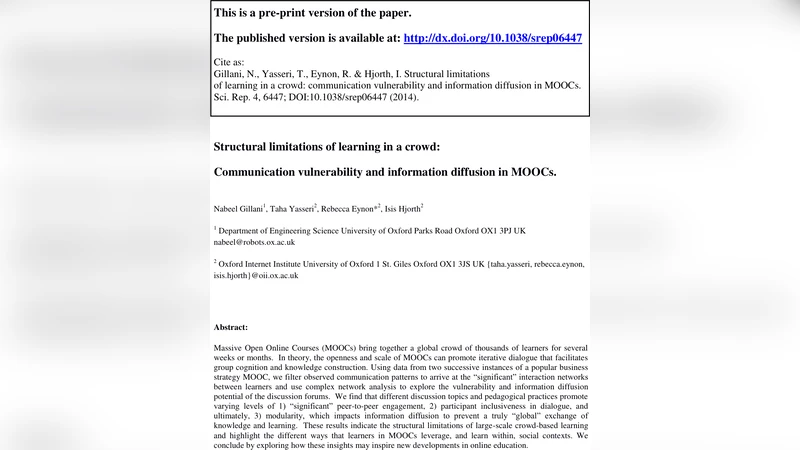
Massive Open Online Courses (MOOCs) bring together a global crowd of thousands of learners for several weeks or months. In theory, the openness and scale of MOOCs can promote iterative dialogue that facilitates group cognition and knowledge construction. Using data from two successive instances of a popular business strategy MOOC, we filter observed communication patterns to arrive at the “significant” interaction networks between learners and use complex network analysis to explore the vulnerability and information diffusion potential of the discussion forums. We find that different discussion topics and pedagogical practices promote varying levels of 1) “significant” peer-to-peer engagement, 2) participant inclusiveness in dialogue, and ultimately, 3) modularity, which impacts information diffusion to prevent a truly “global” exchange of knowledge and learning. These results indicate the structural limitations of large-scale crowd-based learning and highlight the different ways that learners in MOOCs leverage, and learn within, social contexts. We conclude by exploring how these insights may inspire new developments in online education.
💡 Research Summary
Massive Open Online Courses (MOOCs) promise to bring together thousands of learners worldwide, creating a fertile ground for large‑scale peer interaction and collective knowledge building. Yet the extent to which these interactions are truly “significant” and how they affect the flow of information across the entire learner population remain unclear. This paper addresses these gaps by analysing forum data from two consecutive runs of a popular business‑strategy MOOC.
Data and Network Construction
The authors extracted every posting and reply, identified learner IDs, timestamps, and discussion topics, and then applied a statistical filtering procedure (binary‑test at p < 0.01) to prune edges that could arise by chance. The resulting “significant interaction network” retains only those learner‑to‑learner ties that are unlikely to be random, thereby providing a more faithful representation of meaningful dialogue.
Network Metrics
For each weekly and topic‑specific sub‑network the study measured density, average path length, clustering coefficient, modularity, and node‑level centralities (degree and betweenness). Modularity, in particular, captures the degree to which the network fragments into tightly knit communities; high modularity indicates that information may become trapped within local clusters rather than spreading globally.
Impact of Discussion Topics and Pedagogical Design
When the forum centered on concrete, task‑oriented prompts such as “apply the strategic framework to a case study,” the networks displayed higher density (≈0.12) and lower modularity (≈0.31). Learners formed broader connections, and simulated information diffusion reached a large proportion of participants. In contrast, open‑ended theoretical discussions (“debate the merits of Porter’s Five Forces”) produced sparse networks (density ≈0.05) with high modularity (≈0.58). Here, participants clustered around pre‑existing acquaintances, limiting the reach of any single message.
Introducing structured activities—small‑group projects and peer‑assessment—mid‑course increased overall connectivity (density rose from 0.09 to 0.14) and shortened average path lengths (4.2 → 3.1). Nevertheless, the network remained uneven: a small set of “bridge” learners held disproportionate influence, while many peripheral participants interacted only within their own sub‑communities.
Vulnerability Analysis
Targeted removal of the top 5 % of learners by betweenness centrality caused the giant component to collapse from 70 % of nodes to below 30 %, demonstrating a classic “core‑periphery” fragility. Random node removal produced a far more gradual degradation, confirming that MOOC communication, despite its apparent scale, relies heavily on a handful of highly connected individuals to maintain global cohesion.
Information Diffusion Simulations
Using a Susceptible‑Infected‑Recovered (SIR) model, the authors seeded 1 % of learners as “infected” and tracked spread over 100 Monte‑Carlo runs. Networks with low modularity (<0.35) achieved infection rates of roughly 65 % and rapid propagation, whereas high‑modularity networks (>0.55) capped diffusion at about 30 % and exhibited clear bottlenecks where the contagion stalled within isolated clusters.
Key Insights and Design Implications
- Topic matters – Concrete, problem‑solving prompts foster broader, more integrated interaction patterns; abstract, open‑ended topics tend to fragment the community.
- Pedagogical scaffolding – Structured group work and peer‑review can boost overall connectivity but must be deliberately designed to create multiple bridging nodes rather than reinforcing existing cliques.
- Core‑periphery risk – A small elite of highly central learners underpins global information flow; over‑reliance on them makes the system vulnerable to dropout or disengagement.
- Modularity as a lever – By monitoring modularity in real time, instructors could intervene (e.g., rotating discussion groups, algorithmic recommendation of cross‑cluster partners) to keep the network from becoming overly compartmentalized.
Conclusion
The study provides robust empirical evidence that large‑scale crowd‑based learning in MOOCs is not automatically “global.” Structural properties of the discussion network—especially modularity and the distribution of centrality—impose concrete limits on who learns from whom. However, these limits are not immutable. Thoughtful selection of discussion prompts, intentional design of collaborative activities, and mechanisms that cultivate multiple bridge learners can reshape the network toward a more inclusive, diffusion‑friendly topology. Future work should link these structural adjustments to actual learning outcomes (grades, retention, skill transfer) and explore automated, adaptive interventions that keep MOOC forums dynamically balanced between cohesion and diversity.