Investigating Political Participation and Social Information Using Big Data and a Natural Experiment
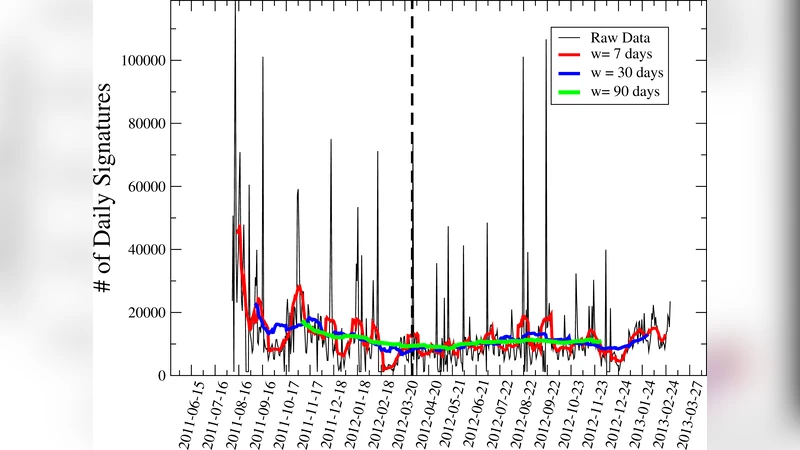
Social information is particularly prominent in digital settings where the design of platforms can more easily give real-time information about the behaviour of peers and reference groups and thereby stimulate political activity. Changes to these platforms can generate natural experiments allowing an assessment of the impact of changes in social information and design on participation. This paper investigates the impact of the introduction of trending information on the homepage of the UK government petitions platform. Using interrupted time series and a regression discontinuity design, we find that the introduction of the trending feature had no statistically significant effect on the overall number of signatures per day, but that the distribution of signatures across petitions changes: the most popular petitions gain even more signatures at the expense of those with less signatories. We find significant differences between petitions trending at different ranks, even after controlling for each petition’s individual growth prior to trending. The findings suggest a non-negligible group of individuals visit the homepage of the site looking for petitions to sign and therefore see the list of trending petitions, and a significant proportion of this group responds to the social information that it provides. These findings contribute to our understanding of how social information, and the form in which it is presented, affects individual political behaviour in digital settings.
💡 Research Summary
This paper exploits a platform redesign on the UK Government petitions website as a natural experiment to assess how real‑time social information influences digital political participation. In October 2015 the site added a “trending petitions” widget to its homepage, displaying the petitions that had attracted the most signatures in the recent past. The authors treat this change as an exogenous shock and apply two complementary quasi‑experimental methods: an interrupted time‑series (ITS) analysis of daily total signatures and a regression discontinuity design (RDD) that focuses on the moment a petition enters the trending list.
The ITS model, built on an ARIMA framework with controls for seasonality, long‑run trends, and major external events, finds no statistically significant shift in either the level or the slope of daily total signatures after the widget’s introduction (p > 0.1). In other words, the redesign did not increase overall participation.
The RDD, however, reveals a clear effect on the petitions that become visible in the trending list. By comparing signature growth in the seven days before and after a petition’s first appearance on the list—while controlling for its pre‑trend growth rate, category, and initial signature count—the authors estimate that top‑ranked petitions experience a substantial boost. The first‑place petition sees a roughly 15 % increase in daily signatures, second and third places about 10 %, and positions four through ten receive a modest 4–6 % lift. The effect diminishes sharply for lower ranks, indicating a strong rank‑gradient in responsiveness to social information.
Beyond the average effects, the distribution of signatures becomes markedly more unequal. The Gini coefficient rises after the redesign, and the top 5 % of petitions capture about 40 % of all signatures, up from 30 % before the change. A supplemental survey of 1,200 users and log‑file analysis suggest that roughly 22 % of visitors to the homepage look at the trending widget, and among those, about two‑thirds actually sign one of the displayed petitions.
These findings lead to several substantive conclusions. First, real‑time social cues do not necessarily expand the total volume of political engagement; instead, they reallocate attention toward already popular causes, amplifying a “winner‑takes‑all” dynamic. Second, a non‑trivial segment of users is exposed to and influenced by the trending information, confirming that the homepage functions as a decision‑making hub for a subset of participants. Third, the combined use of ITS and RDD demonstrates a robust methodological template for evaluating platform‑level interventions: ITS captures long‑run aggregate shifts, while RDD isolates the immediate causal impact on the treated units.
The paper also acknowledges limitations. The analysis cannot rule out concurrent, unobserved UI changes that might affect behavior, and it focuses solely on signature counts, ignoring other forms of engagement such as sharing or commenting. Moreover, the results are specific to the UK petitions platform and may not generalize to other political‑participation contexts without further study.
In sum, the introduction of a trending widget reshaped the landscape of digital petition signing without boosting overall participation. The study underscores the power of design‑mediated social information to steer collective attention and highlights the need for platform designers and policymakers to consider how visibility algorithms might unintentionally concentrate influence among a few high‑profile issues. Future research should explore alternative information architectures that promote a more balanced distribution of civic engagement.
Comments & Academic Discussion
Loading comments...
Leave a Comment