Common lines ab-initio reconstruction of $D_2$-symmetric molecules
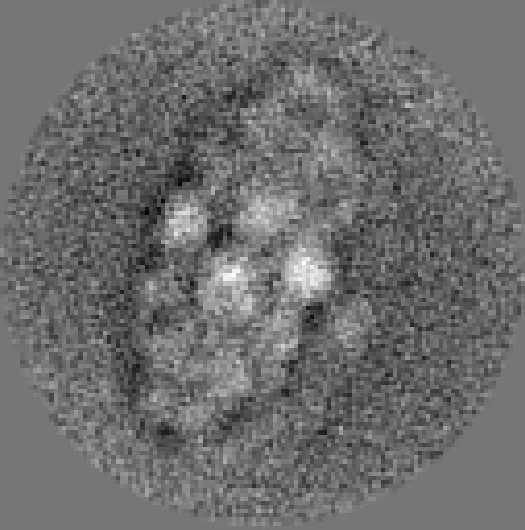
Cryo-electron microscopy is a state-of-the-art method for determining high-resolution three-dimensional models of molecules, from their two-dimensional projection images taken by an electron microscope. A crucial step in this method is to determine a low-resolution model of the molecule using only the given projection images, without using any three-dimensional information, such as an assumed reference model. For molecules without symmetry, this is often done by exploiting common lines between pairs of images. Common lines algorithms have been recently devised for molecules with cyclic symmetry, but no such algorithms exist for molecules with dihedral symmetry. In this work, we present a common lines algorithm for determining the structure of molecules with $D_{2}$ symmetry. The algorithm exploits the common lines between all pairs of images simultaneously, as well as common lines within each image. We demonstrate the applicability of our algorithm using experimental cryo-electron microscopy data.
💡 Research Summary
This paper addresses the fundamental problem of ab‑initio orientation assignment in single‑particle cryo‑electron microscopy (cryo‑EM) for molecules that possess D₂ symmetry. In the absence of any prior three‑dimensional model, the goal is to recover low‑resolution 3D structures directly from a large set of noisy two‑dimensional projection images. While common‑line methods have been successfully applied to asymmetric particles and to cyclic (Cₙ) symmetric particles, no algorithm existed that could handle the dihedral D₂ case, where each image is compatible with four distinct orientations due to the three orthogonal 180° symmetry axes.
The authors first formalize the D₂ symmetry group using four rotation matrices g₁ (identity), g₂, g₃, and g₄, each representing a 180° rotation about the x, y, and z axes respectively. Because φ(r) = φ(gₘr) for m = 1…4, any projection image P_{R_i} is identical to the images generated by the four rotated orientations gₘR_i. Consequently, a pair of images (i, j) does not share a single common line in Fourier space, but rather four common lines, each corresponding to one of the four possible relative rotations R_iᵀ gₘ R_j. This multiplicity creates two major challenges: (1) the ambiguity of which common line belongs to which symmetry operation, and (2) the classic handedness (mirror) ambiguity inherent to cryo‑EM.
To overcome these challenges, the paper proposes a novel “global‑common‑line” framework that simultaneously exploits all four common lines between every pair of images, as well as the three self‑common lines that each image shares with its own symmetry mates. The method proceeds in several stages:
-
Fourier Transform and Central‑Slice Extraction – Each image is Fourier transformed; the central slice (the 2‑D Fourier transform) is stored for later correlation.
-
Construction of a Candidate Relative‑Rotation Space (𝔇_c) – For any two arbitrary rotations Q_l and Q_r (with non‑parallel viewing directions), the set {Q_lᵀ gₘ Q_r | m = 1…4} is generated. The collection of all such quadruplets over the continuous SO(3)×SO(3) space defines 𝔇_c, the search space for possible relative rotations between a pair of images.
-
Maximum‑Likelihood Scoring of Candidates – For a given candidate quadruplet Q_lr ∈ 𝔇_c, the four putative common‑line directions ˜qₘ_lr = Q_l^{(3)} × gₘ Q_r^{(3)} are computed. The actual common‑line directions qₘ_ij extracted from the Fourier slices of images i and j are then compared to ˜qₘ_lr. A likelihood score π_ij(Q_l,Q_r) is defined as the product (or log‑sum) of the correlation coefficients between each pair of directions. This score quantifies how well the candidate explains the observed four common lines.
-
Selection of the Best Candidate – The candidate with the highest π_ij is taken as the estimate of the true set {R_iᵀ gₘ R_j}. Because the true relative rotations belong to 𝔇_c, the search is guaranteed (in the noiseless case) to recover them; in practice, the likelihood formulation provides robustness against noise.
-
Self‑Common‑Line Disambiguation – For each image i, the three self‑common lines between P_{R_i} and its symmetry mates g₂R_i, g₃R_i, g₄R_i are examined. Their directions qₘ_ii allow the algorithm to infer which of the four symmetry operators actually aligns with the unknown absolute orientation of image i. This step resolves the internal 4‑fold ambiguity locally.
-
Global Synchronization – All estimated relative rotations are assembled into a block matrix M of size 3N × 3N, where each 3 × 3 block M_{ij} = R_iᵀ gₘ R_j (the appropriate m is determined from step 5). The matrix can be written as M = UᵀU with U =
Comments & Academic Discussion
Loading comments...
Leave a Comment