Geodetic Line at Constant Altitude above the Ellipsoid
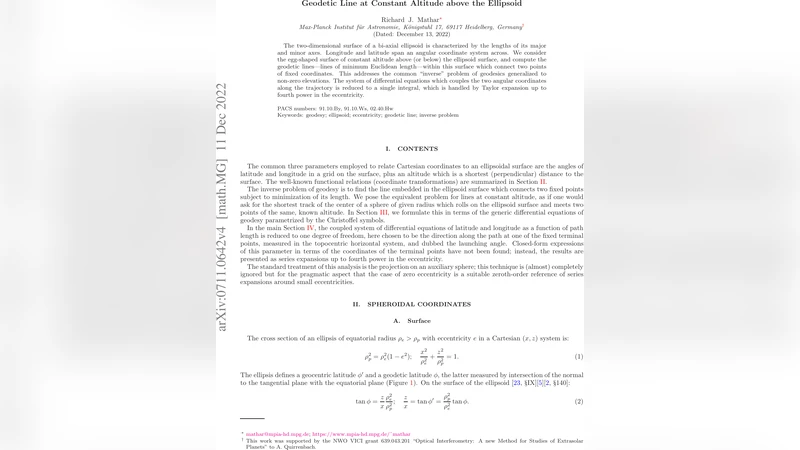
The two-dimensional surface of a bi-axial ellipsoid is characterized by the lengths of its major and minor axes. Longitude and latitude span an angular coordinate system across. We consider the egg-shaped surface of constant altitude above (or below) the ellipsoid surface, and compute the geodetic lines - lines of minimum Euclidean length - within this surface which connect two points of fixed coordinates. This addresses the common “inverse” problem of geodesics generalized to non-zero elevations. The system of differential equations which couples the two angular coordinates along the trajectory is reduced to a single integral, which is handled by Taylor expansion up to fourth power in the eccentricity.
💡 Research Summary
The paper tackles the classic inverse geodesic problem on a biaxial ellipsoid and extends it to the surface that lies at a constant altitude h above (or below) the reference ellipsoid. While the traditional geodesic on the ellipsoid (h = 0) has been studied extensively, practical navigation, surveying, and satellite orbit design often require a path that remains at a fixed height, for example the flight level of an aircraft or the orbital altitude of a spacecraft. The authors formulate the problem in terms of the geographic coordinates latitude φ and longitude λ, together with the constant altitude h, and derive the Euclidean line element on this three‑dimensional surface.
Starting from the position vector
r(φ,λ) = (N(φ)+h) cosφ cosλ i + (N(φ)+h) cosφ sinλ j + ((1‑e²) N(φ)+h) sinφ k,
where N(φ) = a/√(1‑e² sin²φ) is the prime‑vertical radius of curvature and e is the ellipsoid eccentricity, the authors compute the metric coefficients g_{φφ}, g_{φλ}, and g_{λλ}. The length functional L = √(g_{φφ} φ’² + 2g_{φλ} φ’λ’ + g_{λλ} λ’²) is then minimized using the Euler–Lagrange equations, yielding a coupled system of second‑order differential equations for φ(s) and λ(s), where s denotes the curve length.
Because the system is highly nonlinear, the authors eliminate the arc‑length parameter by forming the ratio λ’ / φ’ = dλ/dφ. This reduces the problem to a single first‑order ordinary differential equation of the form
dλ/dφ = F(φ, λ; e, h).
The function F contains the eccentricity e, the altitude h, and trigonometric functions of φ. An exact closed‑form solution is not available, so the authors resort to a perturbation approach. Recognizing that Earth’s eccentricity is small (e ≈ 0.0818), they expand F in a Taylor series in e up to fourth order. Simultaneously, the curvature radii N(φ) and M(φ) are expanded in powers of e² sin²φ, which yields explicit polynomial expressions for the coefficients of the series. The resulting approximation reads schematically as
dλ/dφ ≈ A₀(φ) + A₁(φ) e² + A₂(φ) e⁴ + B₁(φ) h + B₂(φ) h e² + …,
where each Aₙ and Bₙ is a known combination of a, b, sin φ, cos φ, and elementary functions. Integrating term by term from the initial latitude φ₁ to a generic latitude φ gives a single integral expression for the longitude along the geodesic at constant altitude:
λ(φ) = λ₁ + ∫_{φ₁}^{φ}
Comments & Academic Discussion
Loading comments...
Leave a Comment