Morpho-elastic model of the tortuous tumour vessels
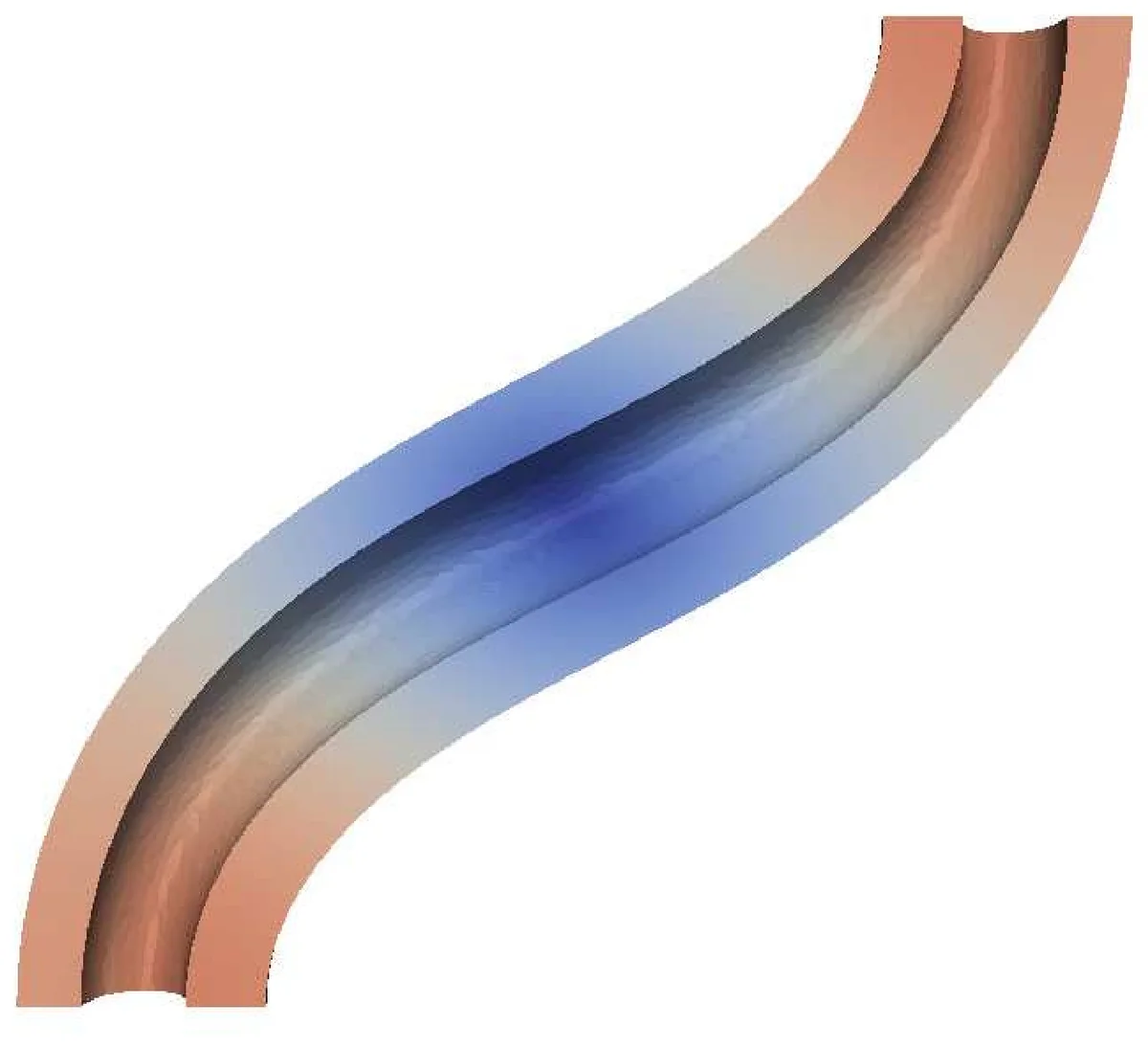
Solid tumours have the ability to assemble their own vascular network for optimizing their access to the vital nutrients. These new capillaries are morphologically different from normal physiological vessels. In particular, they have a much higher spatial tortuosity forcing an impaired flow within the peritumoral area. This is a major obstacle for the efficient delivery of antitumoral drugs. This work proposes a morpho-elastic model of the tumour vessels. A tumour capillary is considered as a growing hyperelastic tube that is spatially constrained by a linear elastic environment, representing the interstitial matter. We assume that the capillary is an incompressible neo-Hookean material, whose growth is modeled using a multiplicative decomposition of the deformation gradient. We study the morphological stability of the capillary by means of the method of incremental deformations superposed on finite strains, solving the corresponding incremental problem using the Stroh formulation and the impedance matrix method. The incompatible axial growth of the straight capillary is found to control the onset of a bifurcation towards a tortuous shape. The post-buckling morphology is studied using a mixed finite element formulation in the fully nonlinear regime. The proposed model highlights how the geometrical and the elastic properties of the capillary and the surrounding medium concur to trigger the loss of marginal stability of the straight capillary and the nonlinear development of its spatial tortuosity.
💡 Research Summary
This paper presents a morpho‑elastic framework to explain why tumor‑induced capillaries develop pronounced tortuosity, a hallmark that hampers perfusion and drug delivery. The authors model a tumor capillary as a hollow, incompressible neo‑Hookean tube that grows axially while being constrained by a surrounding linear‑elastic medium, represented as a spring foundation with stiffness μ_k. Growth is introduced through a multiplicative decomposition of the deformation gradient, F = F_e G, where the growth tensor G = diag(1,1,γ) encodes axial expansion only.
First, an axisymmetric base state is derived analytically. The incompressibility condition yields a radial mapping r(R) that depends on the growth factor γ, and the Lagrange multiplier (hydrostatic pressure) p(r) is obtained from the Cauchy stress equilibrium together with boundary conditions: zero traction on the inner surface and a linear spring reaction on the outer surface. This base solution provides the reference configuration for subsequent stability analysis.
The linear stability of the finitely deformed tube is examined by superimposing incremental displacements δu on the base state. Using the instantaneous elastic moduli tensor A₀ for a neo‑Hookean solid, the incremental Piola–Kirchhoff stress δP₀ is expressed in terms of the displacement gradient and the increment of the pressure field. The governing equations (incremental equilibrium and incompressibility) are cast into the Stroh formalism, leading to a first‑order system dη/dr = (1/r) N η, where η =
Comments & Academic Discussion
Loading comments...
Leave a Comment