Infinite-dimensional uniform polyhedra
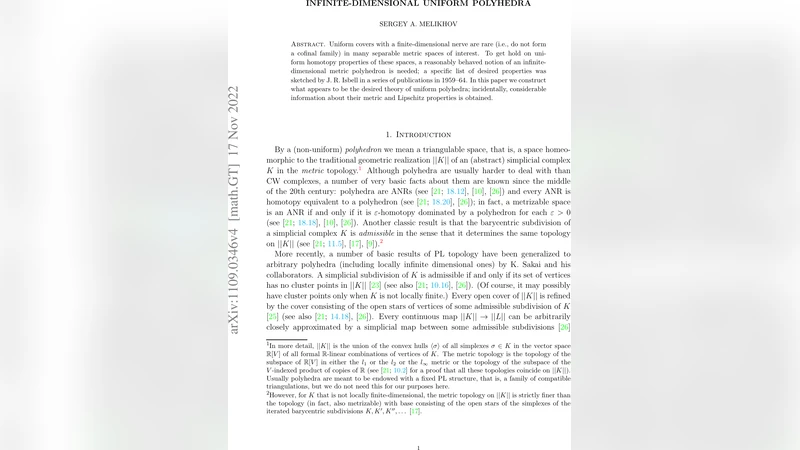
Uniform covers with a finite-dimensional nerve are rare (i.e., do not form a cofinal family) in many separable metric spaces of interest. To get hold on uniform homotopy properties of these spaces, a reasonably behaved notion of an infinite-dimensional metric polyhedron is needed; a specific list of desired properties was sketched by J. R. Isbell in a series of publications in 1959-64. In this paper we construct what appears to be the desired theory of uniform polyhedra; incidentally, considerable information about their metric and Lipschitz properties is obtained.
💡 Research Summary
The paper “Infinite‑dimensional uniform polyhedra” develops a comprehensive theory of uniform polyhedra that works beyond the finite‑dimensional setting. Classical polyhedra (geometric realizations of simplicial complexes) are well understood topologically: they are ANRs, every ANR is homotopy equivalent to a polyhedron, and barycentric subdivision preserves the underlying topology. In the uniform category, however, the situation changes dramatically.
Isbell’s finite‑dimensional uniform polyhedra are obtained by endowing the geometric realization |K| of a simplicial complex K with the ℓ∞ metric inherited from the ambient ℓ∞‑space ℝ
Comments & Academic Discussion
Loading comments...
Leave a Comment