Which number system is "best" for describing empirical reality?
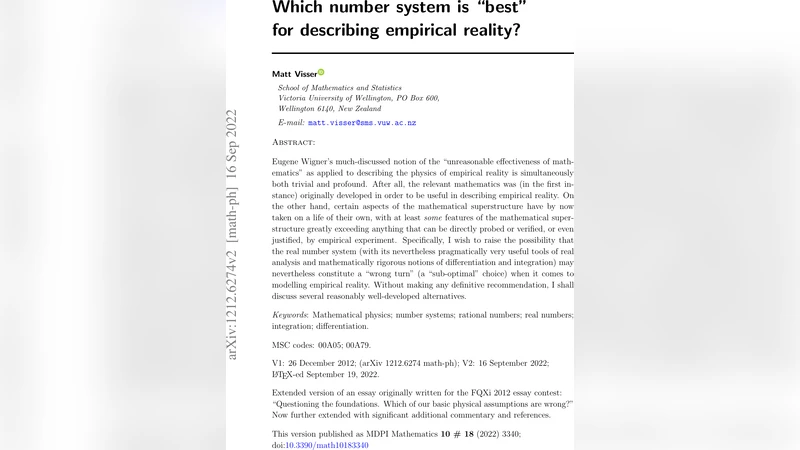
Eugene Wigner’s much-discussed notion of the “unreasonable effectiveness of mathematics” as applied to describing the physics of empirical reality is simultaneously both trivial and profound. After all, the relevant mathematics was (in the first instance) originally developed in order to be useful in describing empirical reality. On the other hand, certain aspects of the mathematical superstructure have by now taken on a life of their own, with at least some features of the mathematical superstructure greatly exceeding anything that can be directly probed or verified, or even justified, by empirical experiment. Specifically, I wish to raise the possibility that the real number system (with its nevertheless pragmatically very useful tools of real analysis and mathematically rigorous notions of differentiation and integration) may nevertheless constitute a “wrong turn” (a “sub-optimal” choice) when it comes to modelling empirical reality. Without making any definitive recommendation, I shall discuss several reasonably well-developed alternatives.
💡 Research Summary
The paper revisits Eugene Wigner’s celebrated observation about the “unreasonable effectiveness of mathematics” and uses it as a springboard to question a foundational assumption in modern physics: the primacy of the real number system for modeling empirical reality. The author begins by reminding readers that mathematics was originally invented as a tool for describing the physical world, and that many of its later developments—especially the abstract superstructures of analysis—have outpaced what can be directly probed or verified by experiment. Real numbers, with their continuity, completeness, and the powerful machinery of differential and integral calculus, have become the de‑facto language of physics. Yet every physical measurement is limited by finite precision, noise, and the discrete nature of data acquisition. The notion of an actual “continuum of infinitesimals” that underlies real analysis is therefore an idealization that may not correspond to any observable feature of nature.
Against this backdrop, the author surveys several well‑developed alternatives to the real numbers, evaluating each in terms of mathematical robustness, compatibility with known physics, and experimental accessibility.
-
Hyperreal Numbers (Non‑standard Analysis). Hyperreals extend ℝ by adjoining infinitesimal and infinite elements, allowing differentiation to be expressed as a ratio of infinitesimals. This framework aligns nicely with the intuition behind classical calculus and could, in principle, provide a more faithful representation of the infinitesimal structures that appear in quantum field theory and continuum mechanics. However, the construction relies on ultrafilters and the axiom of choice, introducing a level of non‑constructiveness that makes direct empirical interpretation problematic.
-
p‑adic Numbers. The p‑adic fields ℚₚ replace the usual absolute value with a non‑Archimedean metric, yielding a topology where numbers become “closer” if their difference is divisible by high powers of a prime p. This leads to a form of completeness that is mathematically elegant and has proven useful in number theory, cryptography, and certain models of hierarchical systems. In physics, p‑adic analysis has been explored in string theory, spin glasses, and models of ultrametric spaces. Its discrete‑valued distance naturally mirrors the finite‑precision, digit‑based nature of experimental data, suggesting a potentially more realistic underpinning for measurement theory.
-
Surreal Numbers. Conway’s surreals form a vastly larger ordered field that contains the reals, infinitesimals, and infinities of all orders. While they provide a universal playground for exploring every conceivable notion of size, the sheer richness of the structure introduces an infinite hierarchy of degrees of freedom that is difficult to reconcile with the parsimonious parameter spaces used in physical theories. Consequently, surreals remain a mathematically fascinating but practically unwieldy candidate for a physical number system.
-
Algebraic Numbers and Finite Fields. The set of algebraic numbers (roots of polynomial equations with rational coefficients) offers a countable, dense subset of ℝ that retains many algebraic properties while avoiding the full continuum. Finite fields, on the other hand, are inherently discrete and have found concrete applications in quantum error‑correction codes and digital signal processing. Both frameworks embody the idea that physical observables might be fundamentally limited to a computable, finite‑precision domain.
The author emphasizes that the choice of number system is not a mere mathematical convenience but a deep ontological commitment that shapes the formulation of physical laws. The historical success of real analysis does not guarantee its optimality; rather, it reflects a combination of mathematical elegance, historical inertia, and the fact that many macroscopic phenomena can be approximated well by continuous models. When one confronts the granularity of quantum measurements, the digital nature of data acquisition, and the possibility that spacetime itself may possess a discrete or non‑Archimedean structure at the Planck scale, alternative number systems become intellectually compelling.
In conclusion, the paper does not declare any single system as the definitive “best” for describing reality. Instead, it calls for a systematic re‑examination of the implicit assumptions embedded in our mathematical language, encouraging physicists and mathematicians to explore whether hyperreal, p‑adic, surreal, algebraic, or finite‑field frameworks might yield new insights, simplify existing theories, or resolve paradoxes that arise from forcing a continuous real‑number ontology onto a fundamentally discrete experimental world. The author advocates for interdisciplinary research that bridges foundational mathematics, theoretical physics, and experimental methodology to assess which numerical foundation—if any—offers the most faithful and economical representation of empirical reality.
Comments & Academic Discussion
Loading comments...
Leave a Comment