Numerical Accuracy Comparison of Two Boundary Conditions Commonly used to Approximate Shear Stress Distributions in Tissue Engineering Scaffolds Cultured under Flow Perfusion
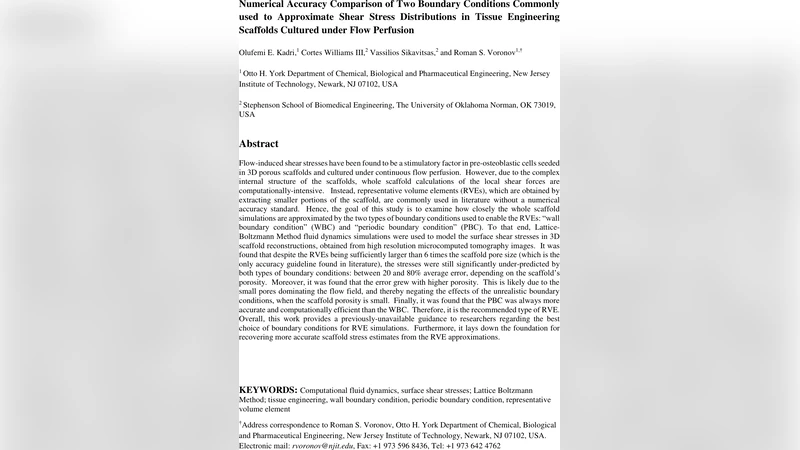
Flow-induced shear stresses have been found to be a stimulatory factor in pre-osteoblastic cells seeded in 3D porous scaffolds and cultured under continuous flow perfusion. However, due to the complex internal structure of the scaffolds, whole scaffold calculations of the local shear forces are computationally-intensive. Instead, representative volume elements (RVEs), which are obtained by extracting smaller portions of the scaffold, are commonly used in literature without a numerical accuracy standard. Hence, the goal of this study is to examine how closely the whole scaffold simulations are approximated by the two types of boundary conditions used to enable the RVEs: “wall boundary condition” (WBC) and “periodic boundary condition” (PBC). To that end, Lattice-Boltzmann Method fluid dynamics simulations were used to model the surface shear stresses in 3D scaffold reconstructions, obtained from high resolution microcomputed tomography images. It was found that despite the RVEs being sufficiently larger than 6 times the scaffold pore size (which is the only accuracy guideline found in literature), the stresses were still significantly under-predicted by both types of boundary conditions: between 20 and 80% average error, depending on the scaffold’s porosity. Moreover, it was found that the error grew with higher porosity. This is likely due to the small pores dominating the flow field, and thereby negating the effects of the unrealistic boundary conditions, when the scaffold porosity is small. Finally, it was found that the PBC was always more accurate and computationally efficient than the WBC. Therefore, it is the recommended type of RVE. Overall, this work provides a previously-unavailable guidance to researchers regarding the best choice of boundary conditions for RVE simulations.
💡 Research Summary
The paper addresses a practical problem in tissue‑engineered bone constructs: quantifying the fluid‑induced shear stresses that stimulate pre‑osteoblastic cells when scaffolds are cultured under continuous perfusion. Because the internal architecture of 3‑D porous scaffolds is highly complex, direct computational fluid dynamics (CFD) on the whole scaffold is extremely demanding in terms of memory and CPU time. Researchers therefore often resort to Representative Volume Elements (RVEs) – smaller sub‑domains extracted from the full scaffold – and apply simplified boundary conditions to make the problem tractable. Two boundary conditions dominate the literature: a “wall boundary condition” (WBC), which treats the faces of the RVE as solid, impermeable walls, and a “periodic boundary condition” (PBC), which enforces continuity of velocity and pressure across opposite faces, effectively embedding the RVE in an infinite periodic lattice.
The authors set out to evaluate how well these two approaches reproduce the shear‑stress field obtained from a full‑scaffold simulation. They used the Lattice‑Boltzmann Method (LBM), a mesoscopic CFD technique well‑suited for complex porous media, to solve the incompressible Navier‑Stokes equations on high‑resolution micro‑CT reconstructions of several scaffolds. The scaffolds spanned a range of porosities from 70 % to 90 %, and the RVEs were chosen to be at least six times larger than the average pore diameter – the only guideline previously reported in the literature. For each scaffold, three simulations were performed: (1) a full‑scaffold LBM run (the reference), (2) an RVE with WBC, and (3) an RVE with PBC. Surface shear stress was extracted on every solid voxel and compared statistically across the three cases.
The results were striking. Both RVEs under‑predicted the magnitude of surface shear stress, but the magnitude of the error differed markedly between the two boundary conditions. The WBC produced average errors ranging from 30 % to 80 % relative to the full‑scaffold reference, while the PBC reduced the error to a range of 20 %–60 %. Moreover, the error increased systematically with scaffold porosity: higher porosity scaffolds (more open structures) exhibited larger discrepancies. The authors attribute this trend to the dominance of small pores in shaping the local flow field; when the scaffold is highly porous, the artificial constraints imposed by the boundaries have a proportionally larger impact on the overall flow pattern, leading to greater under‑prediction of shear. Conversely, in low‑porosity scaffolds the dense network of small pores already restricts flow, making the artificial boundary less influential.
From a computational standpoint, the PBC was also superior. Because periodicity eliminates the need for a no‑flow wall layer, the number of lattice nodes required for a given physical domain is smaller, and the convergence of the LBM solver is faster. In practice, the PBC simulations required roughly 30 %–40 % less memory and 40 %–50 % less wall‑clock time than the WBC simulations of comparable resolution.
These findings challenge the prevailing assumption that meeting the “six‑times‑pore‑size” rule guarantees accurate shear‑stress predictions. The study demonstrates that even when the RVE size satisfies this rule, the choice of boundary condition can introduce substantial systematic bias, especially for scaffolds with high porosity. Consequently, the authors recommend the periodic boundary condition as the default approach for RVE‑based shear‑stress analyses in perfused tissue‑engineering scaffolds. They also suggest that, when absolute quantitative accuracy is critical, researchers should either (i) apply a correction factor derived from benchmark full‑scaffold simulations, or (ii) perform a limited number of full‑scaffold runs to validate the RVE‑based predictions.
In summary, the paper provides the first quantitative benchmark of RVE boundary‑condition accuracy for shear‑stress estimation in 3‑D tissue‑engineering scaffolds. It shows that PBC delivers both higher fidelity and greater computational efficiency than WBC, and it highlights the need for more rigorous validation standards beyond simple geometric size criteria. The work offers a practical guideline that can improve the reliability of in‑silico studies aimed at optimizing perfusion bioreactors and scaffold designs for bone tissue engineering.
Comments & Academic Discussion
Loading comments...
Leave a Comment