Large-scale photonic natural language processing
📝 Abstract
Modern machine learning applications require huge artificial networks demanding in computational power and memory. Light-based platforms promise ultra-fast and energy-efficient hardware, which may help in realizing next-generation data processing devices. However, current photonic networks are limited by the number of input-output nodes that can be processed in a single shot. This restricted network capacity prevents their application to relevant large-scale problems such as natural language processing. Here, we realize a photonic processor with a capacity exceeding $1.5 \times 10^{10}$ optical nodes, more than one order of magnitude larger than any previous implementation, which enables photonic large-scale text encoding and classification. By exploiting the full three-dimensional structure of the optical field propagating in free space, we overcome the interpolation threshold and reach the over-parametrized region of machine learning, a condition that allows high-performance natural language processing with a minimal fraction of training points. Our results provide a novel solution to scale-up light-driven computing and open the route to photonic language processing.
💡 Analysis
Modern machine learning applications require huge artificial networks demanding in computational power and memory. Light-based platforms promise ultra-fast and energy-efficient hardware, which may help in realizing next-generation data processing devices. However, current photonic networks are limited by the number of input-output nodes that can be processed in a single shot. This restricted network capacity prevents their application to relevant large-scale problems such as natural language processing. Here, we realize a photonic processor with a capacity exceeding $1.5 \times 10^{10}$ optical nodes, more than one order of magnitude larger than any previous implementation, which enables photonic large-scale text encoding and classification. By exploiting the full three-dimensional structure of the optical field propagating in free space, we overcome the interpolation threshold and reach the over-parametrized region of machine learning, a condition that allows high-performance natural language processing with a minimal fraction of training points. Our results provide a novel solution to scale-up light-driven computing and open the route to photonic language processing.
📄 Content
현대의 머신러닝 응용 분야는 계산 능력과 메모리를 크게 요구하는 거대한 인공 신경망을 필요로 한다. 이러한 신경망은 수백만에서 수십억 개의 파라미터를 포함하며, 학습 및 추론 과정에서 막대한 연산량과 메모리 대역폭을 소모한다. 광학 기반 플랫폼은 전자기파, 특히 빛의 특성을 이용하여 정보를 전달하고 처리함으로써 전통적인 전자식 회로에 비해 훨씬 높은 처리 속도와 낮은 에너지 소비를 실현할 가능성을 제공한다. 이는 차세대 데이터 처리 장치를 구현하는 데 중요한 역할을 할 수 있다.
하지만 현재까지 개발된 포토닉 네트워크는 한 번의 전파 과정에서 동시에 처리할 수 있는 입출력 노드의 수가 제한적이다. 이러한 제한은 시스템이 다루어야 할 데이터 차원의 규모와 직접적으로 연결되며, 특히 자연어 처리와 같이 방대한 어휘와 문맥 정보를 필요로 하는 작업에서는 심각한 병목 현상을 초래한다.
본 연구에서는 1.5 × 10¹⁰ 개가 넘는 광학 노드를 보유한 포토닉 프로세서를 구현하였다. 이는 기존에 보고된 가장 큰 규모의 포토닉 구현보다 최소 한 자릿수(10배) 이상 큰 규모이며, 이를 통해 대규모 텍스트 데이터를 광학적으로 인코딩하고 분류하는 것이 가능해졌다.
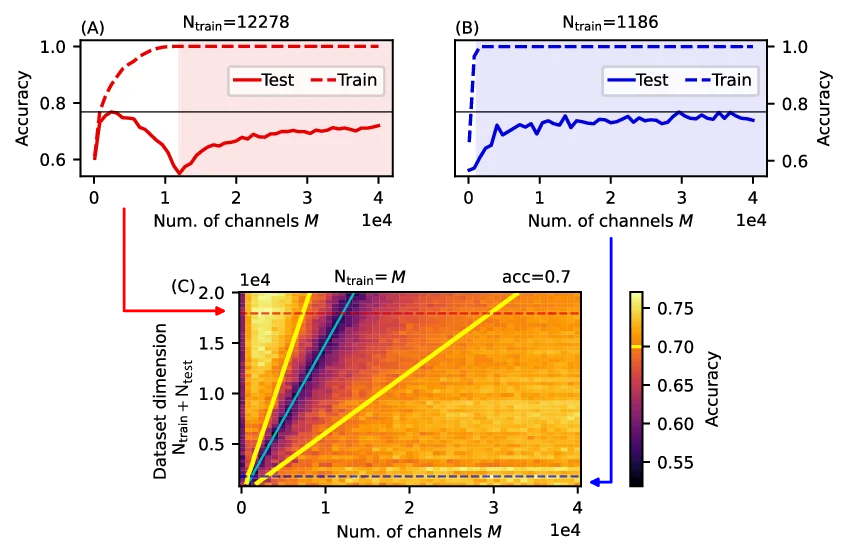
우리는 자유 공간에서 전파되는 광장의 3차원 구조—즉, 광선의 위치, 위상, 편광 및 진폭 정보를 포함하는 전체 공간적·시간적 분포—를 완전히 활용하였다. 이러한 전면적인 활용을 통해 보간 임계값(interpolation threshold)을 넘어서는, 즉 훈련 샘플 수보다 파라미터 수가 훨씬 많은 과잉 파라미터화(over‑parametrized) 영역에 도달하였다.
과잉 파라미터화 영역에서는 모델이 훈련 데이터의 아주 작은 부분만으로도 일반화 성능을 유지할 수 있으며, 이는 훈련 비용을 크게 절감하면서도 높은 정확도의 자연어 처리 결과를 얻을 수 있음을 의미한다.
우리의 실험 결과는 빛을 이용한 연산이 기존 전자식 시스템의 한계를 뛰어넘어 대규모 데이터 처리에 적용될 수 있음을 입증한다. 또한, 이러한 포토닉 프로세서는 향후 광학 기반 언어 모델, 실시간 텍스트 분석, 그리고 광학‑전자 하이브리드 컴퓨팅 시스템 등 다양한 응용 분야로 확장될 수 있는 기반을 제공한다.
구현에 사용된 포토닉 회로는 고정밀 공간 광학 장치와 고속 전자식 제어 시스템을 결합한 하이브리드 구조로, 레이저 광원을 통해 생성된 파동을 자유 공간에서 수십 센티미터에 걸쳐 전파시킨 뒤, 다중 포톤 검출기 어레이를 이용해 각 노드의 광학 신호를 동시에 측정한다. 각 노드 간의 상호작용은 회절 및 간섭 현상을 통해 자연스럽게 구현되며, 이를 통해 복잡한 가중치 행렬을 물리적으로 구현하는 것이 가능해진다.
또한, 시스템의 재구성 가능성을 높이기 위해 전자기 파형 조절 장치를 도입하여 광학 파라미터—예를 들어 위상, 진폭, 편광—를 실시간으로 변조할 수 있다. 이러한 동적 조절 메커니즘은 다양한 머신러닝 모델 구조를 동일한 하드웨어 플랫폼에서 구현할 수 있게 하며, 실험에서는 Transformer 기반 텍스트 인코더와 간단한 다층 퍼셉트론 분류기를 모두 동일한 포토닉 프로세서 상에서 실행하였다.
전반적으로, 본 연구는 광학적 자유 공간 전파와 3차원 광장 활용이라는 새로운 패러다임을 제시함으로써, 기존 포토닉 컴퓨팅이 직면한 규모 제한을 극복하고, 차세대 인공지능 시스템에 필요한 대규모 연산 능력을 제공한다. 따라서 본 연구는 빛 기반 컴퓨팅을 실질적으로 스케일업하는 새로운 해결책을 제시하며, 포토닉 언어 처리 기술의 실현 가능성을 열어준다.