Multiobjective Test Problems with Degenerate Pareto Fronts
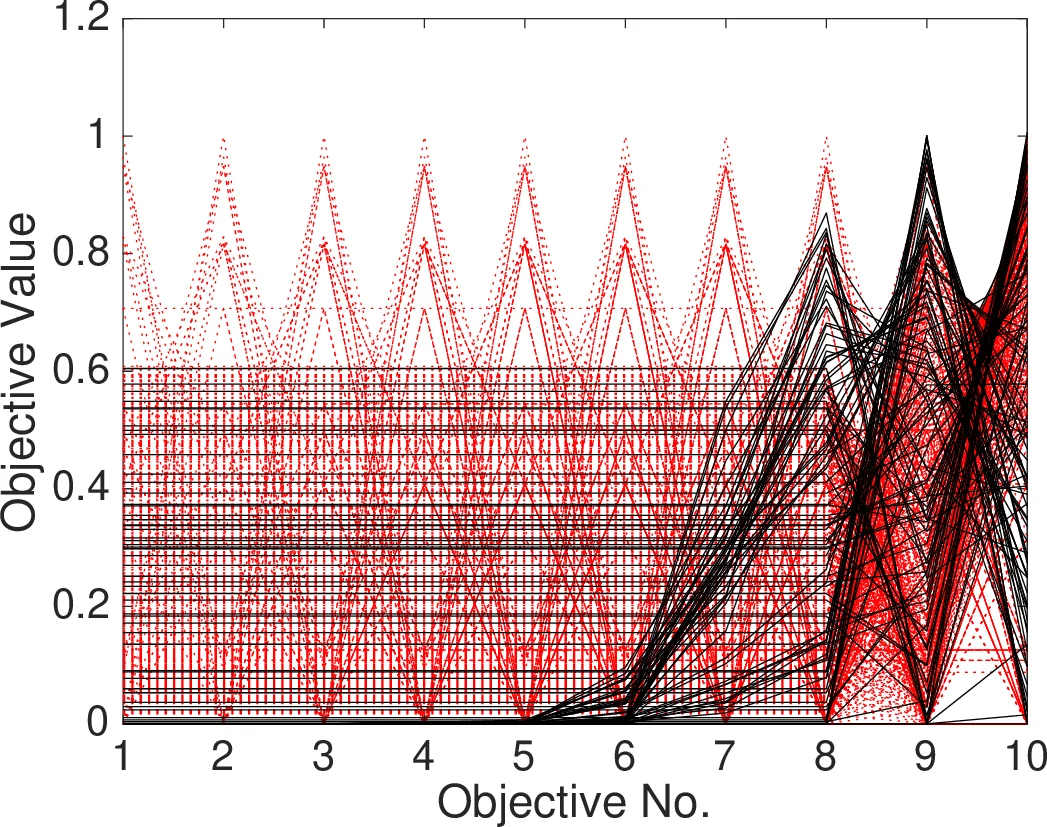
In multiobjective optimisation, a set of scalable test problems with a variety of features allow researchers to investigate and evaluate the abilities of different optimisation algorithms, and thus can help them to design and develop more effective and efficient approaches. Existing test problem suites mainly focus on situations where all the objectives are fully conflicting with each other. In such cases, an m-objective optimisation problem has an (m-1)-dimensional Pareto front in the objective space. However, in some optimisation problems, there may be unexpected characteristics among objectives, e.g., redundancy. The redundancy of some objectives can lead to the multiobjective problem having a degenerate Pareto front, i.e., the dimension of the Pareto front of the $m$-objective problem be less than (m-1). In this paper, we systematically study degenerate multiobjective problems. We abstract three general characteristics of degenerate problems, which are not formulated and systematically investigated in the literature. Based on these characteristics, we present a set of test problems to support the investigation of multiobjective optimisation algorithms under situations with redundant objectives. To the best of our knowledge, this work is the first one that explicitly formulates these three characteristics of degenerate problems, thus allowing the resulting test problems to be featured by their generality, in contrast to existing test problems designed for specific purposes (e.g., visualisation).
💡 Research Summary
The paper addresses a gap in the multi‑objective optimisation (MOO) community: most benchmark suites assume that all objectives are mutually conflicting, which yields an (m‑1)‑dimensional Pareto front (PF) for an m‑objective problem. In many real‑world scenarios, however, some objectives are redundant or partially aligned, causing the PF to be of lower dimensionality—a situation the authors term “degenerate Pareto fronts”. Existing degenerate test problems (e.g., DTLZ5, DTLZ6, WFG3) either have very specific structures or are designed solely for visualisation, and they do not capture the broad range of redundancy patterns that can appear in practice.
To fill this void, the authors first abstract three generic characteristics of degenerate problems:
-
Explicit Redundancy – additional objectives are deterministic, non‑decreasing functions of a set of d conflicting core objectives. Theorem 1 proves that adding any number of such redundant objectives does not change the Pareto set.
-
Implicit Redundancy – the essential objectives are not a subset of the problem’s objective list; instead, they are hidden behind piecewise min/max transformations of a core set of d conflicting objectives. Theorem 2 shows that these transformed objectives preserve the original Pareto set, but the essential objectives cannot be identified by simple objective‑selection techniques.
-
Partial Redundancy – the relationship between two objectives changes across the PF: they may be identical in one region and conflicting in another. This models situations where objective correlations are region‑dependent rather than globally fixed.
All proposed test problems share a unified formulation f(x)=h(γ(x)), where γ(x)=p(x_l)⊙(1+g(x_r)) defines a set of “essential objectives” (γ₁,…,γ_d) using standard shape (p) and landscape (g) functions from the DTLZ/WFG families. The transformation h(·) is then crafted to realise each of the three characteristics.
Five benchmark problems are constructed:
- Problem 1 implements explicit redundancy by appending (m‑d) non‑decreasing functions of the core objectives.
- Problem 2 realises implicit redundancy through a series of nested min/max operations with thresholds η₁,…,η_{m‑d}.
- Problem 3 demonstrates partial redundancy by defining f₁ and f₂ as piecewise functions of a decision variable x₁, making them identical for x₁≥0.5 and conflicting otherwise.
- Problems 4 and 5 combine the three characteristics and are scalable to high‑dimensional objective spaces (e.g., >10 objectives).
The authors evaluate ten state‑of‑the‑art MOEAs (NSGA‑II, NSGA‑III, MOEA/D, RVEA, SPEA2, etc.) both with and without popular objective‑reduction techniques (PCA‑based, KPCA‑based, clustering, etc.). Results show:
- In explicit‑redundancy cases, reduction methods succeed because the redundant objectives are trivially identifiable.
- In implicit‑redundancy cases, most reduction methods fail to detect the hidden essential objectives, leading to poor convergence (high IGD) and loss of diversity (low HV).
- In partial‑redundancy cases, the region‑dependent correlations defeat global reduction strategies; all algorithms struggle to approximate the PF accurately.
- For high‑dimensional degenerate instances, none of the tested algorithms achieve satisfactory performance, highlighting the need for new strategies that can handle both redundancy and many‑objective scaling.
Based on these observations, the paper proposes two research directions:
- Meta‑learning of objective transformations – using deep encoder‑decoder networks or other representation‑learning techniques to infer the underlying essential objectives from data during the optimisation run.
- Dynamic, multi‑stage objective selection – rather than a one‑shot reduction, periodically re‑evaluate objective relevance as the population evolves, allowing the algorithm to adapt to region‑specific redundancy patterns.
In summary, the work makes three major contributions: (i) it formalises three generic characteristics of degenerate MOO problems that have been overlooked in the literature; (ii) it provides a scalable, unified benchmark suite embodying these characteristics; and (iii) it demonstrates, through extensive experiments, that current MOEAs and objective‑reduction methods are ill‑equipped to handle such degenerate scenarios, thereby motivating the development of more sophisticated reduction and search strategies for future research.
Comments & Academic Discussion
Loading comments...
Leave a Comment