Automatic estimation of the regularization parameter in 2-D focusing gravity inversion: an application to the Safo manganese mine in northwest of Iran
We investigate the use of Tikhonov regularization with the minimum support stabilizer for underdetermined 2-D inversion of gravity data. This stabilizer produces models with non-smooth properties which is useful for identifying geologic structures with sharp boundaries. A very important aspect of using Tikhonov regularization is the choice of the regularization parameter that controls the trade off between the data fidelity and the stabilizing functional. The L-curve and generalized cross validation techniques, which only require the relative sizes of the uncertainties in the observations are considered. Both criteria are applied in an iterative process for which at each iteration a value for regularization parameter is estimated. Suitable values for the regularization parameter are successfully determined in both cases for synthetic but practically relevant examples. Whenever the geologic situation permits, it is easier and more efficient to model the subsurface with a 2-D algorithm, rather than to apply a full 3-D approach. Then, because the problem is not large it is appropriate to use the generalized singular value decomposition for solving the problem efficiently. The method is applied on a profile of gravity data acquired over the Safo mining camp in Maku-Iran, which is well known for manganese ores. The presented results demonstrate success in reconstructing the geometry and density distribution of the subsurface source.
💡 Research Summary
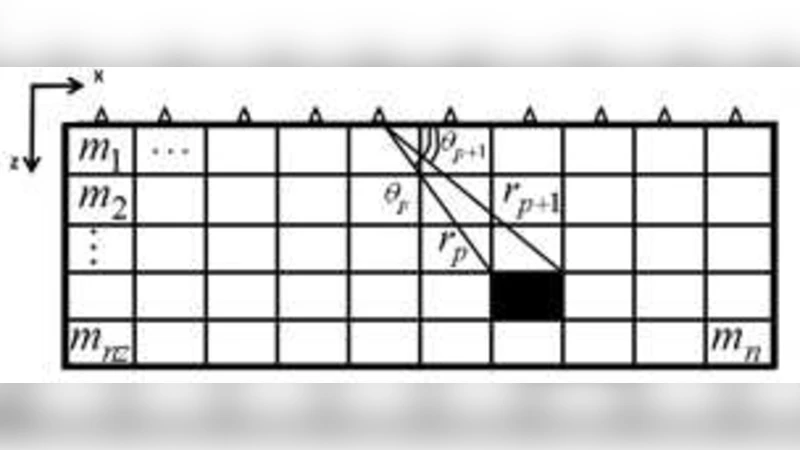
This paper addresses the challenging problem of gravity inversion, which is inherently ill‑posed due to both theoretical ambiguity (different subsurface configurations can produce identical gravity anomalies) and algebraic ambiguity (more model parameters than observations). The authors focus on a two‑dimensional (2‑D) setting, which is appropriate when the geological body is elongated in one direction, allowing the problem to be treated as a series of infinitely long prisms.
The inversion framework is built on Tikhonov regularization, but instead of the conventional smoothness stabilizers (first‑ or second‑order derivatives), the study adopts the Minimum Support (MS) stabilizer. The MS stabilizer promotes compact models with sharp boundaries by weighting the deviation between the current model and a prior estimate through a diagonal matrix Wₑ. A focusing parameter ε controls the degree of compactness; as ε approaches zero the model becomes increasingly focused, though numerical instability can arise if ε is too small. The authors discuss a trade‑off curve method for selecting ε.
A central issue in regularized inversion is the choice of the regularization parameter α, which balances data fidelity against the stabilizer. While Morozov’s Discrepancy Principle (MDP) requires accurate knowledge of the noise level, such information is rarely available in field surveys. Consequently, the paper proposes two data‑driven strategies that only need relative error estimates: the L‑curve and Generalized Cross‑Validation (GCV). Both criteria are embedded in an iterative scheme where α is recomputed at each iteration, eliminating the need for a priori noise statistics.
Because the problem size is modest (the number of observations m is smaller than the number of model cells n), the authors employ the Generalized Singular Value Decomposition (GSVD) rather than iterative Krylov solvers. The GSVD simultaneously diagonalizes the weighted forward operator Ĝ = W_d G and the regularization matrix D (constructed from Wₑ, a hard‑constraint matrix W_hard, and a depth‑weighting matrix W_depth). This yields generalized singular values γ_i and associated left/right singular vectors. The solution can then be expressed in closed form using filter factors f_i = γ_i²/(γ_i² + α²). This formulation makes the evaluation of the L‑curve and GCV inexpensive, as it avoids repeated solves for different α values.
The iterative algorithm proceeds as follows: (1) update Wₑ based on the current model; (2) compute the GSVD of
Comments & Academic Discussion
Loading comments...
Leave a Comment