An Improved Bound for Weak Epsilon-Nets in the Plane
We show that for any finite set $P$ of points in the plane and $\epsilon>0$ there exist $\displaystyle O\left(\frac{1}{\epsilon^{3/2+\gamma}}\right)$ points in ${\mathbb{R}}^2$, for arbitrary small $\gamma>0$, that pierce every convex set $K$ with $|K\cap P|\geq \epsilon |P|$. This is the first improvement of the bound of $\displaystyle O\left(\frac{1}{\epsilon^2}\right)$ that was obtained in 1992 by Alon, B'{a}r'{a}ny, F"{u}redi and Kleitman for general point sets in the plane.
💡 Research Summary
The paper addresses the long‑standing problem of constructing small weak ε‑nets for convex ranges in the Euclidean plane. Given a finite point set P⊂ℝ² and a parameter ε>0, a weak ε‑net is a (not necessarily subset of P) point set Q that intersects every convex set K with |K∩P| ≥ ε|P|. The classic result of Alon, Bárány, Füredi and Kleitman (1992) guarantees the existence of such a net of size O(1/ε²). This work improves the bound dramatically to O(1/ε^{3/2+γ}) for any arbitrarily small constant γ>0, thereby providing the first sub‑quadratic improvement in 25 years.
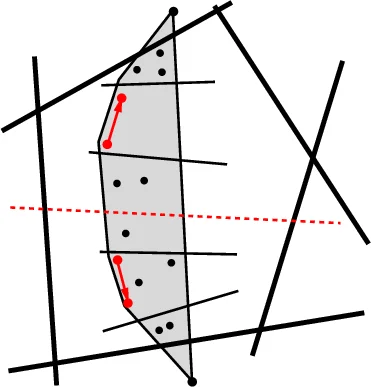
The authors’ approach departs from the traditional “single median line” divide‑and‑conquer scheme. Instead they select r=Θ(1/ε) lines at random from the set of all lines spanned by pairs of points of P and consider the full arrangement A(R) of these lines. The arrangement partitions the plane into O(r²)=O(1/ε²) cells and vertices. From the vertices they extract a modest auxiliary net Q₀ of size O(1/ε^{1/2}) with the following crucial property: any ε‑heavy convex set K that is not hit by Q₀ must be “narrow”. A narrow set is one whose intersection with the arrangement is essentially confined to the zone of a single edge pq formed by two points of P∩K. In other words, K is almost completely described by a “proxy edge” pq∈(P_K)², where P_K is a fixed ε‑fraction of the points of K∩P.
Having reduced the problem to narrow sets, the authors develop two complementary hitting strategies. First, they construct one‑dimensional ε‑nets on a small collection of vertical lines. By choosing ε̂=Θ(ε²) they obtain a net of size O(1/ε̂)=O(1/ε²) on each line, but because only O(r)=O(1/ε) lines are used, the total contribution is O(1/ε^{3/2}). Second, they employ a strong ε‑net for triangles (a classic result of Haussler–Welzl) with respect to the proxy edge. This net, of size O(1/ε̂), guarantees that the zone of the proxy edge is pierced, and consequently the whole narrow convex set K is hit.
The geometric heart of the analysis lies in two observations. (i) For a typical point u∈P_K, the cell Δ containing u holds at least εn/(r+1) other points of P_K, and many of the edges uv are “short” (both endpoints lie in the same cell). (ii) Around each u the plane is divided into z=Θ(1/ε) angular sectors W_j(u); each sector contains only O(εn/r²) short edges. Consequently, unless a large number of short edges are aligned with the proxy edge, the sectors intersect many edges crossing a fixed line, and the one‑dimensional ε‑net on that line will intersect K. When the alignment does occur, the strong triangle net handles the case.
Putting everything together yields the recurrence
f₂(ε) ≤ 2·f₂(4ε/3) + O(1/ε^{3/2}) ,
which solves to f₂(ε)=O(1/ε^{3/2+γ}) for any γ>0. The constant hidden in the O‑notation grows super‑exponentially in 1/γ, reflecting the technical overhead of the construction.
The paper also sketches how the same ideas extend to higher dimensions (d≥3). The main obstacle is that the “sector” argument does not generalize directly, but a suitable notion of “proxy hyperplane” and higher‑dimensional arrangements can be employed, leading to analogous bounds with dimension‑dependent exponents.
In summary, the authors introduce a novel combination of random line arrangements, the concept of narrow convex sets governed by a proxy edge, and classic ε‑net constructions to break the O(1/ε²) barrier for weak ε‑nets in the plane. This result not only advances the theoretical understanding of ε‑nets but also has immediate implications for related problems such as the Hadwiger–Debrunner (p,q) theorem, geometric hitting‑set approximations, and other combinatorial geometry applications.
Comments & Academic Discussion
Loading comments...
Leave a Comment