Geometric Planar Networks on Bichromatic Points
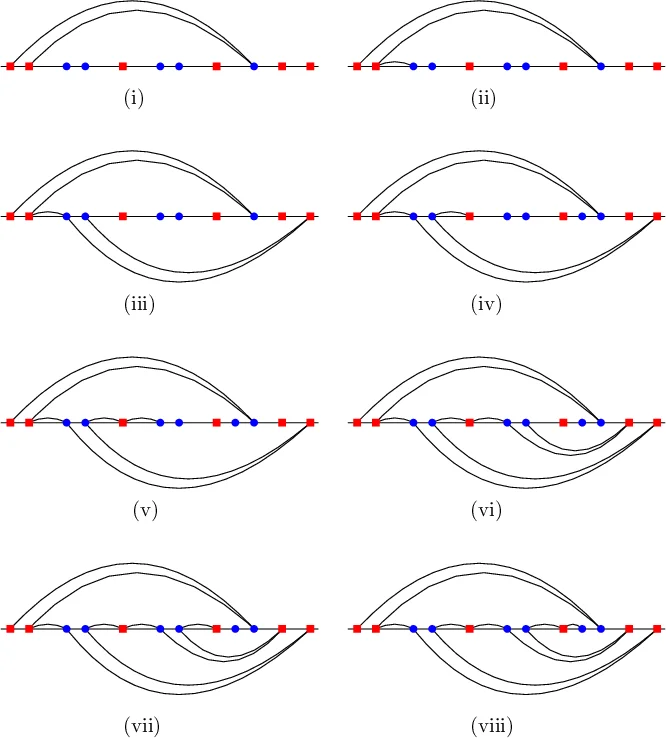
We study three classical graph problems - Hamiltonian path, minimum spanning tree, and minimum perfect matching on geometric graphs induced by bichromatic (red and blue) points. These problems have been widely studied for points in the Euclidean plane, and many of them are NP-hard. In this work, we consider these problems for collinear points. We show that almost all of these problems can be solved in linear time in this setting.
💡 Research Summary
The paper investigates three classic combinatorial optimization problems—non‑crossing Hamiltonian path, minimum‑weight spanning tree, and minimum‑weight perfect matching—on geometric graphs induced by bichromatic (red and blue) points that are collinear on a real line. While these problems are well‑studied in the Euclidean plane and are often NP‑hard (for example, the non‑crossing spanning tree is NP‑hard in the plane), the authors restrict attention to the one‑dimensional setting where all points lie on a common line (the “spine”). In this setting, edges are drawn as circular arcs that lie either entirely above or entirely below the spine, which corresponds to a 1‑page or 2‑page book embedding.
The first contribution is a linear‑time algorithm that always produces a non‑crossing Hamiltonian path when the numbers of red and blue points are equal. The algorithm starts from an arbitrary bichromatic matching, repeatedly “uncrosses’’ intersecting pairs by swapping endpoints according to the colors, and thereby transforms the matching into a laminar (hierarchical) family of edges. Each edge receives a level based on the nesting depth; level‑1 blocks consist of a single red‑blue pair, and higher‑level blocks are unions of lower‑level blocks together with their outer endpoints. Because every block contains the same number of red and blue points, a bottom‑up construction can connect the blocks using arcs placed alternately on the two pages, guaranteeing a planar (non‑crossing) Hamiltonian path. All steps—uncrossing, level assignment, and final connection—require only a constant amount of work per point, yielding O(n) time.
The second contribution addresses the minimum‑weight spanning tree (MST). In one dimension, the Euclidean distance between two points reduces to the absolute difference of their coordinates, so the optimal MST is simply the set of edges that connect each point to its nearest neighbor of the opposite color while preserving connectivity. By scanning the sorted list once, the algorithm builds the MST in linear time. For the non‑crossing variant, the page restriction makes the problem harder; the authors prove that the optimal non‑crossing tree can be found in O(n²) time by enumerating all feasible tree structures that respect the page embedding and selecting the one with minimum total length. This quadratic algorithm is still far more efficient than the best known planar algorithms, which are NP‑hard or require near‑linear approximations.
The third contribution is a linear‑time algorithm for the minimum‑weight non‑crossing perfect matching. The authors again use the laminar matching structure: after converting an arbitrary matching into a hierarchical one, they process blocks from the deepest level upward, always matching the leftmost unmatched red point with the leftmost unmatched blue point within the same block. Because the points are sorted, each such pairing corresponds to the smallest possible distance for that block, and the arcs can be placed on either page without creating crossings. The algorithm traverses the point list once, maintaining pointers to the next unmatched red and blue points, and outputs the optimal matching in O(n) time.
The paper situates these results within a broader literature. It notes that in the plane, non‑crossing Hamiltonian paths do not always exist, and the decision problem is non‑trivial; similarly, non‑crossing spanning trees are NP‑hard, and non‑crossing perfect matchings, while polynomially solvable, have best known runtimes of O(n² polylog n). By focusing on collinear points, the authors exploit the inherent ordering to achieve dramatically faster algorithms. They also point out connections to book embeddings (1‑page and 2‑page graphs), suggesting that the laminar decomposition technique could inspire new approximation schemes for higher‑dimensional bichromatic problems.
In summary, the authors demonstrate that for bichromatic point sets on a line, (i) a non‑crossing Hamiltonian path always exists and can be constructed in linear time, (ii) a minimum‑weight spanning tree is obtainable in linear time and its non‑crossing variant in quadratic time, and (iii) a minimum‑weight non‑crossing perfect matching can be computed in linear time. These results provide a clear contrast to the computational hardness of the same problems in the plane and offer a stepping stone toward more efficient algorithms for geometric bichromatic problems in higher dimensions.
Comments & Academic Discussion
Loading comments...
Leave a Comment